 That Reptile Blog – Reptile, Amphibian and Exotic Pet Care and Information

In Part I of this article, I discussed how we can use simple pitfall traps to capture nutritious foods for pet reptiles, amphibians and invertebrates. While writing, it occurred to me that one of North America’s largest and most interesting beetles, the caterpillar hunter (Calosoma scrutator), often turns up in such traps.
Interesting but Ignored
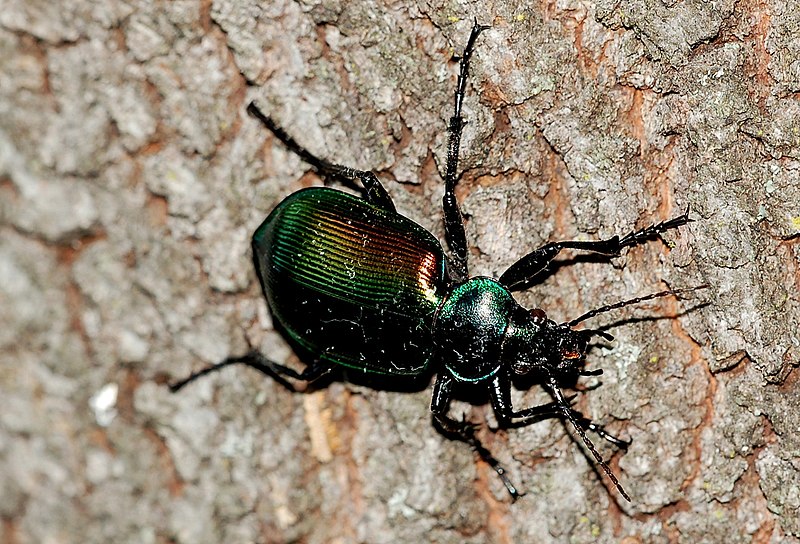 Caterpillar hunters exhibit many qualities that render them ideal terrarium subjects. They are large, bold, diurnal, brightly-colored, voracious predators, temperature-hardy and breed well. Despite this, like most US natives, they receive virtually no attention from hobbyists. Caterpillar hunters are, however, much in demand elsewhere – on my last visit to Japan, entomologists at the Tama Zoo (which hosts a huge building and an outdoor exhibit for insects) assured me they would accept all that came their way.
Natural History
Our native caterpillar hunters are mostly large and brightly-colored, and spend the day searching for insects and their pupae. Over 2,000 species (Family Carabidae) roam our forests, fields and parks, with 40,000+ having been described worldwide. One, the forest caterpillar hunter, was imported to the USA from Europe in 1905 to battle gypsy moths. The grub-like larvae of most are also predacious, constructing burrows from which they ambush passing insects.
Caterpillar hunters are the most numerous predators within many habitats. Calleida decora, for example, achieves densities of over 5,000 individuals per acre on US soybean farms. Much favored by farmers battling the velvet bean caterpillar, a single beetle may consume 7-10 caterpillars each day, and each female produces 800-1,000 eggs.
Captive Husbandry
 Caterpillar hunters make fascinating terrarium subjects. Clad in beautiful iridescent colors, most are not at all shy about revealing a range of interesting behaviors. They do well at normal room temperatures and can be housed in planted terrariums or simple plastic enclosures. Adults hibernate during the winter, with some species reaching at least 3 years of age.
I have bred two species in captivity, and it seems likely that many others would be equally cooperative. Caterpillar hunters can be fed crickets, newly molted (white) mealworms and their pupae, waxworms (which, being caterpillars, are a favorite!) and wild-caught insects.
As certain species defend themselves with irritating secretions, caterpillar hunters are best handled with gloves of tongs.
Further Reading
An interesting account of caterpillar hunter behavior is posted at
Caterpillar hunter image referenced from Wikipedia and originally posted by Fritz Geller-Grimm
Caterpillar hunter larva image referenced from Wikipedia and originally posted by Gyorgy Csoka, Hungary Forest Research Institute, Bugwood.org



dear mr. indiviglio I just happened upun your article on caterpillar hunters for years I ve been searching for these beetles and have come up empty. I ve kept a number of insects including various ground beetles in terrariums and they do quite well. at this time I have succssfully been keeping carolina ground crickets (eunemobius carolinus). they have been breeding from last july 09 through now feb 2010, I have 2 tanks with native local insects in mini eco systems on my windowsill. Getting back to caterpillar hunters whats the best time of day to go out and find them. Im in the bx nyc area i have access to Pelham bay and van cortlandt parks. any new info on where to find these beauties would be deeply appreciated…
Hello Noel, Frank Indiviglio here.
Great to hear from someone interested in native insects…and a fellow Bronxite, no less! Thanks for writing in.
I’m pretty sure I’ve found them in both Van Ctland and Pelham Bay, also on the grounds of the Bronx Zoo, NY Bot Gardens perhaps. They are active by day, but I can’t say I recall any time that might be better than another, although sunny mornings following cool nights in spring/fall are great in general for insects and herps. Most I’ve found have been under logs and rocks, only rarely running about. They do seem to be localized, and they cover a lot of ground which complicates catching them. I recall prime habitats where I never found any, but there was a small strip of overgrown rocky ground where Mickle Ave dead-ended with the train tracks that was very productive (there were DeKay/Brown Snakes there as well) – but, this was decades ago.
Hatari Invertebrates is a great source for native insects – Calosoma scrutator is listed right now, but I didn’t check if they are actually in stock – all sorts of other beetles, aquatic insects, katydids, spiders; owner and staff very knowledgeable and helpful.
If you haven’t done so, you might consider the NY Entomological Society…they meet at the AMNH, meetings open to non-members – usually a small group but someone there might have more current site information. I don’t get to meetings very often these days, but do so when I can.
Good luck and please keep me posted on your activities, I don’t get out as much as I’d like to, so very happy to hear about what you are up to.
Best regards, Frank Indiviglio
Thanx so much for responding….I happened to call hatari inverts months ago and they didnt have any in stock. im looking forward to spring to resume searching for searchers..:-) I hope to one day compile all of my knowledge of the insects i’ve found and studied up in the bx ps I’ve also encountered brown decay snakes toads and various salamanders. There is a rich deversity of life within our parks and more should be done to enlighten the public on the importance of all natural life. we re all in this together .
Hello Noel, Frank Indiviglio here.
Thanks for the feedback – please check in from time to time, I’m eager to hear about your discoveries, urban wildlife is a favorite topic of mine, I long pushed for exhibits at the Bx Zoo (only managed to convince them to do the current “backyard porch” exhibit in the mouse house, however! I hope to post some notes on species to be found in NYC soon – almost 300 birds sp. On Bx Zoo grounds, 12 or so herps (I re-introduced northern water snakes, wood frogs), over 1,500 insects, etc.
If you’ve not seen The Natural History of NYC (Kiernan) and A Lot of Insects (Lutz), please pick them up, you’ll enjoy I promise.
Worthwhile to check in w/Hatari from time to time, they often collect species that are not posted, calling is best, they are usually good about suggesting times to check back, great operation but you need to keep tabs.
Good luck and please stay in touch
Best regards, Frank Indiviglio.
Hello Frank
thanx for the heads up on those books I’ve already ordered one of them and I’ll b lookn for the next one very soon. Im greatful that I’ve meant up with someone like you thats an authority on nyc wildlife I will definetly keep in touch with you and share my expieriences and discoveries.oh yeah what two species of calosma did you breed in captivity?. I will be reading your articles what I’ve read so far is chuck full of helpful insights. Have a great weekend. Again thanx a lot for your feedback as well.
Hello Noel,
Thanks for the kind words, please let me know what you think of the books when you have a look,
I was lucky with the beetles, as the hard work was already done for me (same family as Calosoma, different genera). I rec’d a colony of Calleida decora from an entomologist friend who was working with them at the time, hoping to mass produce as a biological control agent. Some European Ground Beetles, Carabus nemoralis, became established on their own in an exhibit I cared for at the Bronx Zoo’s reptile house. They apparently arrived in a log that was collected on the grounds of the zoo…I’ve never run across them there (outdoors) but a visitor brought some to me during my time at the Staten Island Zoo, she had collected them in her garden, so they are established there as well.
Good luck and please keep me posted.
Best regards, Frank Indiviglio.
I finally got my hands on the history of nyc im reading it and im enjoying it this will lead me to keep my eye on even more potential finds. lots of insects is in the mail cant wait 2 get it. the weather is finally getting nice i ve found 2 different rove beetles one all black and one with an orange elytra as well as a hister beetle and some click beetles all found in rotten log. up in centeral woods by city island and orchard beach. 2morow i ll b headed to van cortlandt park I will let you know if I find anything interesting……:-)
Hello Noel,
Glad you’re enjoying the book, I knew you would!…Less on insects than other creatures, but stories like Beebe trapping mink along Bx River, make it great fun. I read there that copperheads lives along the jersey palisades, even under the GWB on jersey side – but staring across the river as a kid, it seemed like a world away! I did haunt the grounds of the Cloisters, just in case a few were still holding out on my side of the river….
Thanks for the notes on your finds and yes, please update me when you can – I don’t get out as much as I’d like to, and love hearing about what’s going on in my favorite places,
Happy hunting!
Best regards, Frank Indiviglio.
hello how are u? I got to read most of lots of insects it brings me back to my childhood when I first started taking books out of various libraries. i enjoyed it but most of the info was a bit familiar Im always craving new info on insects finding some calosoma beetles have become a partime obbession that is my concusion lol I got to go out to orchard on sat and escaped into the woods and found a (chleanus) ground beetle metallic brassy red head with bluish elytra and some crazy looking gloworm. ?whats the best native moss for my windowsill terrariums?feedback appreciated.
Hello Noel,
Thanks for the note – nice to hear you were out this weekend, I’m jealous. One could have worse obsessions than Calosoma-catching! Same here about books – As a boy, I read every nature/animal book in the child’s section of the tiny NY Pub Library branch on Burke Ave, and was given a “special pass” to use the adult section. Zim’s Golden Guide – “Insects” was my Bible back then….Still keep my eyes open…
I’m embarrassed to say that I’ve never gotten around to keying out the moss I often use – but it is the most common one that you see in the city, grows as a thick carpet and pulls up easily in chunks. Dries out and becomes straw-like in mid-summer heat waves. It douse fine in terrariums with a once/day spraying and most any florescent light – w/o lights might be fine on a windowsill, but I’m not sure. It usually does fine for a few months, then often just dies back – I think it may need a cold period. If it doesn’t take, you can try regular dried sheet moss – it needs a lot of light, but will often “come to” once wet – all sorts of other interesting mosses and plants usually sprout from within it as well. Years ago I had a dozen or so small terrariums set up for an endangered NYS snail (Chittanango Ovate Amber Snail, NY’s only endangered endemic species) each had sheet moss and each was a unique little “forest” – I kept the tanks going long after the snails were re-located to another zoo.
Good luck and please keep me posted.
Best regards, Frank Indiviglio.
thanx for the heads up on the moss I did keep a nice patch of it for a while but it died on me i now realize i didnt water it enough im gonna go find me some. in the 2 tanks i have a mixture of wild grape, grasses some unkown native ground woodland plant, morning glory and missc…..erbs i need the moss to maintain moister in rotten wood, more to come.
Hello, Noel
Thanks for the feedback; I’m interested in native plants that do well, esp. those that can survive winter indoors, I’ll check my notes also,
Good luck, enjoy and please keep me posted.
Best regards, Frank Indiviglio.
hello my friend I got my hands on some native moss and it looks great. You d be surprise at what one can find in the flower district in nyc. the unknown plant that is a common woodland floor plant did quite well all winter and is still kicking I sometimes have to trim it and it keeps on growing providing shelter and food for varioius inverts. I also purchased a mini everygreen bush about five inches tall it too provides a great cover i think it will do well throughout the summer for tree crickets which i ve also kept. wildgrape looking lush but time will tell if it gets too big and dies. only thing is that i seem to have too many sowbugs.i just got a couple of native wood roach and a burgundy/black rove beetle by orchard yesterday. have a great weekend…….;-)
Thanks for the note…yes, I loved haunting the streets around FIT/Flower District, so many surprises; in fact, I still have some succlents “rescued” from the trash outside one of the flower dealers decades ago.
Tree crickets – I’d like to hear more about those sometime, I’ve tried Katydids, even a predacious species when I was at the Bx Zoo, always liked Snowy Tree Crickets but somehow never got around to keeping them,
Good luck and please keep me posted.
Best regards, Frank Indiviglio.
succlents? my apologies I need to get up on my plant skills right now im barely scratching surface whn it comes to plants.i do know a few but not as much as i should but im learning. right now. if i acquire calosoma this spring/summer my tanks will b ready to sustain them….;-) How early in the season have u encountered calosoma scrutator or sycophanta? last summer/fall i kept 1 snowy tree cricket 1broad winged tree cricket and 1 black horned tree cricket the snowy died in a month the broad winged died 2weeks later and the black horned died after yankees won the world series..kept on live plants in tanks i also have lots of pix. thanx for the feedback much appreciated.
Hello Noel, Frank Indiviglio here.
Thanks for the feedback; very interesting bit on the tree crickets. Last summer the NY Ent Society did a survey of night-calling insects, if they do so again this year, I’m sure you would be a great asset.
Succulents is just a very general term – desert plants that store water in leaves…they appear dead when overly dry but perk up (“become succulent”!) right away when given water. Many interesting-looking species, look great in desert terrariums.
Both species overwinter as adults, I’ve found scrutator on warm days in April (under logs though, not out and about; do not recall details re sycophanta.
Good luck and please keep me posted.
Best regards, Frank Indiviglio.
thanx 4 clearafying the succlents & calosoma back in 81 in early july I found the wing cover of a sycophanta it was brilliant brassy green but i lost it. this was in a backyard in pelham section of bx. Id be very interested in checking out the ny entomological society can u send me contact info? I have personal exp with about 9 species of katydids and various crickets in various areas in bx. Id love to share my info. again thanx 4 ur time and positive feedback..
Hello Noel,
Thanks for the note; sycophanta have some of the most beautiful colors of any insect, don’t they?…hope you come up with more.
The NY Entomological Society is run by Lou Sorkin, who has been with the AMNH’s Entomology Dept. for decades…he’s a fountain of info, great guy and would be very interested in your experiences. They meet monthly at the Museum, I don’t often get to meetings, but always try so hopefully we’ll cross paths soon.
Good luck and please keep me posted.
Best regards, Frank Indiviglio.
thanx 4 the info i actually got to check it out and im excited because i ll finally get to share my knowledge and expieriences with like minded people and that cricket crawl seems like fun i ll definetly want 2 be a part of any future events. Im going to try to get to the nyes meeting on tuesday its not to far from my work we ll definetly cross paths sometime i always carry my cam eager to share my photos. the calosoma sycophanta is very bueatiful I would be psyched to have a live specimen. meeting you and sharing my expieriences has also got me motivated to keep learning and sharing. Thanx 4 ur insights…..;-) have a great day… to be continued.
Hello, Noel
Glad to hear you looked into NYES, I’m sure you’ll enjoy. I’ll try to make a meeting soon – if you go, it will be easy to find Lou Sorkin – let him know you’ve been in touch with me or, better yet, let me know when you plan to stop by and I’ll email Lou ahead of time,
Enjoy,
Best regards, Frank Indiviglio.
Im looking forward to going next tuesday to the meeting to check out Toby Upton’s entomology in glass. it will be a privilege to meet Mr. Sorkin and definetly meeting you when u have the time. I got to go out yesterday and collected an eyed click beetle (aluas oculatus) it was embedded in dead tree stump verystriking. the terrariums seem to be comming along I spotted a couple of young field crickets third generation terrarium raised. the other inhabitants in tank keep them from overpopulating. again thanx for all of your positive feedback Frank…. enjoy your weekend my friend.
Hi Noel,
Enjoy, I cannot make that meeting but will catch you soon; I’m on site at thatpetplace’s annual sale, will write Lou before tuesday. Eyed Click Beetles are one of my favotites – I set a few up at Brooklyn Children’s Museum some time ago,
aabest regards, Frank
to bad you can’t make it but we ll definetly link up soon. Im looking forward to checking nyes on tues it will be a new expierience kool…;-) this is only my second eyed click beetle What did you feed your adult click beetles? I’ve read that adults may not feed at all. my first one was kept for 1 month in jar in rotten wood and released. The current one is currently in one of my 2 tanks. will keep you posted on any nwe interesting finds. again thanx for all of the positive feedback etc….. sincerely noel
Hello Noel,
I didn’t care for the beetles once the exhibit was up and running; staff there tried ripe peaches and other fruit, wood/leaf mulch but were not sure if the beetles fed. Unfortunately, they did not reproduce…I’ll see if I can find out details.
Good luck and please keep me posted.
Best regards, Frank Indiviglio.
for now click beetle is sleeping in rotten wood in tank its been chilly when it warms up I ll try honey and fruit. I ve kept hermit beetles grape vine beetles and green june beetles on peaches and grapes. this year im going 2 try honey to attract tree crickets and what ever else. Eventually Id really like to try a few pitfall traps with meat but I have to find a safe spot for that. One time I laid one out and I swear it was removed I even left a subtle natural mark near it anyhow looking forward to nyes 2morow night I ll keep you posted.
sincerely noel.
Hello Noel,
Where would insect keepers be without honey?…painting a tree trunk with a mix of honey and beer sometimes brings unusual moths and beetles (and, I guess, bears and people in some places!).
I found my first Giant European Hornet near the old honey-dispensing “tree” in the Bronx Zoo’s Kodiak bear exhibit – a pair of them descended on the gathered honeybees and plucked them from the air – one was dragged to the ground in the battle ands I netted her – she later chewed her way out of a plastic bag and terrified the reptile house staff!
Enjoy the meeting,
Best regards, Frank Indiviglio.
Hello Frank it was kool I got there a bit early got to chat a bit with Lou Sorkin really good guy lots of insight I got to show him some of my pics and discus a little insects.I even got a regular membership. we havent even scratched the surface lol.the glass artist had some nice pieces got off the insects a bit but it was still pretty interesting. those hornets are no joke I found a semi dormant queen hornet/wasp got some good pics and left it alone. years ago i used to find empty disguarded beer bottles up in pelham sometimes full of dead drunk carabus nemoralis. beer/honey I will definetly give that a try. Thanx again for your positive feedback.
Best wishes to you.
Noel Morales.
Hello Noel,
Thanks and very glad to hear you met Lou – we’re very lucky to have someone like him about – so knowledgeable and willing to share, very rare these days…and in the Museum of Natural History no less! These are the things that make it possible for naturalists to “grow” even in NYC, I think…
Good luck and please keep me posted.
Best regards, Frank Indiviglio.
Your quite welcome your right he was humble willing to share and very insightful. Im looking forward to sharing and learning with you and Lou. If I can help in any way just let me know, for me insects/nature is a heart felt passion and meeting people with the same interests is more valuable than all the riches in the world. Tomorrow is earth day and I ll be up by shore road in the woods by city island exploring and cleaning up disguarded garbage it sometimes seems like an ongoing uphill battle I’ve been doing it for years now the reward is a cleaner wild space and that warms my heart and soul. I’ll definetly will keep u posted on any new and interesting finds.
Best wishes
Noel
Hello Noel,
Thanks for the note…enjoy tomorrow and hope you turn up some interesting finds while cleaning up,
Good luck and please keep me posted.
Best regards, Frank Indiviglio.
Good morning Frank.
Earth day got to clean up a few spots and found a small fungus or carion beetle before thunderstorm hit day after went up to indian field in vancortlandt park came up emtpy.
Hello Noel,
Thanks for the update, sorry about the weather. A trap set ion Prospect Park 10 yrs back came up with some interesting carrion beetles..but, as you mentioned last time, meat-traps are usually raided.
Good luck and please keep me posted.
Best regards, Frank Indiviglio.
Hello Frank
I’ve just been taking care of my terrariums monitoring my plants and iverts. One of my transplant evergreen seems to be drying out but the bottom still has vibrant green on it I just planted another on other side of tank Im going to monitor it carfully to make sure it stay alive. I also have a lot of sowbugs I know they are important to ecosystem any suggestion whats the best predator etc to controll them not get rid of them.
Best wishes
Noel Morales
Hello Noel,
I know quite a few amphibian keepers who wish they had too many sowbugs! I even wrote an article on breeding them, as they are a valuable food/calcium source for many species; useful terrarium scavengers as well – consume feces, un-eaten dead insects, etc. – seems many folks have a hard time with them. Not many smaller predators take them, however – I can’t really think of a useful control organism other than a toad – but they’d all be gone in a night!
I used to toss extras into flower pots – as long as there’s food and moisture, they tend to stay put.
Good luck and please keep me posted.
Best regards, Frank Indiviglio.
Hello Frank
Nice article i can appreciate the benefical aspects of sowbugs in my terrariums as long as they pose no harm to any of my other inverts I have no problem I ve been collecting some and placing them in a smaller 3rd tank solely for keeping sowbugs. young field crickets doing well and making themselves more visable.
Best Wishes
Noel Morales
Hello Noel,
Thanks for the kind words. You must get to the Cincinnati Zoo’s Insectarium sometime, they do wonderful exhibits for common and rare inverts alike; everything is treated with equal importance,
Good luck and please keep me posted.
Best regards, Frank Indiviglio.
Your welcome. I’ve been going to the Bronx zoo since I can remember my favorites have always been the reptile house,world of darkness,wild asia of course as well as the bird houses and mouse house.someone told me that the bx zoo has another live insect display besides whats in wild asia. I may take a trip out to Cincinnati. 2 collecting outings in the last 2 fridays and ive come up empty. I start thinking of all the factors that affect insect populations. Up in Vancortlandt park they are using herbecides to kill off invasive plants and I think its also affecting the rest of the ecosytem this seemingly rich habitat seems a bit empty of various essental species.
Best Wishes
Noel Morales
Hello Noel,
Funny you should mention those, I’ve worked in all, and all were particular favorites of mine. I and a co-worker who was much more knowledgeable than I (a local guy, from Queens, who sadly passed away recently) started the invert collection in ’84 – first inverts since the honeybee exhibit in the reptile house, before my time.
The exhibit is still up – in Jungleworld. Only 12 or so tanks – stick insects, walking leaves, spiders, millipedes, crabs – varies a bit. We almost talked our way into converting the monkey house to insects, but couldn’t pull it off (purse strings, as in most zoos, held by “primate-elephant-panda types”). Still surprises me that the BZ let itself fall behind on invertebrate exhibition.
I donated a number of animals from my own collection/sources to the mouse house, including Flying Squirrels, Spiny mice, Zebra Mice, a striped skunk; also trapped the Norway Rats/House Mice, and Muskrats (muskrats not on exhibit now); World of Darkness a favorite since it opened – that almost became just bats and amphibs, but again it was sidelined. Building now closed – very sad. I began my career by volunteering in wild asia, and was hired to work in the world of birds….well, I could ramble on, way too much history….
Good luck and please keep me posted.
Best regards, Frank Indiviglio.
Hello Frank.
I’ve just been upkeeping my terraruims put some thyme which is short and thick planted greek oregano also short and thick as well as carpet of snow had to replace dwarf evergreen somehow dried out so far new one seems to be doing well. went out last week found a couple of salamanders but I never collect them also found a chlaenius sp.already have one trying to start a culture unfortunatly it got away. I remember seeing an Atlas beetle in jungle world it was always motionless. I was awed by that beetle. I tried getting a couple of calsoma scrutator from bugs in cyberspace but he won t sell them and hatari still doesnt have them. Id appreciate any additional info on another source. How would I go about getting a license to legally collect insects in new york state?
Best wishes
noel morales
Nice to hear from you again; some interesting salamanders still holding on in nYC – redbacks here and there in Manhattan, and a rather rare species in 1 tiny site in Van Ctland…2 lined, I believe, but I need to check.
Unfortunately I don’t know of anyone other than Hatari that deals in insects. All wildlife collecting permits are handled by the Dept. of Environmental Conservation, Stonybrook. It is illegal to collect any herp w/o a permit, but I don’t know if any insects are covered.
Good luck and please keep me posted.
Best regards, Frank Indiviglio.
Thanx for the info I’ve been collecting on and off for the last 30yrs and I”ve never been stopped I usually am discrete I have no access to backyards or private property so I have to collect where ever I can. Im always concious about over collecting or leaving things disturbed. Now that may and june are here im going to put my efforts to find Calosoma its like the road runner and the cyote every year LOLOL.
Best wishes
noel morales
Hello Noel,
Let me know how you do…enjoy the weather and happy hunting,
Best regards, Frank Indiviglio.
I amost forgot to mention that I’ll be going to my second nyes meeting tommorrow evening at 7pm. It should be interesting it will be on dragon flies and damsel flies. I’ll let you know how it goes. Looking forward to going out at end of week and exploring rainy and then warm weather should bring out lots of insects.
Best Wishes
noel morales.
Hello Noel,
Wish I could be there…enjoy and please give my best to Lou,
Happy Hunting!
Best regards, Frank Indiviglio.
Hello Frank.
Touching base. Dragon fly/damsel fly talk at nyes was insightful. Always something to learn. This week I discovered new places to collect way up in northern Pelham took me 4hours just to take stroll found an interesting unkown beetle possibly fungus beetle not sure. I was intrigued in all the years I never ventured out here im talking amost pelhma manner hiking from bx. lots of ground to cover Hope to go out night collecting with various bait ultaviolet lighting flashlight etc. best time is warm humid moonless dusk/night. Do you know where I can get me a folding collecting net?
Best wishes
noel morales
Hello Noel.,
Glad you got to the meeting and a new collecting site…amazing what’s nearby; seems that near cities, animals have to congregate in what undisturbed areas are left…in winter the rangers at Orchard Beach lead walks to see roosting great horned owls, right near the nature center, over 265 bird species counted on Bronx Zoo grounds, Van Courtland known for high numbers of skipper species and so on…
Ward’s has all kinds of insect collecting equipt, here is a link to a folding net – Wards is expensive, however, and you’ll be tempted to but other things, I know!, so you may want to check other options…
Good luck, enjoy and please keep me posted.
Best regards, Frank Indiviglio.
I checked out Wards and ordered me a nice folding net. Thanks for the heads up. I saw more items of interest LOL. WIll keep you posted on my next outdoor encounters will be going out at least once this weekend. Happy Memorial day weekend to you and your family.
Best Wishes
noel morales
Hello Noel,
Thanks for the note – glad Ward’s had what you needed; when I first discovered their catalog (I think in the library at Bx HS of Science, I was floored – they always have the latest equipment; at that time, they also were on of the few sources for live mudpuppies and other oddities;
A nice weekend to you and yours as well,
Best regards, Frank Indiviglio.
Hello Frank.
I finally got to try out my net it makes a difference in the diversity of insects one can collect. Did 2 nights of blacklighting and a host of insects various moths a nicrophorus aka burying beetle about 20mm a couple of small carabids still on the look out for calosoma. Thanks for the heads up on net I will be enjoying this summer. WIll keep you posted.
Best Wishes
noel morales
Hello Noel,
Glad to hear the net is working out…I’m sure like me you used homemade equipt for years – fun, but Ward’s stuff really does help, doesn’t it. I use similar nets for aquatics as well – often to many sunken branches for seining.
Good luck, have fun and please keep me posted.
Best regards, Frank Indiviglio.
Hello Frank.
Mostly sifting small screens made with window screens to filtier through leaf littter and soil. Unfortunatly I havent been out lately not much time but I ll be getting out there this week 4 sure. Have you ever been into the Thomas Pell wildlife sanctuary and is it accessable to the publc.?
Best Wishes
noel morales
Hello Noel,
I’d been there before it was officially named; I believe also that is the area the rangers took us to 2 yrs ago, to check out wintering great horned owls (saw 3!)…a teacher I knew mentioned taking his class there, so I believe it is open but have not checked,
Rains today should help, happy hunting,
Good luck and please keep me posted.
Best regards, Frank Indiviglio.
Thanx 4 the info Frank I ll just have to find out first hand. The only entrance I found was blocked off but I think it was only to block vehicles from entering I saw no signs so i ll just take chances weather permitting I was thinking same thing about the rain and june is the prime month for calosoma sycophanta emergence.I ll definetly keep you posted.
Best Wishes
noel morales
Hello Noel,
Please let me know what you find; enjoy and good luck!
Best regards, Frank Indiviglio.
Hello Frank
I found the darn place and it was beautiful its an obscure entrance by tbe golf courses. There s one main bridal trail which takes about an hour to complete. I got caught in some light rain but it was worth it. I found a species of cockroach that flies many small insects such as ladybeetle larva lots of fireflies it was kind of cool last night not many beetles flying about im so happy because now i have even more new places to explore and collect. Its well worth taking some time and exploring this area barely saw any rubbish whats so ever. There is a magical vibe about upper pelham that can make one feel euphoric. Looking forward to many discoveries here between now and summer.
Best Wishes
noel morales
Hello Noel,
I agree, some great spots there; for awhile I taught after school programs at Riverdale Country Day School – some nice spots up that way as well,
Good luck, enjoy and please keep me posted.
Best regards, Frank Indiviglio.
Hello Frank
I really got a chance to hang out til dark at the sanctuary thurs/friday evenings day one sweeping produced lots small insects such as some hemiptera a couple of small beetles and quite a few young tree crickets 2 small to collect. blacklight yielded nothing too cool and breezy in the eastern side of the park off shore road. Last night was bit warmer and I was in a thick forested area off the Hutch. On the western side of the park. Sweeping yielded nothing however blacklight with rotten banana and a beer/honey mixture with old white tee. I collected a soldier beetle(podabrus tomentosus) about 3 oriental beetles (A.orientalis)2more types of may beetles not sure of exact type a couple of small carabids. and 1to 2 sap beetles. a couple of moths whcih I got 2 photogragh. Still no calosoma. Looking forward to a hot muggy night with no moon. Still no calosoma. Have you ran into any calosoma? Ps also found 2 large wireworms in rotten log (aluas Oculatus) didnt collect but took good pix. Until the next adventure.
Best wishes
noel morales
Hello Noel,
Thanks for the news – especially nice to hear since I’ve been unable to get out at all. I plan to drive out to PA next month and hope to have time to make several stops along the way. Nice mix of beetles…glad to see they are holding out in that area.
Good luck and please keep me posted.
Best regards, Frank Indiviglio.
Hello Frank.
Driving to PA sounds like an adventure at this time of year no telling what you may find. I get a rush just thinking about it. I finally got to go out on a hot night 2 days ago. Same spot by the northbound hutch. Quite a mix of insects at first it was dead then came the bugs.A few more small medium june/may beetles a few click beetles very small to mid sized. a few small flying carabids still no calosoma. I also found and collected a female stag beetle(lucanidae about 22mm a couple sap beetles not collected to small. Suddenly came a stationary motercycle on the hutch woudnt move then someone calls out and I just packed my stuff and left LOL. I would nt want to get ticketed.I don’t think the law permits me there after dark. I do have a better spot away from highway but its a farther walk and I was running late. What I wouldnt do for the love of bugs. LOL.More to look forward to summers just begun. Until the next one.
Best wishes
noel morales
Hello Noel,
Thanks for the note….interesting how some beetles come in “waves” – this week click beetles are all over my screens by the outdoor lights; 10-20 each time I look; this will go on for awhile, then they seem not to fly for the rest of the summer – I only find them on occasion, under rocks in the garden.
I have a few stories like yours – while road cruising in Fla at night for snakes my car was surrounded by police with guns drawn, spotlights blazing – turned out a poacher driving a similar car had just shot at them!
Good luck and please keep me posted.
Best regards, Frank Indiviglio.
Hello Frank
Hope your having a good summer. I was out last week up in Pelham hiking and photographing. Havent been finding anything worth collecting. We are in serious need of some substantial rain to dry and hot. Hopefully this week we ll get some T-stroms. Still no calosoma ;( You can check out some of my photos at Bugguide.net search for Noel Morales. This is a great sight exclusively for North American Invertabrates lots of Data/picsGreat for IDing unkown finds.I have nt had much time to put of a water beetle tank just yet. I did notice Hatari does have both beetles you mentioned I will be checking out more of your articles always something worh reading.
Best Wishes
noel morales.
Hello Noel,
Thanks for the note. I noticed 3 cicadas emerging one night in my yard during the dry spell, not sure how they broke through the ground! Then had a massive thunderstorm (very local, dry a few blocks away) on Sat and that night many more came out; not so much daytime singing yet, however. Much less here on LI and in Staten Is since the W
West Nile spraying – not sure if related, but I’m sure more of the spray lands on treetops than in mosquito breeding/hiding sites!
I enjoy Bugguide, it is a great site; I’ll check the photos. I’ve ordered aquatic beetles from Hatari for an exhibit at Bklyn Children’s Museum – always arrive alive and in good shape; staff there very helpful re care and other advice.
Good luck and please keep me posted.
Best regards, Frank Indiviglio.
Hello Frank.
Its been quite a while its been an interesting summer not too many insects collected in some parts I found a thinner population of various crickets,katydids etc collected a female Broad winged tree cricket(Oecanthus latipennis) was never able to catch a male for it :(. Been maiantianing my terrariums trying my luck at raising a 4th instar chinese mantidthat I got from bugsincyberspace.com.DIdnt even find any mantids by Orchard this year. Have three stink bugs doing well on plant sap and honey found by sweeping tall plants up in Pelham.My 2 tanks are full of sow bugs eating the dying field crickets which have laid tons of eggs in inriched soil . I still have a couple of small/medium carabids doing well in each tank. I’ve given up searching for caterpillar hunters until next year.
Best wishes
noel morales.
Hello Noel, Frank Indiviglio here.
Thanks for the update and hope you are well.
I’ve noticed there seem to be far fewer crickets, katydids as well in the area where I spent most of the summer (Nassau Co, LI); and as you mention, mantids scarce. A spot that I can always count on to yield a few adults at this time of year, and egg cases, was deserted. Annul cicadas scarce as well, and seemed to have died off early; swallowtails and other butterflies also very rare this year, did see usual number of various skippers.
Good luck and please keep me posted.
Best regards, Frank Indiviglio.
Hello Frank.
Two fridays ago I went up to Hunter Island in Orchard not much found but I spent about 3hours cleaning up a spot in the northwest corner lots of plastics and beer cans etc which I believe affect insect populations on the ground. Prime habitat for various ground beetles but none found. Most people are clueless on how their rubbish impacts the envirement and some of these people are supposed to be educated. I’ve seen joggers disguarding garbage on ground. I will keep doing my part to help. I will keep you up to date on any new finds I keep looking for insects well into the winter months as well.
Best Wishes
Noel Morales
Hello Noel, Frank Indiviglio here.
Thanks, nice to hear from you again. With all the difficult environmental problems we face, it shocks me also that something so simple as not littering is still a problem,. When you visit places where people do not litter, it’s easy to see what a great difference peoples’ attitudes makes, and how easy it would be to make a big change in o0ur environment.
I have old records of mink being found on Hunter’s Island…I like to think a few may still be holding out in Pelham Bay. They and long-tailed weasels were also on the grounds of the Bronx Zoo until the ‘50’s; I’ve searched for tracks for decades w/o luck, but one never knows – a beaver showed up a few years ago, and at otters have been seen in 4 locations on LI recently.
Good luck, enjoy and please keep me posted.
Best regards, Frank Indiviglio.
Hello Frank
Always a pleasure to keep sharing my experiences with you and who ever else reads this. Last tuesday I got to go back to Hunter Island and found my previous cleanup paid off the garbage had been totally picked up by parks dept 😉 As a bonus digging in a rotten log in wooded hilltop I found an attractive dark bronzed blue bordered carabid positively ided as Sphearoderus stenostomus which feeds on snails and slugs also found a few salamanders and scarab grubs. Im presently compiling a list of beetles found in these areas. I also found a wooly bear under stone in more open area. I think its quite possible for minks etc to be hiding out in variuos parts of Pelham lots of areas for them to possibly be. Will definetly keep you posted.
Best wishes
Noel Morales.
Hello Noel, Frank Indiviglio here.
Thanks for the update; glad to have word from the field as always…I hope you find that mink! Very good to hear about your interesting finds; do you know if the salamanders were red-backed salamanders? Any would be a good sign, as they are very sensitive to soil acidity and pollution; seeing salamanders bodes well for all creatures.
Check out AMNH’s Science Café if you haven’t already– tonight’s talk is on leeches, I believe; open to public, free, at 7PM, first Wed of each month. Not often animal related, but sometimes…
Good luck and please keep me posted.
Best regards, Frank Indiviglio.
Hello Frank
The salamanders that I;ve encountered in Hunter Island and Van Cortlandt Park within the last 2 to 3 years have been mostly dark some however have red stipes I might have mentioned this previously. Its good to know that there are spots close by which are pretty healthy I ll definelty keep monitoring these places and let you know if I find any new populaitions.
Best wishes
Noel Morales.
Hello Noel, Frank Indiviglio here.
Thanks for the feedback; Red-Backed Salamanders are seen in 2 phases, the darker, known as the “Lead-Back” phase, was more common when I was poking around there as well. Amazingly, in undisturbed woodlands in the NE USA, resident populations of Red/lead Back salamanders exceed all other vertebrates combined in weight! (at least, “way back when”, they did….
Good luck and please keep me posted.
Best regards, Frank Indiviglio.
Hello Frank
Its been a while haven’t been able to head out lately. I’ve found a local live insect dealer actually within NYC that can get Calosoma and various live carabids starting im May Im sure you’ve heard of God of insects. Will update you on any new outings.Right now Im just raising a Malaysian Shield mantis Rhombodera sp. it has grown considerably this past month quite a beauty.
Happy holidays to you and yours my friend.
Best wishes
Noel Morales
Hello Noel, Frank Indiviglio here.
Thanks for the update and kind words…I wasn’t aware of that supplier, unless it is someone I know of, based in Staten Island, operating under a new name (but he specialized in exotics, spiders mainly). In any event, very interesting, thank you; I look forward to checking site out in more detail.
Nice mantid, I’m planning on looking into some soon as well,
A happy and healthy season and new year to you and yours,
Best regards, Frank Indiviglio.
Hello Frank.
Havent gone out into nature lately weathers been a bit harsh. Looking forward to next outing anyway. This spring/summer im going to approach finding calosoma by trying to locate gypsy moth/tent caterpillar outbreaks or more then mormal population thats where one would find Calosoma Sycophanta or Scrutator beetles in numbers. However I have nt run into any Gpysy moth or tent caterpillar outbreaks since 1981 up in Pelham Bay park and at that time I wasnt aware of Calosoma and was limited in my time and distance in search since I was only 11years old. I’ve looked online for outbreak history and found some data but only till about 2007 Have you ran into any caterpillar outbreaks recently? Ps however back in 81 I did find a wing cover of Calosoma Sycophanta in a backyard close to Pelham I got to ID it in 82 field guide to North American Insects and Spiders which incidently described Calosma Scutator but mistakenly photographed Calosoma Scyophanta I discovered this years later. Hope you got to check out God of Insects
Best wishes Noel Morales.
Hello Noel, Frank Indiviglio here.
Thanks for the tidbit on the field guide and the reference to God of Insects…a very nice collection, and some good info as well. Interesting that you mention the lack of those species in Pelham – now that I think about it, I cannot recall any on the grounds of the Bronx Zoo from the early 80’s on…I was working there throughout, and would have noticed. I guess it did not register somehow; I still saw both regularly on LI, especially in Suffolk, and in NJ and central PA.
Here’s to an early spring!
Best regards, Frank Indiviglio.
Hello Frank.
Its been a while hope all is well looking forward to spring/summer.I had a chance to go out to Hunter Island last week when we had that 70 degree day it was just beautiful. I noticed the usual characters of robins jays red winged black birds and various others nice to hear and see them. Digging through rotten wood i found a black rove beetle and a few dark red darkling beeltes known as Uloma sp which I recently IDed. I also found a red lined salamander.This year Im going to focus a bit more on this area for Calosoma.
Best WIshes
Noel Morales.
Hello Noel, Frank Indiviglio here.
Thanks ..nice to hear from you again; much like the redwings’ return, a welcome sign of spring! Happy to hear you got out that day and were able to make some interesting finds. I hope the Caterpillar Hunter’s co-operate this year. Spotted salamanders and spring peepers/wood frogs are on the move, and just yesterday the yellow jackets that nest in a crawl space under my roof began to stir. A few spotted turtle sightings as well…
Good luck, enjoy and please keep me posted.
Best regards, Frank Indiviglio.
Hello Frank
Your welcome its always a pleasure to share my findings here. Talking about the spring peepers I’ve heard them for the last 10-12years in Pelham bay. Will keep you posted on my outing which will be more frequent as the weather warms.
Best wishes
Noel Morales.
Hello Noel, Frank Indiviglio here.
Thanks for your note; great to hear that spring peepers are still holding on in the Bronx; I wonder if there are any spotted salamanders or wood frogs; I and a co-worker re-established wood frogs on the grounds of the Bronx Zoo; they bred for a few years thereafter but I’m not sure of how they fare today.
Good luck, enjoy and please keep me posted.
Best regards, Frank Indiviglio.
Hi Frank
Im finaly experiencing Calosoma scrutator didnt find them in the wild but I found someone in Tampa Florida who has them I just recieved about 4 today very beautiful beetles pix don t do them justice. Im excited if your interested I can give you the info straight forward the guy does’nt play games and the price is awesome 4.00 per beetle.
Best Wishes
Noel
Hello Noel, Frank Indiviglio here.
Very happy to hear your news! Yes., please email me the contact info findiviglio@thatpetplace.com Thanks.
Just today I was turning over rocks with my 3 year old nephew in N. Jersey…was surprised to find a dusky salamander; and I taught him to distinguish between millipedes and centipedes (which is good to know when you are 3 and willing to pick up anything!).
Thanks again for keeping me in mind,
Best regards, Frank Indiviglio.
Hello Frank
Its nice to get the kids into nature my son is 18 now and since he was about 3 I started exposing him to nature and now he has a healthy respect for insects. I would always take him out into the woods exploring lots of fond memories. I sent you the info on getting Calosoma beetles They are doing well they are buried under the soil and leaf litter in tanks. Im going to feed them superworms and medium crickets. IF you have any other suggestions on feeding please let me know.
Best wishes
Noel.
Hello Noel, Frank Indiviglio here.
Thanks for the info; I’ll contact him…looking forward to getting some beetles as well.
Your diet is probably fine; add variety when possible – caterpillars if collected from pesticide free areas or other soft-bodied inverts; cutworms, beetle grubs; perhaps earthworms.
Please let me know if you need any further information. Good luck, enjoy and please keep me posted.
Best regards, Frank Indiviglio.
Hello Frank
Im very happy with my beetles so far I’ve been feeding them blueberries which they enjoy. I’ve got some grubs from my previous outings and 2 wooly bear cats.They dont seem to relish the superworms but they tend to spend most of the time under the leaf litter and rotten wood and damp soil so I dont know if they are feeding beneath debris. Is it ok to keep them on the window sill to match the outside climate? How many can I keep in a ten gallon tank? Thank you for any addtional info in keeping these beauties.
Best wishes
Noel.
Hello Noel, Frank Indiviglio here.
Thanks for the update; room temps near a window are a good idea, just watch for heat buildup on especially sunny days, even now. Keeping them together would increase your chance of breeding them; a 20 would be ideal, but worth trying in a 10; provide lots of substrate, bark, etc to increase surface area available.
Good luck, enjoy and please keep me posted.
Best regards, Frank Indiviglio.
Hello Frank]
Im actually keeping 2pairs in 2 seperate 10gallon tanks. These tanks contain moist soil mixed with dead leaves and bits of rotten wood with some live plants and plenty of sow bugs to keep substrate as clean as possible. I have nt seen them feed on the crickets and grubs but I know they can be secretive in the debris. Have you ever bred these beauties before?
Best wishes
Noel
Hello Noel, Frank Indiviglio here.
Thanks for your feedback; I have, but was fortunate in that I was able to establish a group in an off-exhibit holding area at the zoo; basically a large greenhouse, as close to a natural situation as one could get, so I did not need to do much in the way of manipulating groups, feeding etc. I think the terrarium set up you describe, as with others you’ve mentioned in the past, is a good situation scavengers, prey available all the time, plenty of room to burrow, fluctuating temperatures, etc.
Please let me know if you need any further information. Good luck, enjoy and please keep me posted.
Best regards, Frank Indiviglio.
Hello Frank
Thanks for your insight. My problem is limited space in an apatment setting. My 2 tanks are placed in a southeat facing direction which gives them pretty much not to much not to little sunlight espacially during the hot summer thats not so far away. I also have a west facing window but it gets a lot of sun during the summer and it can get pretty hot I once had a tank there it bloomed with grass and my past ground cricket culture. Is that too hot for beetles and potenal larvae? What could I feed larvae besides caterpillars?
Best Wishes Noel Moralaes.
Hello Noel, Frank Indiviglio here.
Hard to say re temperature, 1-2 panes of glass can be a problem; check temps; my enclosure was 82-84 F most of the time, but soil was 8” deep and cooler below. There were plenty of earthworms in the exhibit, and I added newly-molted mealwoms, small crickets, termites, waxworms and the grubs of other beetles, but am not sure which was preferred.
Please let me know if you need any further information. Good luck, enjoy and please keep me posted.
Best regards, Frank Indiviglio.
Hello Frank
Im keeping the beetles in 4 to 6 inches of substrate. Since the weathers been cool they spend most of the time under the substrate. They seem to be quite hardy hopefully in the comming months they ll reproduce. I’ve just ordered 4 more so I’ll keep 4 in each tank. So far so good. I don t get tired of observing them.
Best wishes
Noel
Hello Noel, Frank Indiviglio here.
Typical springtime temps should be fine…thanks for the supplier’s email. Please let me know how all goes,
Good luck, enjoy and please keep me posted.
Best regards, Frank Indiviglio.
Hello Frank
I just got my second shipment of beetles all were well
now I will have a total of 9. Five in one tank and 4 in another. I’ve been giving them a daily misting enough for live plants soil and debris to be moist but not wet. It seems that on warmer sunny days it can get pretty dry I always check to make sure that its not dry under the substrate. Is it ok to give them ground beef or sardine they seem to enjoy it but I don t want to overfeed. I do know that a deverse diet is always good.
Best wishes
Noel Morales
Hello Noel, Frank Indiviglio here.
It’s interesting to hear how much they are taking in the way of non living foods, especially the grapes that you mentioned earlier…thanks for the info. We’re finding that many snakes and lizards previously thought to be live food specialists do the same.
Since the beetles do scavenge in the wild, I think as you suggest, that it’s a good idea to use this as a way to introduce variety. Just be sure they have live insects available, as there are nutrients in whole organisms that will be missing from other foods. I’m trying to hold back from ordering some, as very busy, but your notes keep pushing me towards setting them up again!
Please let me know if you need any further information. Good luck, enjoy and please keep me posted.
Best regards, Frank Indiviglio.
Hello Frank
Finally the beetles are devouring live crickets which is good because thats the most readily avialable live food I have for now.besides a few hidden scarab grubs Im trying to provide as much as a natural condition as possible.Is there anything else that I can do besides live plants mulch rich woodland soil moss rotten wood dead leaves? Always appreciate your feedback
Best wishes
Noel Morales
Hello Noel Frank Indiviglio here.
Thanks for the update; good sign, I’d say you have everything set very well; look forward to hearing how all goes.
Please let me know if you need any further information. Good luck, enjoy and please keep me posted.
Best regards, Frank Indiviglio.
Hello Frank
Well the verdict is in you cannot keep too many of these beetles together in small tank settings unless theres enough food moisture and hiding places. When it gets warm they get feisty and aggressive towrads each other fighting for food stuffs and turf. Most of the time they are taking out aggression on their food and coexisting.Im probably going to have to spread them out into a third terrarium before the weather gets too warm. I hope to keep these beauties healthy for a longtime. Any additional input always appreciatted.
Best wishes
Noel Morales
Hello Noel, Frank Indiviglio here.
Thanks for the update. I recall that they did battle on occasion, but did not seem to inflict any damage upon one another; Too much stress might in theory limit reproduction, so perhaps you can alternate between mixing them and housing them in less crowded conditions, to maximize chances of mating.
Please let me know if you need any further information. Good luck, enjoy and please keep me posted.
Best regards, Frank Indiviglio.
Hello Frank
So far all the beetles seem to be in good health with big appetites still giving them crickets sardine bits and blueberries. Since the weather is still cool they stay in substrate. However when Im home I close windows and let temp rise they emerge in about 20mins actively foraging for food. More live plants are sprouting up in tanks giving beetles more hiding spots. Im trying to distinguish males from females to isolate them at a later time. Happy Easter to you and your family.
Best wishes
Noel Morales.
Hello Noel, Frank Indiviglio here.
Thanks for the update; you seem to have found the temperature that keys them to become active; keeping them as you are , with varying temperatures, should encourage reproduction; perhaps they can hibernate in the winter as well, assuming their age allows for that.
A happy and healthy Easter to you and yours as well, thanks very much.
Please let me know if you need any further information. Good luck, enjoy and please keep me posted.
Best regards, Frank Indiviglio.
Hello Frank
My problem seems to be heat build up in tanks to remedy this I mist and it seems to help for a bit. Is there anything else that can be done? In your experience with these beetles were they more active day or night in captivity? Thanks for your feedback.
Best wishes
Noel.
Hello Noel, Frank Indiviglio here.
I’ve always known them to be more active by day, but many beetles will change activity levels/times in response to temperature. Those I had in a zoo exhibit were kept quite warm – low-mid 80’s, but there was lots of air flow and substrate to burrow into. Small fans can help, especially in glass tanks that are only open to the air at the top.
Please let me know if you need any further information. Good luck, enjoy and please keep me posted.
Best regards, Frank Indiviglio.
Hello Frank
Lately I’ve been noticing beetles spending more time in substrate regardless of the temp day night humidity etc. Im thinking that they might be accllimating to northeast spring because they’re from FL. Do you think its normal? Should I be worried? It would be ashame if I have to dig them up the tanks are looking very nice with growing live plants. I do know based on what I’ve read they are active between May/November.
Best wishes
Noel
Hello Noel, Frank Indiviglio here.
You make a good point…for herps, at least, we know that temperature tolerances vary
within the range; for example, a green anole from s Fla cannot survive n. Fla’s cold snaps; an eastern box turtle from Va could not make it through a winter in upstate NY; insects may follow, but we know less.
However, being indoor, even near a window, would likely moderate this in your case. I would leave them be – while temp and humidity are impt considerations, we really do not know enough about the many other factors that influence behavior; it would be impossible to make an educated guess as to what else, if anything, might be going on. I do recall that in the large exhibit mine varied widely as to when they were out and about.
Please let me know if you need any further information. Good luck, enjoy and please keep me posted.
Best regards, Frank Indiviglio.
Hello Frank’
Im happy to report that my beetles seem to be doing well they have been occassionally emerging 1 or 2 at a time and devour whatever food is nearby and then they procceed to hide again. So far they have demonstrated their hardiness. I think these beetles make great pets in a terrarium setting. It dosent take too much work so far.However the critical moments are yet to come such as extreme summer heat followed by next winters deep freeze.
Best wishes
Noel Morales
Hello Noel, Frank Indiviglio here.
Thanks for the update; good to hear. Depending on their age and temperatures, they may become dormant in the winter or stay active if warm enough. Hard to say how that would affect lifespan….Chinese Mantids, as you’ve likely experienced, may survive into December indoors. Caterpillar Hunters have longer natural lifespans, so it will be interesting to see how yours fare.
Good luck, enjoy and please keep me posted.
Best regards, Frank Indiviglio.
Hello Frank.
They are still going strong I lost one 2weeks ago I opened tank to feed at night they were active one climbed on a plant and took off out the window they are very strong flyers. It was fascinating to see it fly off like that.The rest seem to be doing well since its been cool out they spend much time underground but have been emerging actively running around but i havent seen them feeding even though I keep them supplied with waxworms in tanks and feeding the occaisional semi smashed cricket. Do beetles feed underground?
I have also been able to maintain 3 other species of carabids that I probably mentioned earlier kept in same tanks as Searchers. I ‘ve also started on a third tank housing one Calosoma a small conlony of termites a couple of unkown cricket nymphs another small carabid.
Hello Noel, Frank Indiviglio here.
Thanks for that great observation! Always surprising when they fly (especially near an open window…I once lost a beautiful (and very expensive) tropical mantid in that way! Well, I’ll bet he/she will find a place to live and a mate, probably in Van Courtland Pk by now!
They will feed below ground, most observations are above but makes sense.
If you could get the termite colony going, you could have a whole new business for yourself – dart frog keepers would snap them up I’m sure!
Good luck, enjoy and please keep me posted.
Best regards, Frank Indiviglio.
Hello Frank
Sorry for your loss I know how it feels being expensive adds an extra blow. Now that the weather is warmer they tend to emerge from late afternoon through the night to run around and fly in tanks. Still watching one of the tanks where activity is less. The third tank has only one which finally emerged last night to feed. The termites are still kicking in a four to five inch soil/grassy with wood substrate. Any additional insight on maintaining termites? When you had the Calosoma did they spend lots of time in substrate during warm weather?
Best wishes
Noel Morales
Hello Frank
Its been a long time I hope all is well.I want to let you know that indeed C.srutator estivates in warm/hot weather deep in substrate kept semi damp. Occasionally 1 or 2 will come up for food. I will definetly keep these hardy beauties around for a longtime. Great pets for beetle lovers.
Best wishes
Noel Morales.
Hello Noel, Frank Indiviglio here.
Nice to hear from you and great to have confirmation that caterpillar hunters slow down during hot spells. Thanks very much.
FYI, I group of European land snails that I collected for a friend have been in aestivation for 4 weeks or more.
Good luck, enjoy and please keep me posted.
Best regards, Frank Indiviglio.
Hello Frank. Dropping by to tell you that my Calosoma beetles are still alive hibernating in soil. Very hardy,this past summer was quite productive found various carabids a thriving ant colony not sure what sp. they are meat scavangers eating dead insects etc. I kept a snowy tree cricket alive for 9weeks sheltering on live cat nip possibly nibbling on leaves also fed on sugar water honey and tiny insects. I also had third generation field crickets and a first generation of Carolina ground crickets which laid eggs for next year. Best Wishes Noel Morales
Hello Noel, Frank Indiviglio here.
So nice to hear from you again…wonderful news, thanks! Very interesting to hear that the snowy tree cricket consumed insects…did you mix these into the sugar water, or did the cricket catch them?
Best regards, Frank Indiviglio.
Hello Frank
I kept the snowy tree cricket in one of my present living terrariums,which I planted some catnip. The tiny insects aphids.mites etc were established in tank. The sugar water and honey were seperately used via water dropper on plants. I also kept a broad winged tree cricket. Oecanthus latipennis. our recent snow finished him off. In this tank I had other live plants but found both tree crickets singing on the cat nip. Thanx for the quick response always my pleasure to share my observations. My computer was down for a while hence my delayed responses.
Hello Noel, Frank Indiviglio here.
Thanks for the feedback; always happy to hear about your collection. Very interesting bit of info on the tree crickets.
Best regards, Frank Indiviglio.
Hello Frank
Keeping tree crickets can be a bit of a challenge. However once they get comfortable it gets easier. In a 10+gallon tank with established live plants in organic soil. Herbs are good like the catnip. This is yet another species one can keep on windowsill to make their habitat as natural as possible. They will chrip most of the night for up to 9weeks. I had my snowy tree cricket till Nov 2nd stopped chirping Oct 28th. Thats my own new record. Sweet liquids are key they are also known to eat small caterpillars according to Audobon society North American insects & spiders. Best Wishes Noel Morales
Hello Noel, Frank Indiviglio here.
Thanks for the info. Great that you can keep them going so long; I always like to keep track of how long various crickets, katydids call outdoors. Indoors, I’ve had Chinese mantids survive until early December.
Best regards, Frank Indiviglio.
Hello Frank.
Yesterday I took a nice long hike up in Pelham and discovered that there are still some crickets chirping away. Allards ground cricket ( allonemobius allardi) Carolina ground cricket (eunemobius carolinus) and Jumping bush cricket ( orocharis saltator).The ladder is a bush/tree inhabitant which was a surprise to hear even after our early snow. In previous years I’ve heard a couple of katydids as late as mid nov. True katydid and Greater angular winged katydids. Back in early Dec of 98 I heard a Black horned tree cricket chirping on ragweed. Best wishes Noel Morales.
Hello Noel, Frank Indiviglio here.
Thanks…so nice to hear about these. Glad to see that I’m not the only one keeping track of such things. I always try to note “earliest” and latest” times I’ve heard/seen various insects. Some that start singing by day in late August are, for me, the first sign of autumn’s approach. Older Japanese plays and even movies often used insect sounds to signal seasonal changes; the friend who explained that to me was very surprised to hear of my interest.
Best regards, Frank Indiviglio.
Hello Frank
Indeed singing insects play an important role in Japanese culture. The earliest I’ve heard in May was the spring field cricket (gryllus veletis). I’ve heard various tree crickets in July as well as ground crickets and Oblong katydid. In late july through august as you know everythig peeks. Recently I discovered a Pink spotted sphinx moth in my house 1week before our early snow. According to various sources this species is migratory. Does nt even reside in New York that was quite a surprise. Photographed and released strong flyer. Best Wishes Noel Morales.
Hello Noel, Frank Indiviglio here.
Thanks…that moth is quite a find! Too bad more folks do not watch and record insects as is done with birds…a few years of “insecting” in NYC would yield more species than most birder’s life lists! As a child, I used to try to catch ruby-throated hummingbirds with my butterfly net (they were regular visitors to our garden in the Bronx, back then). Once I did make a successful swing, but my captive turned out to be a Hummingbird Clearwing Moth…opened a whole new world for me.
Best regards, Frank Indiviglio.
Hello Frank
I have a rough draft list of the insects i’ve encountered over the years.There are still species that I need to add to it.What would be the proper way to compile this list into something tangable? Wow thats awesome that you’ve encountered a clear winged hummingbird moth. That must have been an experience.
Best wishes
Noel Morales
Hi Noel,
Were you thinking of publishing it? NY Entomology Society (Lou Sorkin) might be able to provide some useful info; I’ll think about it a bit more also; would love to see your list as well
Best, Frank
Hello Frank
Thanks for the suggestion I never looked at it from that perspective. It would be an opportunity to share my experiences with our local bronx inverts. I’d be glad to show you samples of list and you can give me some of your insights. I will also keep in mind Lou Sorkin and give him a call or email.
Best Wishes
Noel Morales
Hello Noel,
Thanks…It would be very useful to get your info out in circulation, I think. I have lists of herps, mammals, birds and fishes sighted on the grounds of the Bx Zoo as well, maybe we can coordinate something.
Best regards, Frank Indiviglio.
Hello Frank
That sounds like a good idea just let me know how
we can get it together and I’ll get started from my end.
I have to do some research and make sure things are properly IDed etc.
Best wishes
Noel Morales.
Hello Noel,
Thanks, I look forward to seeing your list,
Best regards, Frank Indiviglio.
Hello Frank
I thought about it and decided to send you what I have via email. Where should I send it? Give me a couple of days to review and send it. Basically its going to be the common name followed by scientific name. Will it need dates locations photos etc?
Best Wishes
Noel Morales
Hello Noel,
Thanks, you can send to findiviglio@thatpetplace.com. Just the list, in whatever form is easiest for you, would be fine… I don’t have a place to publish it now, but would love to see it for my own interest and share with others who I know would appreciate it. Perhaps I’ll write a blog article on NYC inverts in the future, would be great to have it on hand for that as well.
Best regards, Frank Indiviglio.
Hello Frnak
Do with it as you wish as long as my name appears on it.:) It would be an honor to be part of one of your articles or blogs in that capacity. To be able to share with others that would appreciate would also be an honor. I’ve always done this for pure love and enjoyment of these fascinating creatures. Always something new to learn.
Best WIshes
Noel Morales
Hello Noel,
Thanks; just heard from a museum that needs some info on native inverts…may be useful there,
Best regards, Frank Indiviglio.
Hello Frank
I’ve been going through list and Its gonna take some time to get it together because im still comfirming some IDes through Bugguide.net where I have some pix. Its seems smaller than I anticipated.That is awesome about interest from museum. Just bare with me for a moment again thanks my friend.
Best Wishes
Noel Morales. Ps if you get a chance go check out my pics on Bugguide.net they are part of list.
Hello Noel,
I checked out your photos, thanks…nice to see that you are involved with BugGuide; a great resource. No hurry at all,
Good luck, enjoy and please keep me posted.
Best regards, Frank Indiviglio.
Hello Frank
Thanks for checking out my pics on Bugguide.net Indeed they are a great resource for IDing bugs from one’s own experiences. Im finally working on compiling list it will take a bit more species being added to it. I hope it will be a benefit to you and others. Thanks for your patience.
Besst Wishes
Noel Morales
Hello Frank
Its been a while I want to let you know that my beetles are still alive and still hibernating a couple are visible in bottum of substrate through glass. I also presently have these small very shiny black carabids fairly active even when temps are between 30s & 50s. My ant colony still thriving in soil complete with winged individuals also visible through glass. I have’nt had a chance to work on rest of list which are inverts which im still in the proccess of at least getting right genus.
Best Wishes
Noel.
Hello Noel,
Thanks…so much of interest; It’s a shame that so many people miss the chance to work with the insects that are right in front of them. You’re an inspiration…I’m looking forward to spring, hope to get out and look around this year,
Best regards, Frank Indiviglio.
Hello Frank
Your welcome my friend I really enjoy this stuff . Today I observed a shiny black Staphylinidae about 9mm hope to ID very elusive also a 7-8mm Carabidae with shiny dark brown elytra another unkown. I’ve been putting fragments of sardines and for the first time raw chicken fort ants beetles and sowbugs. Calosoma still cozy in soil. Wish I could do this for a living.
Best Wishes
Noel Morales. PS hope to be going out to park soon to do some winter hunting.
Hello Noel
Thanks for your interest the note; some of my best times in the zoo world were in caring for inverts; esp. unidentified species that arrived from southeast Asia when we set up JungleWorld; but for pure invert work in the USA, Cincinnati Zoo is the place. I spent a week with the staff of the insectarium there and was floored. Hope you get to see it, if you’ve not.
I heard a cardinal trying out its song, and have crocus buds in a sunny, south facing patch, very promising…good hunting,
Best regards, Frank Indiviglio.
Hello Frank
Your welcome Id volenteer just to experience encountering new creatures not limited to insects.I got to go out on wednsday to Centeral woods up in Pelham bay.I heard a great horned owl for the duration of the hike as well as various birds not sure of species. Didnt get to really find any inverts I did take a good amount of leaf litter for my terrariums which really enriches soil and comforts my beetles etc. I also encountered budding young sweetgum trees. Will be going out soon. Whats the best way to clean glass from inside tanks?
Best wishes
Noel Morales
Hello Noel,
Thanks for the update; nice to hear that the owls have started…Great Horned Owls lay eggs in Feb, I’ve heard them there in past as well; once had a chick that someone picked up near Orchard Beach, raised it at the Bx Zoo.
Bx Zoo reptile house used volunteers in the past; not sure about now but I could email a phone number to you if you wish; invert ops very limited though – a few exhibits at Jungle world, Congo, and butterflies in summer.
Vinegar/water mix works well for stains, hard water marks etc., on glass; I used for amphibs and inverts w/o incident, but always made sure to wipe off quickly and avoid spilling into soil.
Best regards, Frank Indiviglio.
Hi Frank
Thank you for the heads up on vin/wat.solution it worked well. Tanks seem to be doing well keeping them cold til spring. One of the tanks is lively with the black carabids and staphylinae I mentioned before also woodlice pinkesh milipede and ant colony. Calosoma still deep in soil moving slightly.Looking forward to tanks in spring , already planted with seeds. It would be great to possibly volunteer at the zoo I’m sure it would be a rewarding experience.Thanks again my friend. Will keep you posted on any new finds in the parks spring seems so far away.
Best Wishes
Noel Morales
Hello Noel,
Thanks glad to hear it worked; has been very useful to me in zoo exhibits, where windex and such could not be used. I look forward to your updates,
Good luck, enjoy and please keep me posted.
Best regards, Frank Indiviglio.
Hello Frank.
I’ve gone out twice since I last wrote to you. I’ve encountered a couple of hibernating click beetles 1 larvae which may be soldier beetle or carabid. A couple of metallic green bees/wasps stingless all found in rotten wood in Centeral wood in Pelham. The owls are present spring birds making a come back and for the first time I spotted 2 deer.I am also happy to report my Cat.hunters are doing well one just emerged eating a piece of sardine at moment. Indeed beetles very hardy.
Best wishes
Noel Morale.
Hello Noel,
Thanks, great that the Cat. Hinters came through the winter…will be very interesting to see how they do this season. Deer…I’m still always surprised, despite how adaptable they are. I‘ve seen a few near the Bx/West border, but not in the Bronx…who would have imagined, back when we were kids, that deer and coyotes would be living in the Bronx! They have spread into central Nassau Co as well.
I was poking around a swamp in N NJ yesterday…many centipedes and all the usual suspects out, did not see peepers or spotted salamanders at night, but I’m sure they are on the way soon. On Feb 17th, I came across the snapping turtle pictured in this article...basking in shallow water, small pond just off the Hudson River, N NJ. They are know to be cold tolerant, but still surprising to see.
Best regards, Frank Indiviglio.
Hello Frank
Finally got to witness a couple of my Calosoma beetles mating. Interesting to see if larvae actually hatch and grow. Got a chance to get out to Van Courtlandt last week and spring peepers were out.I also found a few black carabids a couple of glow worms. This week with the comming warm temps hope to get out to Hunters Island to explore and maybe collect. Will definetly keep you posted.
Best wishes
Noel Morales
Hello Noel
Great news, thanks! I tried an amphibian pond on Friday, in NJ, but no luck, good to hear peepers are out in the Bx. I look forward to hearing about the larvae, good luck,
Best regards, Frank Indiviglio.
Hello Frank
Im happy to report that my caterpillar hunters are still doing quite well I’ve wittnessed yet more matings still waiting to see if any larvae are produced the cool weather has slowed them down so larvae may take some time to appear.I’ve heard spring peepers in Pelham bay too when we had that unusual warm spell. This late spring early summer I hope to actually set up 1 or 2 pitfall traps and see what happens will let you know when I do this have to find the right spots.
Best wishes
Noel Morales
Hello Noel
Thanks for the update; I was just going to write you re a question from another reader…when you have a chance, please let me know what salamanders have you seen in Pel Bay/Van Courtland, Thanks,
Best regards, Frank Indiviglio.
Hello Frank
Red backed salamander(Plethodon cinereus)which I’ve found in both Van courtlandt & Pelham bay.Its a very distinctive species. I’ve probably encountered 1 or 2 otheres but can’t be sure of species. I will definetly keep an eye out for other salamander species and let you know.
Best wishes
Noel Morales.
Hello Noel,
Thanks very much; that’s what I usually saw also. Dusky Salamanders once, and there was a tiny, localized population of 2-Lined Salamanders that a ranger once showed me.
Best regards, Frank Indiviglio.
Hello Frank its been a while please forgive me for delay.Unfortunatly i’ve experienced 3 loses of adult beetles so far. I did acquire 4 new sp this year the others seem to be resting under soil substrate. They are always dead on surface never under soil. I.ve yet to see larvae i’ve wittnessed a number of matings over the last 2 to 3months I hope its age killing them and not anythung else. Id appreciate some of your insights.
Hi Noel,
Thanks for the update. Some species can reach 3 years of age; it sounds as though you are doing everything right, and, considering all your experience with other insects, I’d say the deaths are due to age. I hope you get larvae this year, please let me know, Best, Frank
Hello Frank Thank you for quick response. This year I decided to start on a 4th tank a tall 20 gallon I figure spreading out beetles and adding a few new sp hopefully. Im a bit uneasy about how much air is getting in tank. Although its on window the remaining gap of open window to tank ratio is only 4in the other tanks have 8inches. Windows are always open. Im going to continue to perfect keeping these beauties alive. Have you noticed any caterpillar infestations lately? I am on the lookout where theres numerous cat. there may be various calosoma species.Happy Memorial day weekend to you & yours . Bedt wishes Noel Morales
Hi Noel,
Most of my time out has been in NJ lately; mostly have been seeing tent caterpillars, seem to be in usual numbers. Have been seining a bit with my little nephew; raising some huge dragonfly larvae now, Green Darners I hope, Best, Frank
My apologies for type o. I hope to get out early this week and thoroughly explore and do some nightime lighting with all this warm wet weather im bound to score some kool species. Goodluck with dragonfly nymphs. Thats great that your nephew gets to experience nature at early age. Will keep you udated .Best wishes Noel Morales
Thanks, Good luck and enjoy. Here he is with a mantid egg case, last spring. We hatch and release a few each year. Best, Frank
Hello Frank. Happy summer still add it with terraruims so far this season not to many large insects up in Pelham or Van Cortland unfortunetly this doesnt surprise me due to many factors which we’ve disscused before namely pesticides & pollution.However there are quite a bit of smaller insects such as fireflies and various other beetles,moths,mostly cabbage white butterflies,leafhoppers,imature katydid & snowy tree cricket,ants,flies etc.Back at home still have 3 to 4 carabids including 5 calosoma unfortunetly no larvae these guys are a challenge on the flipside im still seeing field crickets caught wild about 5 years ago. i will keep you posted on any new developements. Happy hunting to you & nephew. Best wishes Noel
Hi Noel,
Thanks for the update. On LI, I notice that the lack of butterfly diversity seems worse each year; saw a good many early spring species in N Jersey, however. Please give me more info on the crickets, when you have a moment..very interesting, and if you can a quick update on how the caterpillar hunters spent the winter (I recall they became dormant..any details on timing, temperatures would be appreciated).
Enjoy, best, Frank
Hello Frank For many years i’ve noticed that bio diversity is dwindling in the parks. For example 9 out of 10 butterfly sightings ends up being non native cabbage butterflies. So far this year I’ve seen a couple of spring azures 1 red admiral & quite a few white cabbage butterflies.
Hi Noel,
Same on LI, sadly, although this spring I saw a surprising number of red admirals, painted ladies and mourning cloaks in n. NJ. I have “butterfly bushes” planted in my yard on LI, but diversity not good at all.
Best, Frank
Continued. Last night i was at Central woods in Pelham attracting insects with light. I collected an uknow darkling beetle and two smallish very fast carabids. There were a few moths which are more diverse than butterflies in the area. My calosoma beetles spent the winter in 4 to 5 inch moist soil mixed with dead leaves and some rotten woodif desired. These beauties are indeed temperature hardy. My captive bred field crickets are becoming more visible and larger. These are very simple to breed all u need is a 10 to 20 gallon tank filled with at least 3 inches of damp soil with some dead leaves and live vegetation this will trigger females to lay eggs Try to keep tank cold in winter so next spring you’ll get hatchlings they ll feed on vegetation fruit and dead or crushed insects. Always my pleasure to share my experiences. Will keep you posted. Blessings to you & yours Noel Morales
Thanks very much Noel. Am thinking of setting up crickets or caterpillar hunters for my nephew. I enjoy aquatics, but I’m not always able to get to his house as often as needed to keep up on water quality and al, so may add a few terrestrial inverts.
Enjoy, best, Frank
Hello Frank its been a while I am happy to report that Im still dealing with my live calosoma beetles. I see them less but Im not too concerned because everytime they surface they are feeding. Its been a rough summer for some of my live plants but all and all keeping tanks damp not wet with fresh dead leaves rotten wood& rich soil & sowbugs still working for me. I seem to be a bit overrun by field crickets which make good food for everything else. I’ve managed to collect a pair of Short winged meadow katydids( C.brevipennis) & a pair of Broad winged t.c.( O.latipennis) Both have mated will look for eggs on stems very soon. Getting back to beetles I’ll say it again they do make excellent pets.
Best wishes
Noel Morales.
Hi Noel,
Always great to hear from you, thanks for the interesting update. I’m hoping that Brooklyn Children’s Museum will go ahead with a local invert exhibit, so that I can perhaps put your excellent species lists to good use. Collecting a bit myself this year, with my nephew. have a Brown Water Scorpion now (will post an article soon) as well as other aquatics. Reared a Green Darner nymph, which was great fun. Best, Frank
Hello Frank
Im happy to hear that you may use my lists for the BK zoo exhibit. Its always my pleasure to share what I know and keep learning.I have a few more sp to add it.I’ll update you via email. Glad to hear that you’re still collecting with your nephew always a good thing. I look forward to checking out article. I got up to Pell wildlife Sanctuary collected some tree crickets as I was exiting by Metro North I heard what sounded like a coyote howling about 40 feet from me in the brush.Could it have been a fox? There were also a couple of great horned owls in the distance as well. This summer I’ve also encountered a few deer on various outings in Central wood up in Pelham Bay. Going to be headed out again today beautiful day.
Best Wishes
Noel
Hi Noel,
Thanks for the two notes. Great that you are still encountering new species…always something to look forward to. I went up to see Great Horned Owls in winter, 3 years ago; seems they often shelter in the pines behind the nature center, saw 3. Rangers usually know location of nesting pair (late Jan-feb); would likely be able to show you; I missed it last few years.
Foxes yip and growl, some drawn out calls but not a real howl. Coyotes made it down to the Bx Zoo years back (and now Central Park, amazing!) so I’m guessing that is what you heard. Thanks for the note on the deer – back when we were kids, prowling around there – who would have imagined!!
Have a nice swamp near my nephew’s in NJ, so aquatic bugs are a real highlight for us now. Plenty to see everywhere, though; quite a few spiders that are new to me.
Hope you enjoyed the most recent visit, Best, Frankj
Hi Frank
Nice to hear that lists may be useful for possible invert exhibit.Im adding a few more sp. to it I’ll email you with any updates. You guys must have quite an assortment of aquatic sp. The adult freshly emerged green darner must have been a sight. I recently got to Pell wildlife bridal trail and collected a pair of tree crickets and encountered 2 new cricket and katydid sounds.I ided katydid with just the sound it was an American shield back (Atlanticus americanus).Not sure of cricket might be ground cricket. I also heard at least 2 great horned owls and as I was exiting by Metro North tracks I heard what I thought was a coyote about 30ft. from me in the brush. I’ve also noticed more then usual deer sightings in seperate outings at Central woods up in Pelham Bay. Must be cautious of ticks and mosquitos.Hope they don’t spray these beautiful areas which are already under a lot of enviremental pressures.
Best wishes
Noel
Hello Frank
Want to bring you up to date I still have a few live C.scrutator overwintering in tanks although I found left over of a dead specimen about 3weeks ago. I also have a few other carabids such Chlaenius tri color,Chlaenius laticollis,agonum sp.,S.stenotomus ,Scarites sp.,and also unwittingly bred a few Harpalus pensylvanicus. I still have a Short winged meadow katydid and a Mediterranean katydid. most of these insects are in my Bugguide.net page. One final note I have successfully fed my viper boa it turns out he loves mice he s eaten twice already. Im going to check list and send you any sp I might have overlooked which are recent.
Best wishes
Noel Morales
Hi Noel,
Thanks for the update.. glad to hear the caterpillar hunters are still going strong; I wonder how long into the winter the katydids will survive….
Good news on the viper boa, glad it worked out. Looking forward to any list additions,
Best regards, Frank
Hello Frank
I know its been a long time since I’ve written any updates on here. Hope all is well nice to see you on fb. I’m glad to
report that I finally have a few Calosoma scrutator larvae. I noticed them about a week ago in the substrate. I noticed adutls mating for the last 2 months now so I removed all adults from tank and noticed the larvae digging around and aggressively hunting down wax worms. They seem quite at home growing slowly. The five inch damp soil dead leaf substrate is the way to go with these guys. I’ve confirmed 4 larvae I will keep you posted as they grow and hopefully mature. You can check out my other fb dedicated to my insects its Nature’s Wonders on fb noelmorales113@gmail.com/facebook. There are photos of my tanks adult beetles and larvae on this page.
Best Wishes
Noel
Wow!..congrats, Noel, great to hear…how long has it been since you started with them?
No eggs from Giant Water Bugs, but enjoying. Will be out tomorrow at S. Mt Reservation in Essex, NJ. Mantids hatching, setting up new ant farm for nephew, very glad spring is here. Enjoy, Frank
Hello Frank
I’ve been keeping these beetles since 2011 most of them are still alive and well. It’s been two weeks I’ve had the larvae. They tend to be very secretive and I mostly see them at night rushing about slowing getting larger. I’m looking forward to new adventures this spring. Did you find anything at S Mt Reservation? It’s great that you have your nephew hooked on bugs. Happy spring.
Noel
I thought it might be 2 years…I think your group will yield ;lots of useful info, pl keep me posted.
We spent a good deal of time checking vernal ponds for amphibs, and measuring pH; wood frogs still calling a bit, plenty of tads, also green frogs in small vernal ponds with pH of 6…unusual, but they are quite hardy, I’ve foung greens in sphagnum bogs, and hibernating on land.
Billions – literally – of 17 Year cicada nymphs were at surface, in holes, waiting to emerge…they scuttle down when disturbed, but we nabbed 4 and set them up at home,. I’ve read of their numbers, but have never witnessed it firsthand…must get back when the adults are calling. Took some aquatic larvae for ID, and came upon a very large click beetle..not the species with the eyespots, but same size… hope to check into it,; pl let me know if you have any ideas.
happy spring, Frank
That’s amazing that you have access to a spot where you can see the periodical cicadas first hand. Let me know how the adults emerge from your set up how deep is the substrate are you using a tank? Your outing yielded quite a bit of finds good. I’ve never tested ph levels it would interesting to learn how and also to test soils for contaminants. I’ve noticed this year I have not heard any spring peepers so far. If I had a pic of your click beetle I might possibly ID it. Years ago I found an eyed click beetle hope to find this year again. I read somewhere how a young lady was successfully raising that species. I notice that the larvae tend to slow down and disappear when it’s cool out such as today. This week should be warm and humid so I expect to see more activity. Yesterday I went out to the Siwonay trail up in Pelham and I have to say Parks department did a wonderful job of restoring the trail damage by Sandy. I will keep you posted and continue to keep this thread going
Enjoy your weekend. Noel
Hi Noel,
I need to look into the proper way to set them up, as of now they are in soil/litter I collected there, 8″, they seem to be staying at surface. I’ll keep you posted. Unfortunately I did not photograph the beetle..my nephew is very well behaved, but so much going on that we were moving in 3 directions at once for most of the day, I’ll see if I can ID and will keep you posted.Peepers do vary in numbers from year to year; a friend in NJ did not hear them either, although in parts of Ct they were calling in March; pH changes and runoff hits small ponds har, but peepers are fairly resilient. Soil pH levels shown to affect red backed and other salamanders, will cause them to leave; I’ve not seen too much re inverts.
best, frank
Hello Frank
I’ve noticed 2 of the Calosoma larvae getting quite large,they are probably 1 or 2 molts closer to pupal stage. They make tunnels in the soil sometimes they can be seen through glass. I’m giving them wax worms which they devour with in minutes if hungry.I was lucky enough to observe a tomato horn worm create a pupal chamber in soil visible through the glass.It sat there for about a day or two. I would frequently observe it.On the third day I saw a plump Calosoma larvae next to what was left of pupae.This larvae dug through soil to seize the pupae. That was amazing to see. Happy memorial day wknd to you and your family.
Best wishes
Noel
Hi Noel,
They really are tigers of the soil! You’ve convinced me to set up a group for my nephew.
last fall I mentioned a wooly bear that we had collected in August…you reminded me that they overwinter as larvae. I kept it in a cool basement overwinter, it pupated in march. Brought it to room temperature a month or so ago and woke one morning last week to loud buzzing …2 Tachinid Flies had emerged from the cocoon..nice \to have such a surprise, hadn’t occurred to me, and really opened my nephew’s eyes to new possibilities…although I had quite a time convincing him it wasn’t one of my tricks, as I’m always attempting to trip him up!
Reading “A gathering of Wonders”; history of AMNH; I missed it somehow when published 10 yrs ago. I enjoyed the first history, Bankers, Bones and Beetles; this one is fantastic, covers recent history, many invert references, behind the scenes stories, etc; I’ve you’ve not read it, have a look.
Best to you and yours, thanks, Frank
Hi Frank
I’m pleased to inform you that I have at least 2 confirmed new adult fiery searcher beetles. I noticed this last night in the tank with no older adults. The older adults in separate tanks are spending more time in soil but still alive. Although its still a work in progress it’s headed in the right direction. Life cycle from larva to adult takes about 4 to 5 weeks. It is very important to always have enough food and kept separate from parents and other carabids which may attack pupae underground. How did you cicada project pan out? Last week I set my first pitfall trap baited with ground beef 2 days later I checked it and found a hister beetle small carrion beetle dead wood roach and quite a few ants. I set it up in Van courtlandt park. I will be setting up another one soon time permitting.Hope you are enjoying your summer. Keep me posted on any new finds.
Noel
Hi Noel,
Great to hear, thanks…what an exciting project!~ I went to a cicada site in N NJ earlier this week…no words to describe it! Despite having seen films, I was unprepared. My nephew went wild…I’ll post photos on FB soon. The nymphs we collected did not survive.
Also visited a favorite sphagnum bog in Suffolk, LI; I took advantage of my nephew’s keen eyes and saw 2 several spiders new to me, fishing spiders, bladderworts, sundews, pickerel frogs, ribbon snake; and Geolycosa, a pine barrens specialist spider that ambushes prey from burrow entrance; great field sweeeping as well.
Still keeping giant water bugs, ferocious water bugs, mantids
Thx for checking in, enjoy, Frank
Hello Frank
I’m sorry to hear about your captive cicadas I can’t even imagine what you and your nephew experienced being privy to
a cicada swarm, that memory will last a life time. I have confirmed 4 adult Calosoma beetles.:) I’m still seeking Calosoma sycophanta although my time has been limited lately. What is your set up for giant water bugs like. Do they try to fly in your enclosure yet another species totally new to me. I will keep you posted on any new finds and observations. I’m looking forward to checking out some of your photos on fb. I will also post new photos of my new bug adventures on fb as well.
Happy hunting my friend.
Noel.
Hi Noel,
They are quite simple…room temps; an aquarium with a very simple betta-type filter, cork bark and floating plants to hang onto; now that the weather is warm they are ravenous..they take thawed minnows from tongs, will attack tong if minnow falls off. Some are more agressive than others. they do fly at night sometimes, so a cover is needed as they are one of the last things one would wish to find in bed! best, Frank
Hello Frank.
It’s been quite a long time since we’ve correspond i hope all is well. This year
it’s been almost impossible to get out and collect however I’m still keeping 2 terrariums 1 ten gallon and 1 twenty gallon. I still have 4 live calosoma beetles in ten gallon hopefully will breed. I’m also keeping a couple of Scarite ground beetles found last year up in Pelham Bay. These guys are also hardy captives., I also have 2 chlaenius ground beetles. I hope to get out soon to collect and share my findings. Happy spring/summer.
Best wishes
Noel Morales
Nice to hear from you Noel, I hope all is well. You’ve done quite well with the caterpillar hunters, glad to hear! This year we’re keeping 2 species of fishing spider, incl the huge Dolomedes tenebrosus, , crevice spiders, several native tarantulas, some aquatics…hoping to come up with some predacious diving beetles. Enjoy, Frank