Posts tagged new frog species

World’s Smallest Frogs Added to 2011’s List of Newly-Discovered Amphibians

Eleutherodactylus iberia
Hello, Frank Indiviglio here.  Two frog species recently discovered in southeastern New Guinea are smaller than any other 4-legged vertebrate.  Within their pea-sized bodies, they pack a brain, lungs, heart, digestive system and most of the other organs that people have…simply astounding!

Tiny Frogs and Fish

The frogs, Paedophryne dekot and P. verrucosa, were collected several years ago, but were only described as new species this year (please see ZooKeys article).  Among all the world’s vertebrates, only a single fish, a Southeast Asian relative of the carp (see amazing photo here) is smaller – and the new frogs exceed it in size by only 0.1 mm!  Another contender for the title, a leaf-litter frog from Cuba (please see photo of striped frog), is only a tiny bit larger. More >

Vote This Post DownVote This Post Up (No Ratings Yet)
Loading ... Loading ...
Amphibians, Conservation, Frogs, General Reptile & Amphibian Articles, Lizards, Monitors, Reptiles and Amphibians in the News, Toads

Frog News – Land-Dwelling Tadpole Lives in Trees and Feeds on Wood

Indirana semipalmataHello, Frank Indiviglio here.  Frogs are well-known for their amazing survival strategies.  From behemoths that swallow entire clutches of cobras (please see article below) to tadpoles that develop within their parents’ vocal sacs, frog facts are truly stranger than fiction.  Recently, it was discovered that the tadpoles of India’s Brown Leaping Frog, Indirana semipalmata, are unique in both habitat choice and diet (please see photos of this frog and its tadpole).

A Unique Tadpole Habitat

Biologists at the Agumbe Rainforest Research Station inKarnataka,Indiawere amazed to discover several clutches of Brown Leaping Frog eggs adhering to tree bark. While other frogs are known to lay eggs on land, in such cases the tadpoles are carried by rain or their parents to water to complete their development; Smoky Jungle Frog and certain other tadpoles develop within a moisture-retaining nest. More >

Vote This Post DownVote This Post Up (No Ratings Yet)
Loading ... Loading ...
Amphibians, Recent Research

A Frog First – the Fang-Bearing Tadpoles of the Vampire Flying Frog

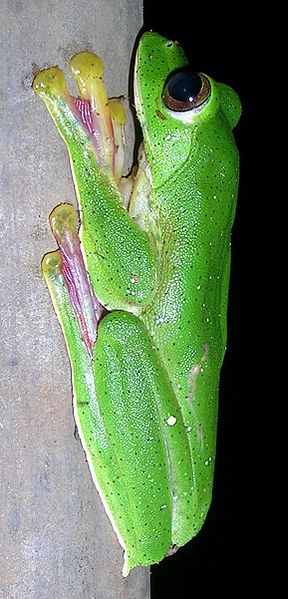
Rhacophorus malabaricusHello, Frank Indiviglio here.  The year 2011 has barely begun, but it is already supplying amphibian enthusiasts with exciting news items.  One of the most surprising is the discovery that the tadpoles of the newly-described Vampire Flying Frog, Rhacophorus vampyrus, sport hard, sharp fangs…a previously unknown amphibian adaptation.

A Surprise in the Treetops

Biologists from Australia, Vietnam and the USA (North Carolina Museum of Natural Sciences) uncovered the new frog and its odd tadpoles while surveying montane forest canopies on the Langbian Plateau in southern Vietnam.  Their findings, published in the journal Zootaxa (please see article below), have left herpetologists wondering just why tadpoles might need such odd mouthparts…certainly not to puncture veins, as their common name suggests! More >

Vote This Post DownVote This Post Up (No Ratings Yet)
Loading ... Loading ...
Amphibians, feeding and diet, Frogs, Recent Research, Reptiles and Amphibians in the News

2010’s Amphibian Discoveries – New Species and New Information – Part 1

 Heterixalus alboguttatusHello, Frank Indiviglio here.  In the wake of continuing amphibian extinctions, herpetologists made a special effort to study frogs and salamanders in 2010.  Their hard work resulted in the discovery of new species and others believed extinct, and in many surprising new findings about how they live.

Please note: the species described below are barely studied; the photos shown here are of close relatives.  Please see article below for actual photos.

“Back From Extinction”

Biologists participating in a program launched by Conservation International and the IUCN combed the globe in hopes of finding amphibians that have already been “written off” as gone forever.  Herp enthusiasts were pleased to learn that at least 3 of these, while very rare, do indeed continue to hold on. More >

Vote This Post DownVote This Post Up (No Ratings Yet)
Loading ... Loading ...
Amphibians, Conservation, Frogs, General Reptile & Amphibian Articles, Newts, Reptiles and Amphibians in the News, Salamanders, Toads

Frog Recently Discovered on Borneo is Eastern Hemisphere’s Smallest

Nepenthes ampullariaHello, Frank Indiviglio here.  An article in the August, 2010 issue of Zootaxa announces that a recently discovered frog is the smallest species in the Eastern Hemisphere.  Known only as Microhyla nepenthicola, the minute native of Borneo is barely the size of a green pea!  Interestingly, specimens have been in museum collections for over 100 years, but they were believed to be immature individuals of other species.

A Pitcher Plant Specialist

The tiny amphibian breeds in a unique habitat – the water contained in the base of pitcher plants.  Pitcher “ponds”, which serve to drown insects that are digested by the plants, support miniature ecosystems inhabited by insect larvae, snails, crabs, algae and other organisms.  More >

Vote This Post DownVote This Post Up (No Ratings Yet)
Loading ... Loading ...
Amphibians, Conservation, Field studies and notes, Frogs, General Reptile & Amphibian Articles, Reptiles and Amphibians in the News