 That Reptile Blog – Reptile, Amphibian and Exotic Pet Care and Information

Click: Emperor Scorpion, Pandinus imperator, Care – Part 1, to read the first part of this article.
Heat, Humidity and Light
 Temperature should be maintained at 78-86 F, and humidity at 70-85%. Do not cover the terrarium’s top with plastic in order to increase humidity, as air circulation is desirable. Rather, use a moisture-retaining substrate (please see above) and spray frequently with de-chlorinated water (the substrate should be slightly moist to the touch).
In order not to disturb your scorpions at night, heat should be provided by an incandescent “nocturnal” bulb; this will also allow you to observe your pets when they are most active. A ceramic heater may also be used.
Due to peculiarities in molecular structure of the exoskeleton, scorpions fluoresce under UVB light. Despite having discovered this in the 1940’s, scientists cannot as yet determine why such a facility should exist. The fluorescent sheen they exhibit is quite unearthly…a UVB-lit scorpion exhibit that I maintained at the Bronx Zoo has long been a favorite of visitors. Try lighting your scorpions with a UVB bulb at night…and while you’re at it, please see if you can find out what is going on with their fluorescence!
Feeding
Scorpions should be offered a wide range of soft-bodied invertebrates, including crickets, roaches, waxworms, silkworms and butterworms; some individuals will accept earthworms as well. Do not rely on crickets as a dietary mainstay; rather, provide as much variety as possible. In the warmer months, I feed mine mainly on wild caught moths, earwigs, caterpillars, katydids, crickets and soft-bodied beetles (Zoo Med’s Bug Napper is an excellent insect trap).
Emperor scorpions take readily to tong feeding , and should be provided with canned grasshoppers and silkworms as a means of increasing dietary variety. We know nothing of their vitamin/mineral needs…I powder my scorpions’ food once weekly with a reptile dietary supplement as “insurance”.
Emperor scorpions may on occasion take small frogs, lizards and even nestling rodents in the wild. This is almost certainly a rare event…vertebrate food is not required in captivity.
Water should be provided in a shallow, easily-exited water bowl.
Social Grouping/Compatible Species
Emperor scorpions present the opportunity for fascinating studies in the evolution of social behavior. Despite being as close to “living dinosaurs” as we are likely to see, these ancient animals exhibit complex social behaviors. In the wild, they often live in discreet groups that occupy a single, extensive system of burrows. We know little about the functioning of these groups. The young of emperor and other highly social scorpions remain dependent upon their mothers for longer than do other species, but other than that, specific details are lacking.
As emperor scorpions readily exhibit natural behaviors when properly housed in captivity, the research potential for interested hobbyists is enormous. I urge you to seriously consider working with this fascinating creature.
Captive groups almost always co-exist peaceably, provided they are given ample space and hiding/burrowing areas. Females that breed in group situations require special attention…I’ll address this in an article on reproduction shortly. Emperor scorpions will attack and/or consume other types of scorpions.
Further information and references to papers on emperor scorpions is posted at



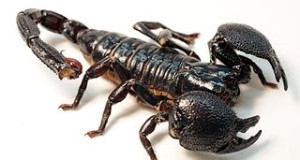

My scorpion was laying on his side yesterday when I woke up but he was still kicking his legs. I tried rolling him over to get him on his legs and he wouldnt go. Later on in the night I went and checked on him and he was on his back moving his tail up and down very slowly. I then finally got him back to his feet. It is now about 24 hours later and he has still yet to move, yet when I go to put him in a container his tail starts twitching mildly. Is this normal for them or is he dead?
Hello, Frank Indiviglio here. Thanks for your interest in our blog.
I apologize for being so long in responding. The delay was caused by a technical difficulty which has now been resolved.
We do not know a great deal about scorpion disease. However, your scorpion might be going through a dry shed – emperor scorpions need to be in a humid environment at shedding time, although some individuals seem to do fine when fairly dry. Animals that seem to be stuck in a shed can be placed in a plastic contained half-filled with damp sphagnum moss for a day or 2. A single, small ventilation hole will allow for sufficient oxygen transfer and assure that humidity remains high.
Be sure to provide your scorpions with a substrate that allows for burrowing (i.e. a mix of Coconut Husk and Forest Floor Bedding) or moss-filled artificial caves; they will seek these humid retreats out during shedding time.
Best regards, Frank Indiviglio.
I have heard that Emperor Scorpions are/can be commuinal.I was wondering if this is necsscery or if its prefrence. I was thinking of getting Emperor Scorpions when I read this . If I decide to host 2-3 Scorpions would a 20 gallon tank be good. I also heard that for 1 Scorpion a 5 to 10 gallon tank would be good.
Hello, Frank Indiviglio here. Thanks for your interest in our blog.
Emperors are quite unique among the relatively solitary scorpions and can indeed be housed communally. A 20 gallon tank with a deep substrate and plenty of ground cover could accommodate 2-3 animals. Try to purchase a group that has already been living together, as it is not always possible to establish new groups or to add new individuals.
Outside of breeding, however, emperor scorpions also do fine when kept singly…a group will provide more interesting observations, but otherwise it is a matter of your own preference. An adult might get by in a 5 gallon aquarium, but a 10 would be preferable.
Please let me know what you decide and do be in touch if you need further information.
Good luck and please keep me posted.
Best regards, Frank Indiviglio.
Thanks for the info
Hello, Frank Indiviglio here.
You’re most welcome; please let me know how it goes.
Good luck.
Best regards, Frank Indiviglio.
I am going to try to get 2-3 Scorpions that have been living together and if not than just 1. In my opinon local stores such as petsmart and stores similar dont treat their animals with the best respect. (I found a lizard dead in its cage and they walked right by it.)I am probly going to go to an exotic store however I was wondering should I get some/a baby scorpion/s around 5 cm or the ones that seem like their grown or in between. The only problem I heard with babies is that they die during moults
Hello, Frank Indiviglio here. Thanks for your feedback.
A group of young animals raised together will likely get along (probably related in any event) but there are some concerns re shedding. Young shed frequently, and there is some risk of predation and desiccation at this time. Providing a deep substrate and plenty of room helps, and ambient humidity will need be kept higher than as is usual for adults.
A group of half grown or adult animals that are already housed together might be a wiser choice. You can’t really tell the age of adults, but very old animals usually do not find their way into the trade.
Please let me know if you need anything further.
Good luck and please keep me posted.
Best regards, Frank Indiviglio.
Hey I was also wondering if you knew alot about Tarantulas specificly the Cobalt Blue Tarantula or the Usambara Baboon Tarantula?
Hello, Frank Indiviglio here. Thanks for your note.
I’ve worked with some very large public collections of tarantulas, and was fortunate enough to have had the opportunity to assist co-workers in field research on several occasions. I’ll be happy to try to offer some advice.
Best regards, Frank Indiviglio.
Hello agian I am probly getting anoying but would you recomend getting them online and do you know what an Euro is to an American dollar
Hello, Frank Indiviglio here.
Thanks for your interest …no trouble at all; I really enjoy this aspect of my work. I have a book’s worth of horror stories from the days when it was nearly impossible to find competent advice, and am very happy to have the chance to make a small difference to today’s hobbyists.
As a general rule, smaller tarantulas ship very well while adults ship poorly. A colleague is actually looking into that dilemma…seems adults are much more complex and “aware”, and “home oriented” than we give them credit for. A trustworthy breeder will select healthy animals, and should be able to ship without incident.
Unfortunately, I am quite useless in financial matters (as are most naturalists!) and cannot offer any information on the Euro…
Good luck and please keep me posted.
Best regards, Frank Indiviglio.
I really apreciate your guidence and will take in everything youve tought to me and use it wisley. I will be buying or makeing decisions tomarrow and I will tell you how it goes. One final quetion today what would you recomend Usambara Baboon Tarantula or Cobalt Blue Tarantula? So far I am leaning tords the Cobalt Blue but I want your thoughts on the situation.
Hello, Frank Indiviglio here. Thanks so much for taking the time to write the kind words; much appreciated.
Southeast Asia’s cobalt blue tarantula (Haplopelma lividum) is a strikingly colored animal…in the right light the legs can only be described as “electric blue”. It is, however, persistently secretive, nocturnal and aggressive, and accounts for a number of bites to hobbyists yearly. So far, while no one would care to repeat the process, reactions have been limited to pain and swelling, but the danger of a sensitive individual is ever present. Like all tarantulas, these should never be handled, despite the nonsense that floods the inter net. Even moving or working around cobalt blues is a risk, as they are quick as lightening, and escapes are common. In decades of working with thousands of tarantulas, it was only a cobalt blue that sailed past its holding cage door and landed on my chest years back at the Bronx Zoo.
That being said, they make for interesting exhibit animals. Cobalt blues do not take well to artificial shelters and fare poorly unless given a deep, moist substrate in which to burrow (i.e. a mix of Forest Floor Bedding and Coconut Husk) and a humid environment. By inverting a small terrarium within a larger one, you can force the spider to burrow along the glass, “ant farm” style. The spider will block off the glass with silk, but may not do so if you cover the burrow area with black construction paper, hinged with tape at the top. In this manner you can lift it and peer in occasionally (a similar setup has been in place for burrowing rodents at Tokyo’s Ueno Zoo for decades…simple but effective. Reptile Night Viewing Bulbs will allow you to watch the spider hunt and go about its business after dark. Cobalts do fine on a diet of crickets, earthworms, roaches, waxworms and wild-caught insects. Neither they nor any other tarantulas require live mice (this disturbing trend has arisen to serve the interests of certain ill-informed tarantula owners, not tarantulas).
By housing the spider in this manner you may well add to our limited knowledge of this species and its needs.
A number of spiders within the genus Pterinochilus are sold under such names as Usambura Baboons and Sunburst Baboon Spiders. Most hail from East Africa, and are adapted to drier environments (i.e. overgrown scrub and grassland) than are the forest-dwelling cobalt blues. Most species are non-burrowing terrestrial spiders which take shelter below boards, rocks, brush and sometimes within people’s homes. As such they take well to artificial caves, and may be kept in a simpler set-up than can cobalts. They are, however, also quite aggressive and fast-moving, and have racked up a number of hobbyist bites to their credit.
Although somewhat more likely than cobalts to emerge by day and feed, baboon spiders are largely nocturnal and best viewed via reptile night light.
Several species in the trade are arboreal, and built silken retreats at sites where branches cross, or within elevated cork-bark retreats. These are particularly prone to exploding outward when the terrarium cover is opened, and account for a number of escapes. Their diet is as has been described for the cobalt blue.
Please bear in mind when keeping high strung spiders that we know far less about their venoms than we do as regards snakes, and that outside of 1-2 major US cities competent medical advice is difficult to access.
Good luck and please keep let me know what you decide.
Best regards, Frank Indiviglio.
Hey man I am trying to get all 3 but if not then most likely Cobalt Blue Tarantula and the Emperor Scorpion
Hello, Frank Indiviglio here. Thanks for the update.
Please let me know if you need anything once you have the animals…be careful and enjoy!
Good luck and please keep me posted.
Best regards, Frank Indiviglio.
Hey man I am bored and maybe we could chat? Question would a 10 gallon tank be good for the CBT and the UBT (OBT).
Hello, Frank Indiviglio here. Thanks for your note.
Either an adult cobalt blue or Usambura baboon tarantula could theoretically be housed in a 10 gallon aquarium, but such would be a bit tight for either. Both are high strung and do much better in larger enclosures. The cobalt blue in particular settles in much more successfully when able to construct a deep, secure burrow.
I would suggest a 15 gallon aquarium at the minimum; a 20 would be preferable.
Good luck and please keep me posted.
Best regards, Frank Indiviglio.
For a sling (Tarantula and Scorpion)I think a deli cup would surfice filled halfway with the bedding, light misting, and maybe 1-2 food items. When should I move them into there final cages?
Hello, Frank Indiviglio here. Thanks for your comment and interest.
Deli cups are an old standby for hatchling tarantulas, and they work quite well. It is a simple matter to regulate humidity and check upon the animal’s condition and monitor its feeding. Hatchlings are not very effective hunters in large spaces, so keeping them in close contact with their food, as in a deli-cup, is a good idea. As the spider becomes proficient at hunting, you can move it to larger plastic terrariums and, eventually, a 15-20 gallon aquarium.
Good luck and please keep me posted.
Best regards, Frank Indiviglio.
Hey sorry I have been on vacation for awhale and I still will be untill the 22nd of July. Anyways I am looking to end up with about 10 Ts and 2-3 scorpions. I deeply need you advice on the following.Greenbottle blue T. vs. Cobalt blue T..I have done my reserch and the cobalt blue has often been referd to as a “pet hole” and stays there at mounths at a time . The GBB I herad is just as beautifull but is more expensive and makes a web like burrow or funnel. Also with the cobalts I heard males are a black or brown. Emperor scorp. vs. red claw scorp.vs. B.Jacksoni vs. arazona desert hariy scop. ES great begginer, kind of lazy, doent eat redily, and has also been referd to as a “pet hole” RCS not as lazy as ES, More aggresive than ES, same needs as ES, not a “pethole” , and eats like an animal. BJS communal like ES and not like RCS, small there for the enclosue can be smaller, and how poteint is there venom?. ADHS desert sp. there for easier taking care of , not communal,and eats like a big and aggresive. Also wich of these species is th easiest to breed? and one final? what if any seller/breeder would you recomend
Hello, Frank Indiviglio here. Nice to hear from you again.
Both tarantulas you mention, as well as nearly all others, are nocturnal and secretive…there really would not be much of a difference between them as regards visibility. A reptile night viewing bulb would be well-worth trying, in terms of watching the animals at night. You might also wish to check out some of the ideas in my article Creating an “Ant Farm” for Burrowing Amphibians, Reptiles and Tarantulas”.
The same applies to most scorpions…groups of emperors that I kept at the Staten, Central Park and Bronx Zoos were all extremely active in “reverse-cycle” exhibits…again, reptile night viewing bulbs may be of use here.
Babycurus spp. and red-claws vary greatly among individuals in their activity levels, as do Arizona desert hairy scorpions. I would suggest choosing a species based on your interest levels, as there are few hard and fast rules about what to expect in terms of activity, breeding etc. We know far less about Arizona desert scorpions than the others mentioned, and, as one of our largest native scorpions, they might well be worth looking at closely. By working intensely with them, you may be able to uncover here-to-fore unknown natural history details.
Please bear in mind that we know very little about the nature of scorpion venoms, far less than is the case for venomous snakes. All, even the commonly kept emperor, should be regarded as potentially dangerous. Individual populations may vary in venom makeup, just as occurs in snakes, with some populations of, for example, prairie rattlesnakes being far more dangerous to people than others. Remember also that 2 fairly well-studied snake species were believed harmless until each killed a prominent herpetologist…such could easily be the case for any number of scorpions. Individual sensitivities must also be taken into account…bee stings kill quite a few people each year in the USA, due to allergies or other unexpected problems.
Unfortunately, I’m not in close contact with any scorpion breeders, and so am unable to provide a reference. Asking detailed questions of your potential source is the best method of assessing his or her competence.
Good luck and please keep me posted.
Best regards, Frank Indiviglio.
Thanks for the reply I am most likely going with the cobalt blue tarantula,emperor scorpion, and the red claw scorpion . Maybe if you know anything about red claws you could give me a mini-caresheet or was I right and they can be kept like emperors. I heard they are not communal like emperors and are a little more difficult to breed maybe you could confirm this. Also if you are a member of arcnoboards I am a memeber there so we could also chat there and if your not I recomend this you could be very helpful to others rather they have Ts or scorps.
Hello, Frank Indiviglio here. Thanks for the feedback.
Red-clawed scorpions, Pandinus cavimanus, can in general be kept in the same manner as emperor scorpions. However, red-claws have a wide range and inhabit regions that range from quite dry to very moist, and their ecology differs in each environment. As it’s usually difficult to ascertain where your animals originated from, you may need to experiment a bit with humidity, temperature, etc. This is actually one of the most interesting facets of keeping such creatures, with lots of opportunity for new discoveries.
Most red-claws in the trade burrow more deeply than do emperors, perhaps a holdover from drier environments; anecdotal evidence indicates that they tolerate lower temperatures, i.e. 72 F well, but others do fine at 76-80 F. I would suggest 76-78, with a dip at night to 72-74 F. Bump temperatures up a bit if their activity level/feeding seems depressed.
Sociability s a difficult concept, even with emperors…much depends upon the individual animals and the size and physical characteristics of the terrarium; populations may also differ in this regard throughout the range. Emperors often do not get along, and females eat their young regularly, especially when stressed. Red-claws are difficult to pair up, and, in most cases, do not do well in groups. Pairs should be monitored carefully and given as much room as possible, as well as a deep substrate with plenty of ground cover and barriers (wood, rock) to break up the surface of the terrarium.
Thanks for the reference to Arachnoboard. I plan to investigate becoming involved in the future. For now, I would greatly appreciate your corresponding with me on this site, as this is where I publish articles and spend most of my time. Right now my schedule is quite full (a second edition of one of my books, Newts and Salamanders, is due at the publishers next week), so it may be a bit of time before I can review the site thoroughly, but it is on my list.
Good luck and please let me know how all goes with the red-claws if you do try to keep a pair or group together.
Best regards, Frank Indiviglio.
I have had a lot of pets before and now and am looking to add to my T and scorp collection. Alive: veiled chameleon, red eared slider turtle, and leopard gecko. Dead: fire belly toads x2, chliean rose hair tarantula, milk snake , ball python, and a cockatiel bird. I have also helped a friend take care of his mexican red knee for a while.
Hello, Frank Indiviglio here. Thanks for the feedback.
The species you are considering are all very interesting…any would be a good choice.
Good luck and please keep me posted on your collection.
Best regards, Frank Indiviglio.
Those are just past pets the species I am considering now are : H.Maculata, H.Lividum, P.Murianus, C.Crawshayi, B.Smithi, B.Vegans, A.Avicularia,P.Imperator,P.Cavimanus, and possibly a P.Metallica or a M.Viridis (Green Tree Python) for x-mas or my next B-day.
Hello, Frank Indiviglio here.
In all my years with various zoos and in the field, and among my own collection, I’ve always found it difficult to pick any favorites…have been equally fascinated by leaf cutter ant and elephants (although would much rather clean up after the former than the latter!). But, as I’m sure you know, being open to everything makes for a very interesting life.
I say work with as many species as you can properly handle, and please let me know if you need any assistance.
Best regards, Frank Indiviglio.
I forgot to mention the Brazilian Black and White tarantula. My lepard gecko has the attitude of a OBT and a king baboon combined. My chameleon is kind of a wuss and is very deffensive especially when cornerd. My red ear is not that bad hisses ocasenally way less than my chameleon though. My rose hair was also very high strung and did some nice threat poses even though it never flicked its hairs. Everything else was prety docile even though my milk snake bit me wich wasnt his falt because he was realy hungry because the pet store was out of mice 4 days past feeding day
Hello, Frank Indiviglio here.
The Brazilian black and white tarantula is a spectacular animal, not all that easy to come by but worth searching for. Unlike most spiders in the trade, it inhabits grasslands. Some areas within its range flood for a portion of the year…it would be interesting to discover how the spiders survive at this time.
Good luck,
Best regards, Frank Indiviglio.
Just examining my pets and I discovered my lepard gecko (I am 100% sure) is a male, my red eared slider(I am 90% sure ) is a male, and (I am 85% sure)that my veiled chameleon is a male.
Hello, Frank Indiviglio here.
The veiled chameleon’s crest will become more pronounced in time if it is a male. Male sliders develop very long nails on the front feet (used in courting females). The tail is also much thicker than a female’s, but you may need to see a few of each sex side by side at first in order to notice the difference.
Best regards, Frank Indiviglio
Thanks for the help the pet store I got him from told me he was a male but you can never be sure with them.
I need your help witha very difficult decision.
my top 9 Ts
H.Lividum
H.Maculata
H.Gigas
A.Avicularia
B.Smithi
B.Vegans
C.Crawshayi
P.Murinus
N.Coloratovillosus or B.Colloratvillosum I am not sure on the latin name for the Brazilian Black and White t.
pick the top 3 from the list 🙂
Hello, Frank Indiviglio here.
Well, you have a great list there…the main considerations would be your own experience, interests and ability to provide proper environments. If I were selecting for my collection, I would go with spiders from different habitat types, as it’s always interesting to me to see how creatures with the same ancestors and body plans have evolved to fit into widely varying environments and niches.
That being said, I would choose the pink-toed tarantula, as they are so highly arboreal and sometimes do well in groups and the Brazilian black and white, as we know little about them and there are not many savannah/pampas species in the trade. The red-knee, despite its long history and familiarity, is still an all-time favorite of mine (I kept one female for nearly 19 years). They are robust, bold and beautiful, and most readily move about by day once habituated. They hail from arid scrub and semi-desert, and so exhibit yet another lifestyle and set of adaptations.
I hope this was of some use. Good luck and please keep me posted.
Best regards, Frank Indiviglio.
I mean best 3 not as in the real top 3
your reply is very helpful indeed.
Hello, Frank Indiviglio here. Thanks for the feedback, happy I could be of some help.
Please let me know how all goes.
Best regards, Frank Indiviglio.
Alright so I have been doing some planing and so far I figure I will get
C.Crawshayi
N.coloratovillosus
A.Versicolor
B.Smithi
P.Murianus(x2-3)
The things I am still debating about are the
H.Gigas
H.Lividum
greater horned baboon
and the scorpions
p.imperator
and the red claw
I am planing to oreder from swifts inverts.:)
Hello, Frank Indiviglio here.
II think you’ll have quite a lot to keep you interested (and busy!). Please let me know if you need any advice as you start to build your collection.
Enjoy, good luck and please keep me posted.
Best regards, Frank Indiviglio.
Alright this is what my collection is what I am hopeing to turn out as
H.Lividum
A.Versicolor
C.Crawshayi
P.Murinus(x2)
B.Smithi
N.coloratovillosus
P.Cavimanus
my questions would be that deli cups are great for slings but what ssubstrate and how much to fill it up to? and what hiding spots could I provide if any because I dont think there are caves and or branches that are that small. I belive that my 15 gallon tank could hold a 4 inch red claw.What hiding spots should be provided caves ,logs ,plants ,nothing and just 6 inhes of substrate and how humid should it be? And what is the best way to recreate the brazilian balck and whites habitat . I know they are not burrowers and so 3 inches is good 2 hiding spots and a water dish but there from grass lands so should I try to make it grassey or not. I am probaly going to order everything on sunday so it will get here on monday oh and I may have to get a cobalt from somewhere else because it dosent look as if swifts has any. Are pet stores animals usally wild caught?
Hello, Frank Indiviglio here. Nice to hear from you again.
For hatchlings in deli cups, you can use moistened coconut husk as a substrate and bits of dead leaves or crumbled paper towels to provide cover.
Red claws can be kept like emperors, with moderate humidity (some populations are from dry areas, some from humid). They tend to burrow deeply, and will also use artificial caves.
The Brazilian black and white tarantula does not need grass; its habitat varies from very wet to very dry depending upon the season…moderate humidity, i.e. slightly moist substrate and a daily misting, should be fine. They usually do not burrow deeply, but may evacuate shallow depressions below cork bark or within artificial caves. Some people like to provide novel shelters such as vases or artificial skulls for non-burrowing tarantulas….most readily use these as well.
With so many people breeding spiders these days, and more stringent import/export regulations, nearly all tarantulas that you see in pet stores will have been captive bred.
Good luck and please keep me posted.
Best regards, Frank Indiviglio.
Hey swifts just got some cobalts! a.versi vs venezulen suntiger vs h.mac vs indian ornemental.
a.versi- nice and pretty docile and the venom is not bad but I have heard are not very hardy and can die rather qickly for no reason.
suntiger- fast I am not sure pokie fast but fast pretty agin venom is wosre but still not horrible and I heard is more hardy than the avics
pokies and h.mac- teleportation fast I heard venom is bad but I want to know how bad because there is a 1 year old babie around and if it can do her serious harm or worse I will try to avoide it again pretty and i heard is more hardy than the avics
is this correct and your thoughts on who wins.
Hello, Frank Indiviglio here.
I think it best to treat all tarantulas with great care, as we really do not know very much about their venoms, and individual sensitivities can render a bite from any species quite dangerous. The ratings of “mild”, “severe” and so on that have become popular on some web sites are really not very useful, and are based more on conjecture than actual research.
Avicularia versicolor can be a bit delicate, but f given plenty of room and fairly high humidity they can do quite and have even been bred. They are more manageable than the others you’ve mentioned which, as you note, are extremely fast-moving and prone to escapes…having a Venezuelan sun tiger roaming about your bedroom can wreck havoc on your sleep!
Good luck and please keep me posted.
I am a first time scorpion owner and i was curious about the activity level. I have a peat moss surface and i use a black light for heat as well as an under the tank heater on one side of the tank and than the housing on the other side. The scorpion never seems to come out of the housing, it is eating and seems to have a good appetite . The temperature is around 90 degrees and the surfacing on the side where the housing lays is about 4″ deep i am not sure what i am doing wrong. have any suggestions
Hello, Frank Indiviglio here.
Thanks for your interest in our blog.
Emperor scorpions are largely nocturnal and some individuals are more secretive than others. In the wild, it’s “in their interest” to remain hidden and expend as little energy as possible. Therefore, most do not move about much unless hungry or seeking a mate.
There are a few things you might try…90 F is a bit warm; reducing the temperature to 78-85 F may help. Also be sure that the humidity is high (moist substrate, misting), as they remain inactive during dry weather. Oddly, providing the animal with a deeper substrate, so that it can burrow, sometimes encourages more activity…it seems that some scorpions are stressed if unable to burrow deeply, and hence remain hidden. Try adding a few inches of substrate – peat moss is good as a base; you might mix in some coconut husk to provide stability for burrow construction. Covering the substrate with dead leaves may also create a more secure environment and encourage the animal to move about more.
Good luck and please keep me posted.
Best regards, Frank Indiviglio.
thank you for your response. i will de make sure that the temp is reduced to a healther 85 degrees. My tank hs a very high humidity because i mist and i hav made a plexy glass lid with sufficient ventilation and that keeps things very humid. I heard that potting soil works well to, is there a good brand that can be used. I have also heard that vermiculite ca be used as well. Should i also get rid of the heating pad uder the tank. Thank you for your help
Hello, Frank Indiviglio here.
You’re quite welcome.
You’ve raised several good points. A heating pad can overheat the substrate, which would be stressful to the scorpion. Try taking a temperature in the area where the pad is located, directly on the substrate. They also tend to dry the area – bulb-derived heat is usually easier to manage.
I recommend that your replace the plexi-glass lid with a screen cover, as the scorpion needs good air circulation as well as high humidity…health problems often arise when circulation is impeded. You’ll need to monitor the humidity more closely with a screen lid, however. You can cover ½ the screening with plastic if the air in your home seems unusually dry, but I would not suggest any more than that.
Any potting soil that has not been treated with insecticides will suffice, and vermiculite (large grain is preferable) mixed in to any substrate will help retain moisture and allow for air circulation as well.
Good luck and please keep me posted.
Best regards, Frank Indiviglio.
Hey going home tommarow ordering time soon! Is the cobalt the pet hole people describe it to be? I have heard 50/50 some are and some come out every night. If it truley is (I didnt mention the king baboon because a lot have said that it is out alot reajusting its burrow but tell me if it is a pet hole too) I dont want to look at dirt the whole time so my back up is the indian violet tarantula. The scorpion I am going to pick at a lps because swifts only has wild caughts of the species.
Hello, Frank Indiviglio here.
Tarantulas of all types vary a great deal from individual to individual in terms of showing themselves, and it’s very hard to make any general statements regarding an entire species (except for red-knees, which tend stay out in the open more than others). Almost all spend most of their time in hiding, in the wild and in captivity. A friend who has studied them for years in the field reports that even the highly aggressive Theraphosa blondi rarely leaves the entrance of its hole when hunting, and retires as soon as a meal has been captures. Your best chance of observing them is via a night viewing light.
I’ve had some luck with “ant-farm” type enclosures, but even in these there is a chance that the spider will cover the viewing glass with silk. For more information, please see my article Creating an “Ant Farm” for Burrowing Amphibians, Reptiles and Tarantulas.
Good luck and please keep me posted.
Best regards, Frank Indiviglio.
i thought so about the plexi i was thinking if i cut a hole in the plexi, maybe a 6×8 hole than fasten a strong plastic screen over the hole so it allows sufficient circulation and humidity control. Also what about moving the heater to the side wall of the tank would that help
Hello, Frank Indiviglio here.
Nice to hear from you again.
Anything you can do to vent the top, such as installing a screen panel, would be helpful. As regards moving the heater, it’s difficult to say as the effect will depend on the heater’s size, the room’s ambient temperature, the effect of a partially solid terrarium top in preventing the heat from escaping and so on. You’ll need to make gradual changes and note the effect on the temperature and your scorpion’s behavior.
Good luck and please keep me posted.
Best regards, Frank Indiviglio.
Just posted my own thread on arachnoboards check it out!
It is called what to get posted buy HESSWA
i just recently got baby red eared slider. I noticed that he isnt the most active and he very rearly opens his eye. When he does his eyes look fine i just do not kno what is worng. i thin he is eating because i put black worms in front of hi and when i cam bck later they were gone, i also had guppies in the tank but i dnt kno if he ate it or my albino frog did do u have any suggestions
Hello, Frank Indiviglio here.
Nice to hear from you again.
Young red eared sliders are very commonly afflicted with Vitamin A deficiencies and eye infections, both of which render the eyes swollen and/or difficult to open. A healthy slider will be very alert and active. I suggest that you take the turtle to a veterinarian in order to determine the nature of the problem…thus should be done quickly, as either condition can quickly kill the turtle. There eye drops and similar products available, but you’ll need a veterinarian’s intervention at this point. Please let me know if you need the names of reptile veterinarians in your area…I may be able to provide a reference.
Be sure to provide the turtle with ample UVB radiation (the Zoo Med 10.0 bulb, positioned within 12 inches of the basking site, is ideal) and a basking site of 85-90 F, so that it’s immune system will be functioning at full capacity. Please write back if you need advice concerning a balanced diet.
When the turtle has recovered, you will need to move the frog to another aquarium. Healthy sliders, even quite small ones, invariably attack African clawed frogs. The resulting wounds quickly become infected, and usually lead to fatalities. Also, the turtle may be harmed b y the frog’s protective skin toxins.
Good luck and please keep me posted.
Best regards, Frank Indiviglio.
hey man, this is cody. i just recently purchased a emporer scorpion and have his tank filled with damp peat moss. but when i put in the hygrometer the humidity never reads past 64%. I was wondering if you would an idea on the amount of misting that would be required to keep it around the scorpions liking. I also head that the calcium fortifide water substitute was a good choice for their water. i was just wanting some advice from someone who seems like they know what their talking about. i was also thinking about maybe later on getting another one of the opposite sex to breed and was wondering when the brrod is born if i should take the male out. ive read that the females get really aggressive and start eating the babies if they are startled.
hope to hear from you soon,
regards, cody
Hello Cody, Frank Indiviglio here.
Thanks for your interest in our blog.
It’s difficult to provide any recommendations on misting frequency since so many factors are involved – the room’s ambient humidity, how the tank is heated and to what temperature and so on. If the scorpion has established a burrow or stays within a cave by day, the humidity there will be higher. Keep the moss slightly moist, i.e. so that it clumps together when grabbed but does not shed water. Misting at night, when the scorpion will come out to forage, is useful. 64% with a moister shelter should be fine.
I’ve never found the need to use calcium fortified water – using pre-fed crickets, and as much variety as is possible, including wild caught or canned insects, will keep the scorpion in good health and provide enough calcium (earthworms, if accepted, are usually a good source of calcium).
I have raised scorpions with males present, but only in very large enclosures/exhibits. In average sized terrariums it is a bit risky – as you say, stressed females will consume their young. It has been done, however, in 20 long style aquariums. The key is having a pair that gets along, a calm female (they vary in this regard) and providing deep substrate and lots of cage “furniture” (dead wood, etc.) to break up the living area.
Good luck and please let me know if you do decide to try breeding.
Best regards, Frank Indiviglio.
hey man, cody again. thanks for the advice. im gonna go to the store thiis tuesday and get some more peat moss. she finally made a burrow in the far corner of the tank where i have a branch arch for cover. i think she needs more so thats my next project.
agian, thanks for your help, i will deffinetly get back with you if i have anymore questions.
regards, cody.
Hello Cody, Frank Indiviglio here.
Thanks for the feedback and kind words.
You may see more complex burrows if you give her a deeper substrate…really interesting what they can do. Please let me know if the burrow does not hold its shape, as there are some substrates you can add to shore it up.
Good luck, enjoy and please keep me posted.
Best regards, Frank Indiviglio.
hey i have an emperor scorpion that just started burrowing but the entrance is mostly covered with the substrate i used for him. is it caved in? can he dig himself out? thanks
Hello Adam, Frank Indiviglio here.
Thanks for your interest in our blog.
As long as the scorpion is in good health, it will be able to dig out – they are like little bulldozers! However, it’s best to use a substrate that holds up to digging, so that the burrows will retain their shape and not collapse. You might try mixing some topsoil or coconut husk in with what you are using now. Keeping it slightly moist, so that the substrate clumps together when squeezes, is also useful.
Good luck and please keep me posted.
Best regards, Frank Indiviglio.
accually i have a quiestion my scorp gave birth to my surprise 3 weeks ago as soon as the babies started comeing off her back she would kill them so i took them all out now im finding out that mom kills prey for them im afraid to put them back for fear she will kill them all i dont know what to do i took them out 13 hrs ago and i dont know if i even can put them back, please help me i have no idea on what to do
hi frank –
how often do black emperors molt and how long does it take? our juvenile female has been very inert for 2 – 3 days and as this is our first, we’re not sure if she’s ready to molt or if she’s ill. is there a way to tell the difference?
many thanks!
Hello Karen, Frank Indiviglio here.
Thanks for your interest in our blog.
Unfortunately, it’s very difficult to tell illness from molting behavior, we still know very little about scorpion disease…however, a molt should not go on for days. If she is molting, increasing the humidity will help. Try spraying the tank; can even mist the scorpion lightly, and cover ¾ of the screen top with plastic (remove after she molts). Molting frequency varies greatly depending upon temperature, diet, age and so on, so no real way to predict future molts.
Please send details as to your set-up, substrate, temperature, shelters and such, if you feel it would be helpful for me to have a look at that as well.
Good luck and please keep me posted.
Best regards, Frank Indiviglio.
Frank-
The set up is as follows:
False botton 20 gal tank, 4-5″ of coco husk and peat moss. There’s a pothos plant in there too, and a wood log hide for her. Temps are kept high 70’s–80’s, occasionally up to 90 or so. It’s moist enough in there where there’s condensation on the glass. She’s been pretty inert for a few days, but she will respond to touch or if you blow lightly on her.
Hello Karen, Frank Indiviglio here.
Sounds like you have everything just right; Hopefully it is a dry shed, so I would just keep the humidity high and leave the scorpion undisturbed for the time being. Unfortunately, not mush one can do if the animal is sick – some of the vets I’ve worked with at zoos have experimented but nothing reliable available yet.
Good luck and please keep me posted. A Happy and healthy New Year to you and yours.
Best regards, Frank Indiviglio.
hello Frank, its cody again. i had a quick question about the scorpion tank. since i have been feeding them crickets and other insects. i have noticed that underneath the tanks moss are tons of little baby crickets. i mean TONS…. i was wondering if something like that could be harmfull to the scorpions. such as causeing mites and stuff like that. just let me know what you think.
Looking forward to hearing from you
Cody Stratton
Hello Cody, Frank Indiviglio here.
Usually people have trouble breeding crickets! The only problem might be as they grow and develop stronger jaws, they could nibble on the scorpion when it molts and is soft and defenseless for a few hours. You should be able to bait them into a jar with tropical fish food flakes/orange.
You may see tiny white mites on the scorpion…these seem to arrive as eggs with almost any substrate and are not harmful…they may even be of some use in consuming debris.
Good luck and please keep me posted.
Best regards, Frank Indiviglio.
Hi Frank,
I have read a few of your blogs and you obviously know your stuff so i was hoping to pick youjr brains abnout my Imperial if I may please?
I bought it 2 days ago and transfered it into a 12x12x12 viv, it has 2 inches of expandable arachnid strata and plenty of wood to hide in, and also a heat matt under the glass on about a 3rd of the viv.
I ate a few crickets the day I got him but since then has just sat motionless under the wood, no interest in food or stimulae and doesn’t even come out for a night time wander…
There is an amount of condensation on the sides of his viv,, is that normal for a new set up? will it clear of its own accord once the srata dries out a little?
I am just a bit worried he may be either ill or not happy with the set up I have (on the advice of the pet shop).. can you shed any light onto possible causes/issues that I may have and if possible any solutions,, he is abnout 4/5 inches long with his tail flat so not that old I guess,, its my first one,, I am entranced by these creatures and want to do my best to make his stay with me a rewarding one for both of us.. many thanks,
njx. ;?)
Hello, Frank Indiviglio here.
Thanks for your interest in our blog and the kind words, much appreciated.
Heat pads are not ideal, as they do little if anything to warm the air. Under the bark, your scorpion is basically at room temperature. A small Ceramic Heater or Night Viewing Bulb will provide warmth w/o disturbing the animal at night. The bulbs are nice in that they allow you to watch the animals after dark, and are not sensed by scorpions. With both, however, you’ll need to monitor humidity as they may dry the substrate.
Deeper substrate, 4-6 inches, will allow the scorpion to burrow – not all do, but very interesting if they do.
A bit of condensation is okay, as long as the substrate is not soggy; they need high humidity but should have good ventilation (screen top) as well.
Appetites depend on age and temperature, but their intake is fairly low. 2-3 crickets would be fine for the week, perhaps more as it warms up. Best to warm the animal soon, so that it can digest its last meal properly.
Good luck, enjoy and please keep me posted.
Best regards, Frank Indiviglio.
Dear Frank latest update 3 of 5 scorplings have now made it to 1st instar and also are now eating gutted cricket entrails one of the 3 that had the dark spot now looks like a normal emperor scorpling within 2 days i have had them molt this is my setup for them they are all communaly together in a large enough deli container with moist coco fiber aprox about 1 foot underneath a red incandescent heat light with the top on the container with large single hole on top and multiple holes on the sides which allows for ample humidity since i see condensation but all are doing fairly well and i am quite elated to see they are doing well but this time i will feed them little so as to not allow them to gorge themselves on food unlike my juveniles that come out everynight to feed on 4-5 crickets at once lol very amusing and i have a successfull cricket/sowbug/millipede colony setup too where there are thousands of cricket nymphs too
Hello James, Frank Indiviglio here.
Thanks for the update. Very useful information…I’ll be sure to keep it on hand and relay to others. I hope all continues to go well.
I wasn’t able to view the photo you sent…I’ll try to open via another means.
Please let me know if you need any further information. Good luck, enjoy and please keep me posted.
Best regards, Frank Indiviglio.
Hi Frank,
Your care sheets are very helpful and I enjoy reading your info.
I got a pair of emperor scorpions(adult male and female).
They are in a 10 gallon tank, with deep substrate(which is damp) and enough hiding space. They also have a swallow water dish.
I have all types of animals(especially tarantulas). I got a new interest and love for scorpions and I would like to breed with them. What would be the ideal conditions for them to breed and what should the ideal cage setup look like?
Something else I noticed is that the female is very calm and i don’t see her moving or anything and just sits and hide the whole time, while the male being very active and walks around through the whole cage(even during the day time) and seems restless. Is this behavior normal for these scorpions? And anything else I should know about them?
Kind regards, André.
Hello Andre, Frank Indiviglio here.
Thanks for your interest and kind words.
They can be bred in a 10 gallon, but a 20 gallon with even deeper substrate and more caves/cover might increase the probability; they seem quite aware of their surroundings and cover quite a lot of ground in the wild. Predicting births is difficult, as mating can occur at any time of the year and gestation can last for 7-10 months or longer; females also store sperm. Varying the diet and feeding heavily may help to bring them in to breeding condition, but manipulating humidity/temperature etc., as works well for some herps, seems not to be necessary. A red or black “night bulb” may help you to observe mating behavior at night. A bit more general info can be found here.
If both were overly active I’d suggest checking temperature, etc., but they do vary greatly in individual behavior. Not normal for him to wander much by day if conditions are as they should be. Check that the male is getting enough food and not being displaced from hiding spots by the female (aggression may occur only at night); perhaps add some caves/cork bark; not all individuals will burrow. He may also be seeking a mate; if the female is not ready to breed, or is already gravid, she will fight off his advances.
Please let me know if you need any further information. Good luck, enjoy and please keep me posted….we still have much to learn, so any observations would be most welcome.
Best regards, Frank Indiviglio.
Hi Frank,
I notice that my scorpions don’t burrow, or even attempt to burrow. The male prefers to go in to the same hide as the female, even if there is other hiding spots… He is also the only one coming out in the night time(and he also comes out just before sunset) and he walks around a lot during the night. The female on the other hand, I don’t ever see her coming out.
The temperature was at about 74 degrees F, but put it up to about 81 now. The humidity is at abour 85%.
The female hasn’t eaten since I got her about % days ago, and the male did after a bit motivation(keeping the cricket in front of him). He also is very jumpy, for instance when I move my hand near him he makes sudden movements.
Thanks a lot for your fast response and helpful attitude! I greatly appreciate it!
Kind regards, André van der Westhuizen.
Hello Andre, Frank Indiviglio here.
Thanks for the feedback and kind words.
81 is more suitable, and may change their behavior a bit; some favor it a bit higher, but 81 is usually fine.
Emperor Scorpions have a very wide natural range, and individuals behave differently throughout; I’ve noticed also that some burrow deeply, others not at all. This may have to do with substrate type, humidity, predators and other factors in their native habitat (or the habitat of their ancestors, if captive bred).
Same re activity levels; some individuals take longer to adjust to changes. Despite being largely blind, they are no doubt very aware of their surroundings, and react to changes accordingly. Gravid females may remain hidden more than others; activity also drops off before shedding.
No need to worry too much about their food intake at this point. They can get by on very little food, and will adjust their metabolisms, it seems, to match food availability. Especially for shy individuals, feeding may be more likely if you leave food items in overnight…not too many adult crickets (possibly a problem if scorpion sheds, although I’ve not run across this); perhaps some waxworms in a jar lid, etc. You may not be able to tell who is feeding, but once they adjust they will likely feed by day, and from tongs.
Please let me know if you need any further information. Good luck, enjoy and please keep me posted.
Best regards, Frank Indiviglio.
Hi Frank,
I have kind of an emergency…
My female emperor is half lifeless. She is just lying down, and twitches now and then. She came out of her hide yesterday and was just lying there ever since. How would I know if she is dying or molting or what so ever?
Thanks a lot!
Kind regards, André.
Hello Andre, Frank Indiviglio here.
Thanks for your interest. Unfortunately we know vey little about the treatment diseases and parasites that affect scorpions. Molting problems can occur, and are best treated by raising the humidity; covering screen top with plastic until molt is completed will help.
However, what you describe is more likely disease related; age could be a factor as well – no accurate way to assess age unless the animal’s history is known. Sadly, they do not usually recover once in the state you describe.
Best regards, Frank Indiviglio.
I have two black emperor’s one of them has been laying on its side in a strange position,the other has been fine actually watched it eat yesterday, then today it is on its back all sprawled out. Its legs move and it like twitches when I misted it with warm water. The one has been laying on its side for going on three days I moved it to a normal position and then it would move off and I find it on its side again,and now the other one is flipping over onto its back I put it in normal position and it immediately flips on its back. what is up?
Hello Jason,
The most likely explanation is that they are having a difficult time molting. Try covering the scree top with plastic and spray heavily to increase the humidity.
That are your day and night temperatures?
There can be many other reasons…illnesses and parasites that are not well-studied, unfotunately, but molting problems are common.
Please send info as to set-up, diet etc when you have a chance, best Frank
Why does my scorpion look soft/fuzzy on his sides. Almost like his exoskeleton is seperated just on his sides. I have tried to read up but am a little lost if this is normal or not
Hello Tasha,
Females become very heavy before they give birth, and the exoskeleton may spread out during that time. be sure she has secure hiding spots and keep the humidity up. Various health problems, infections, etc can also cause this, but more commonly it occurs in gravid females. I hope all goes well. Frank
l’m very keen to have one or two emperor scorpion. but as I live in Bangladesh can you please advise me how to get them safely here? thank you
Hello,
Unfortunately I do not know of any dealer that ship to Bangladesh.
Best regards, Frank