 That Reptile Blog – Reptile, Amphibian and Exotic Pet Care and Information

I received my first “Uncle Milton’s Ant Farm” at about age 6, and instantly realized that therein lay the keys to a world previously closed to me (incidentally, Uncle Milton’s Ant Farms are still on the market, complete with decorative green plastic farmhouses and a coupon for live ants!). My interest in subterranean creatures soared, and I soon had farms stocked not only ants but also earthworms, beetle grubs and even mole crickets.
From Ants to Gerbils
My introduction to using ant-farm type enclosures for other animals came a few years later. Mongolian gerbils had just entered the US pet trade, and I became fascinated with these social, burrowing rodents.
In preparation for receiving my first pair of gerbils, I read all that I could get my hands on. This amounted to a single care pamphlet – but within its pages I read about a burrow system designed by the author. By inverting one aquarium (bottom side up) inside a larger tank, the author encouraged the rodents to burrow along the front glass. When they emerged, the active little fellows had use of the entire large enclosure, since the bottom of the inverted tank, covered with soil, served as a substrate.
Fossorial Herps and Invertebrates
Starting with my own collection and refining the system while working at the Bronx and Staten Island Zoos, I found the basic premise widely applicable to fossorial (burrowing) creatures of all types. The burrows are essentially sandwiched between 2 panes of glass, allowing for easy viewing through one side.
I especially like this set-up for eastern spadefoot toads, marbled salamanders, Australian water-holding frogs and fossorial tarantulas, scorpions and centipedes. In the terrariums and zoo exhibits typically used for such creatures we are fortunate to get an occasional glimpse of anything approaching natural behavior. However, displayed as described above, they reveal a great deal about their fascinating life histories.
Refinements
 Tarantulas often line terrarium glass with silk, thwarting our efforts to observe them. However, they are less likely to do this if you cover the outside of the glass (that portion that fronts along the burrow) with black paper or cardboard, hinged at the top with tape. If you lift this gently, the spider may remain on view.
This technique is also useful for other high-strung creatures. At Tokyo’s Ueno Zoo, I noticed that fossorial voles were very nicely displayed in an ant-farm type enclosure. A hinged wooden door was used in place of the black paper described above, allowing visitors a peek at the rodents going about their business below-ground. I have also successfully used the tank-within-a-tank system in zoo exhibits for dune mole rats and African pygmy mice.
Useful Products
Many burrowing animals are not only shy but nocturnal as well. A night-viewing bulb will help in observing them.
Substrate composition will vary, depending upon the species that you keep. Two very useful products for burrowing animals are R Zilla Coconut Husk and Zoo Med Repti Sand. Experiment with moisture levels until you have a composition that supports permanent burrow systems.
Further Reading
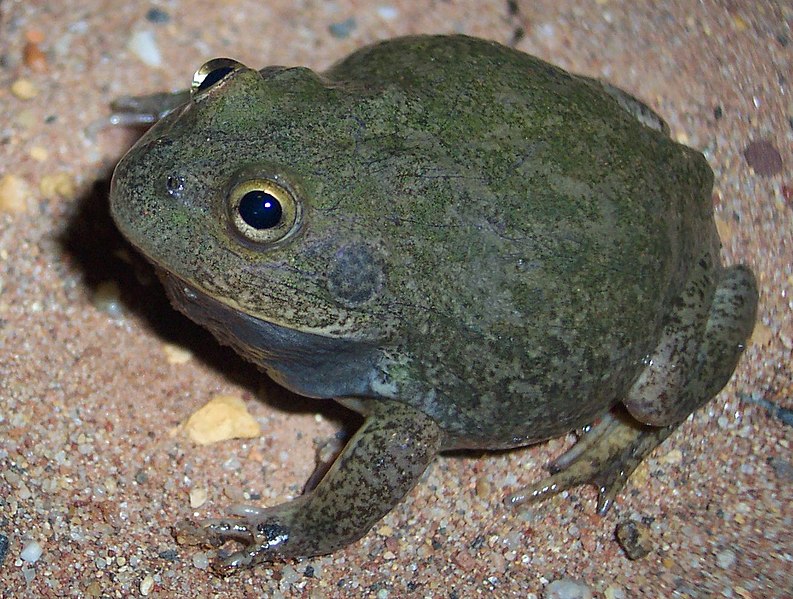 Some years ago I acquired a group of Australian water-holding frogs (Cyclorana platycephala) and found them to be among the amphibian world’s most accomplished burrowers. To learn more about these amazing creatures, please see http://animals.jrank.org/pages/181/Amero-Australian-Treefrogs-Hylidae-WATER-HOLDING-FROG-Cyclorana-platycephala-SPECIES-ACCOUNTS.html.
Water holding Frog image referenced from Wikipedia and originally posted by Haplochromis



what is the black thing?
Hello, Frank Indiviglio here.
Thanks for your interest in our blog.
The creature you are asking about is a Thailand black tarantula, Haplopelma minax. It is shown just emerging from its burrow. This species lays silk threads down on the ground outside its burrow, and rushes out when an insect or other small animal walks across the silk.
Best regards, Frank Indiviglio.
Hello Frank,
Have read this several times…maybe when I have room and the time/ability to build something similar I will have to try. I too had an antfarm or two as a kid, and also tried putting various animals into them. However, though appropriate for queenless groups of harvester ants(which pack quite a punch!). they generally proved either too insecure, or too narrow for the other aimals I tried putting in them.(argentine ants quickly escaped, worms,etc.). At one point I collected hordes of fire ants including nuptial individuals(Very itchy business…the nuptials were eventually butchered by the workers insteading of founding a colony as I had hoped…I even put another jar over it to serve as a flight area to no avail). They went into a peanut butter jar, with a brick inside to coax them to burrow on the edges, which was glued pretty much airtight(and nearly(!) ant-tight) except for the brief moments when the eraser plug was pulled and various goodies dropped quickly before too many of the angry beasts came out!
Your mention of gerbils is intriguing. I’ve heard gerbils are very clean aimals compared to other pet rodents such as hamsters…though I suppose you’d still at least occasionally have to change out all the substrate.
Any experience with Teratoscincus(frog eye geckos?). They dig deep slanting burrows in the wild to escape the harsh desert heat and come out at night to forage despite the cold.
Kudos for a great article
~Joseph
Hello Joseph, Frank Indiviglio here.
Thanks for the kind words and stories…ants really do cause all sorts of mischief – I once had many leaf cutter ants escape on a plane, while I was in the company of a young, newly-appointed and very nervous zoo curator….
Frog-eyed Geckos would be a great one to try, I’ve not worked with them for any length of time.
Gerbils are quite “neat” in their habits, and, if given enough room, establish a toilet area/chamber. Their droppings are bone dry – Mongolian gerbils/jirds need little if any water, seeds meet their needs, plus a tiny bit of vegetation. Lots of unique behaviors – females leave the natal colony, mate with distant males, and return. You might like this article on our Pet Blog re their entry into the trade: A Naturalist-Priest, Yellow Rats and Bacterial Research.
Good luck and please keep me posted.
Best
This is exactly the concept I was I wish to employ in my scorpion habitat. The first question that springs to mind is, “What proportion of the scorpions’ body is appropriate for the space between panes?” 1.5 times the vertical thickness of the mesosoma? 2 times?
Hello Trevor, Frank Indiviglio here.
Thanks for your interest in our blog. A space about equal to or slightly exceeding the scorpion’s length (body, excluding telson, or tail) works well – this allows the animal room to maneuver when digging and to turn around in its burrow.
Good luck, enjoy and please keep me posted.
Best regards, Frank Indiviglio.
Thank you, sir.
Hello Trevor, Frank Indiviglio here.
My pleasure; this type of enclosure is not often used, so please pass along any thoughts or observations you may have.
Good luck and enjoy,
Best regards, Frank Indiviglio.
Hello Frank,
Hope this isn’t too many comments for you from one person-just that I’ve been brooding a few more ideas lately.
Have you ever heard of one way or tinted glass being used for these kind of enclosures(or enclosures for sensitive animals?). Might make the animals feel secure while they are actually in plain sight.
Thanks!
~Joseph
Hello Joseph, Frank Indiviglio here.
Your comments are always top-notch, keep them coming!
Great idea…We use tinted glass for Naked Mole Rats at the Bronx Zoo, and I’ve seen it elsewhere; slipped my mind when I was writing, thanks. I can’t say I’ve heard of one way glass being used…not sure why – now that you mention it, seems very worthwhile. Perhaps I’ll have a chance to bring it up in a future zoo project – I’ll let you know.
Good luck and please keep me posted.
Best regards, Frank Indiviglio.
Hello Frank,
Interesting on the use with naked mole rats. After some further reading it appears that one major problem with using it for burrowers is that the viewer from the lighted side is the one who cannot see through the glass(while the viewer on the darker side can see through). I suppose if you have any particularly shy(but diurnal and ok with light) animals one way glass would be useful to allows viewers to look into the enclosure from a darkened exterior.
I’ve heard in many places that many animals have difficulty seeing in the red part of the spectrum-thus the use of red bulbs for nighttime heat(apparently diurnal lizards can see red, however). If one way glass would not be appropriate-what of red tinted glass?
Actually, do most of the animals you’ve tried this on(reptiles, amphibs, etc.) seem much disturbed by bright light in their normally pitch black tunnels?(would they habituate to it over time if perhaps light intensity was gradually increased?) Tarantulas as you already mentioned will tend to web up the sides.
All the Best
~Joseph
Hello Joseph, Frank Indiviglio here.
Thanks for the info on 1 way glass – explains why it hasn’t been used much in zoos. Red light and the newer blue-black lights work very well for some creatures; in fact, the nocturnal animal exhibit at the Bronx Zoo was called the “red light house” years ago.
Reactions vary greatly by species – I’ve kept nocturnal frogs and rodents that would become active at the same time each day, even if lights were left on (during after hours tours at the Bx Zoo, thousands of house mice would emerge in certain exhibits at the usual “lights-out” time!); a green iguana I kept remained on its exact wake/sleep- schedule for 6 months despite being kept under lights 24/7. Fish and inverts, some mammals tend to keep foraging if slightly lit when in dark enclosures – for mole rats, we once installed tiny white lights within a red-lit exhibit, which worked well. Not sure about habituation, but would be likely for mammals…lots of nocturnal species will forage on cloudy days, or even bright days when hungry, etc.
Good luck and please keep me posted.
Best regards, Frank Indiviglio.
Any attempts at keeping fossorial snakes in such exhibits? Main issue I see is the difficulty in gaining access for cleaning/feeding etc. One species I’ve always found neat is the sunbeam snake(Xenopeltis unicolor)…though it seems few cases of long term success-captive breeding have occured. Wonder if a setup like this would allow them to be observed without undue disturbance.
Hello Joseph, Frank Indiviglio here.
Nice to hear from you again. Great idea, I’m sure many would take to it but servicing would be difficult without some nifty construction. I’ve always wanted to spend more time with Sunbeams myself; I’ve found Eastern Worm Snakes on a few occasions and toyed with the idea of trying them as well, but not yet…
Many snakes spend more time below ground than most realize. Friends who followed radio-tagged Eastern and Black Pine Snakes found that they were fairly deep below ground most of the time; the root systems of dead conifers seem essential to the survival of the very rare Black Pine Snake.
Good luck and please keep me posted.
Best regards, Frank Indiviglio.
Hello Frank,
Have you ever heard of anyone using tubes of sorts to allow either snakes or a small rodent(perhaps robo hamsters) little highways out of the cage so they could travel round the home? Kind of like the habitrail thing but on a larger scale. I’m assuming not just any clear plastic would work for the rodents as I think would would chew threw polyvinyl tubing given time.
~Joseph
Hello Joseph
I was just wondering how you’ve been; nice to hear from you. I haven’t seen anything like that, but wouldn’t be surprised if people were doing it for rodents…haib-trail type material is available; some larger pet stores here in NY have some pretty expansive set-ups. Naked Mole Rat colonies cover many acres in the wild, and in zoos they take very well to large plastic tube exhibits; however, they have pretty strict temp/humidity requirements, and are sensitive to vibrations – and not in pet trade….yet! actually, a very unique fellow in NYC had them in his personal collection years before they were seen in any zoos here! He was also especially good with ants, termites, designed zoo exhibits for colonies, so Mole Rats were “a natural” for him.
I’ve not seen anything with snakes, although buried plastic tubes are sometimes as sub-surface tunnels in exhibits.
What are you planning?
Best regards, Frank Indiviglio.
I was thinking of using plastic tubes to allow snakes the ability to thermoregulate without the input of electrical heating. Holes of the appropriate size could be put into plastic bins and then tubing could be inserted and allowed to travel around the room(to a windowsill, for example for warmth, or down along a tile floor under the table to provide a cool spot). Maybe I should pitch the idea to Zoomed…haha It’d be neat to do something similar for say little hamsters but I’m not sure what material would be appropriate-the available one from manufacturers are quite expensive.
Hello Joseph,
Very interesting…might be worth trying, to see if snakes will adjust and learn or sense where to go when cool, hot, etc. After that…why not try to develop it (make sure you speak with a lawyer first!)? I reel when I think of all the advances in my lifetime, and recently. Someone took a chance on habittrails, and so many other innovations…
Best regards, Frank Indiviglio.
This is too hard for me to understand without pictures (diagram etc) or photos detailing the setup to compliment the written instructions. It would be great if you could put some up so I can understand the underground burrowing system techniques properly.
Hi Kit,
Thanks…i was worried that it would not be clear. Unfortunately I do not have any at present, but will be stopping at the Bx Zoo soon..an exhibit I set up there may still be in place; if so. I’ll phot. In the meantime, please let me know if I can help by answering any questions, best, Frank