 That Reptile Blog – Reptile, Amphibian and Exotic Pet Care and Information

Click: Captive Care of the Ball or Royal Python, Python regius – Part 1, to read the first part of this article. Or, click: The Natural History of the Ball Python, Python regius: Ball Pythons in the Wild to read about the natural history of Ball Pythons.
Feeding
 Most ball pythons take readily to pre-killed mice and small rats, with hatchlings usually being large enough to handle a “fuzzy” mouse. In the wild, ball pythons do not feed when nighttime temperatures become cool (January-February in some areas), during much of the breeding season, and while incubating eggs. They are well adapted to long fasts, and frequently go off-feed in captivity. This can occur even in captive-hatched animals, tuned, perhaps, to an internally-controlled cycle, and is rarely a cause for concern.
Individuals that go off feed regularly should be fed once weekly during those times when they do accept food, as should hatchlings and young animals. Regularly-feeding adults do fine with a meal each 10-14 days.
Leaving a food animal in the terrarium overnight may induce reluctant feeders to eat. Particularly stubborn animals may sometimes be tempted by switching food animal species…Mongolian gerbils are a particular favorite, but sometimes a weaning rat does the trick. Of course, you may then be saddled with the responsibility of always providing that favored food item, so think carefully before offering anything too exotic. “Scenting” a mouse by rubbing it with a with a favored food item is a well-known technique for tricking fussy snakes into eating.
Captive Longevity
A ball python kept at the Philadelphia zoo died at age 47.6 years, and holds, as far as I know, the longevity record for captive snakes. Another was reported to have survived until age 51, but the record is unpublished. A number of specimens have lived well into their 30’s.
Handling
Ball pythons are fairly mellow in disposition, but even long term captives will bite if provoked. Their habit of coiling into a ball, while interesting, is a defense response – please do not harass yours into exhibiting this behavior. As with all snakes, the head should not be placed in the vicinity of one’s face.
Breeding
 Only snakes in good body weight should be used for breeding purposes. Success will be more likely if the male and female are housed separately outside of the breeding season.
Ball pythons should be subjected to a semi-natural temperature and light cycle prior to and during the breeding season. In October or November, nighttime temperatures should be allowed to fall to 68-72 F, and a night (dark) period of 12-14 hours should be established. Daytime temperatures should remain as usual. Feeding should be discontinued 1 month prior to turning down the temperatures, to allow for digestion of the last meal.
One month after the cooling period has begun, the female should be placed in the male’s cage for 1-3 day periods each week. This process should continue for 6 weeks or so, after which temperatures and the day/night cycle should be returned to normal.
Gravid females will usually not feed. Eggs may be expected from 2 weeks to 2 months after the reintroductions have been discontinued, depending upon when copulation had occurred.
The Rosemond Gifford Zoo ball python information sheet is posted at:
http://www.rosamondgiffordzoo.org/animals/Reptiles/BallPython.pdf




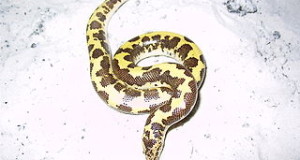
I just got my first pet snake and I decided on a ball python. I love it and now I’m reading all about it online so I can take great care of it
Hello Brett, Frank Indiviglio here.
Thanks for your interest in our blog. A ball python is a fine choice – one at the Philadelphia zoo lived for 50+ years, so you may have a long time to enjoy your pet! Please write in with any questions you may have.
Good luck, enjoy and please keep me posted.
Best regards, Frank Indiviglio.
Hello Frank,
I find your articles very informative. Thank you. I have two ball pythons, a 3-month old and a 11-month old. The younger is a male named Henry and the elder is female (yet to be named). I have a concern about the female, she seems to be in good health and is from a reputable reptile store. My mother knows the owner personally and does all her business there. But she won’t eat. It’s been going on 3 weeks since she ate last. I read a few of your articles that state this can be normal. However, she did not exhibit this behavior prior to purchase. We have tried frozen (thawed and then warmed) mice and rats as well as live baby rats. The store we bought her from said they fed her live mice and rats. Henry (the male), did not have any problem eating even after the trauma of purchase and moving and being a Christmas present (packaged in a small gift box for about 5 mins). If you have any other info on this habit of fasting or any other resources I should check out, I would greatly appreciate it. Keep up the great info. Thank you for getting the word out about these amazing creatures.
Thanks again,
Kim
Hello Kim, Frank Indiviglio here.
Thanks for your interesting post and the kind words, much appreciated.
With most snakes, you can relate fasts to breeding seasons or to internal “clocks” that respond to conditions in their natural habitats. Unfortunately this seems not to be the case with ball pythons; despite generations of captive breeding, they continue to exhibit this behavior – but it is not clearly tied to, for example, the dry season in their natural range. Even long term captives – 50+ years in one case (the longest lived captive snake known) continue with unpredictable fasts. But they are very good at adjusting their metabolisms to suit their needs (please see this article for an example) – as long as your snake has fed regularly in the past, 3 weeks is of no consequence – indeed, 3 months is not unusual.
Snakes fed on live rodents sometimes take awhile to adjust to pre-killed food…but best to stay with dead prey; ball pythons never become confirmed live-food specialists as might other species.
An old trick is to “hide” food within a cave; no research behind this, but it seems that tracking and “finding” the food kicks many individuals into feeding mode. Spraying the terrarium each day is sometimes helpful as well – just be sure the snake has a warm basking spot and that the cage dries out thoroughly.
If they are housed together, it may be that the female is stressed by the presence of the other. They show very few external signs of stress, but it is an important concept – ball pythons are solitary in the wild and so separating them might be helpful (usually helps in future breeding as well, if that is your goal…“absence makes the heart grow fonder” and all…!). Be sure also that the snake has a small, dark, hiding spot.
Good luck and please take notes – maybe you’ll be the one to break their code. Please let me know how all goes,
Best regards, Frank Indiviglio.
Ball pythons become nearly brain dead in captivity. They become very inactive, indifferent to their environment and even forget to hunt properly. They simply take half automatically a dead big ball, then go warm up and defecate. They are one of the reptiles which get the less stimulation in captivity, as many owners don’t give them anything more than a hide and a water bowl. Is that a life? In nature, even if they are quite inactive and hidden most of the time, they surely do climb and search much more. Because they don’t show many signs of discomfort that doesn’t mean that they enjoy being in a bare enclosure with a hiding hole only.
What do you mean when saying basking spot? don’t they heat while hidden? Also, how a lamp will effectively heat under a hide? Isn’t a heat pad the economical solution?
Hello,
It’s difficult to use concepts that apply to mammals when considering reptiles. Behavioral enrichment has long been standard practice in zoos for mammals, certain birds. Can be useful in encouraging activity in reptiles; in general, however, they move , hunt etc out of necessity – not in their “interests” to move about, better to add weight/size etc. This partially accounts for high obesity rates among all types of captives, including mammals. When involved in field studies of anacondas in Venezuela, I was amazed at how very little they moved over the course of several months.
Hunting behavior is instinctive, and will not lessen or improve in captivity. However, live rodents introduced into a terrarium often startle rather than stimulate snakes…many react defensively, or refuse to feed, may not have space to properly subdue the prey etc.; often appear unable to hunt properly, but this is a function of the situation.
Ball pythons bask, and heat lamps do change temperatures within shelters; small temperature guns are very useful in keeping track of shelter, basking and other temps. heat pads are best reserved for certain nocturnal and or fossorial species , .e. sand boas; basking beneath overhead heat is preferable for most snakes, more in keeping with natural means of regulating temperature. Impt to remember that pads usually do little to heat air (newer radiant pads an exception, and can be useful)..in cool situations, snakes may remain on pads to long (more common with hot rocks). heat pads also used where supplemental heat is needed,…esp. for individuals taking large meals and needing lengthy basking/digestion times (large constrictors). Best, Frank
I have 9 ball pythons and all of them have their own unique personalities, they vary so much that even my snake fearing mother was surprised how much personality they have! Out of my 9 only 3 enjoy handling and actively seek it out, the others only enjoy roaming around their cages or poking their heads out to observe. The ones that don’t enjoy being handled have different reactions as well. One will hiss, shove my hand away and bite, two others will just hiss and shove my hand away, The other 3 will either run or go into what I have dubbed a “freezing” behaviour where they just freeze and don’t move. This usually happens when moving away or fleeing doesn’t work. I can move and position them like dolls and they won’t move a muscle. I’ve gotten great pictures this way but I suspect it’s a sign of severe stress so they are mostly left alone.
I have one male, named ‘Little Dude’, that has developed an adorable habit of quickly slithering under the frames of my glasses and pulling them off!
I have another male, Riley, that has an established routine, he does this every night I take him out. He’ll smell my hands and face and either sit quietly next to me for 10 minutes or begin exploring, depends on his energy level I suppose!
I also have a large yearling female, Winter, that gives off whistling noises when she is excited, irritated or really wants to come out of her cage. She is 100% healthy and has no RI, when she first began displaying this whistle behaviour I was concerned and watched out for any signs of RI but there are none and she’s my best feeder out of the 9 and the fastest grower. She also has a habit of usually wrapping herself around my legs and, I suspect, going to sleep when I take her out. I don’t believe she’s uncomftorably cold either, my room is kept at 80 degrees. Or she’ll take a spin aound the room occassionally letting out a whistle of excitement. She’s a character!
I suspect my snakes display such personality because I keep them in glass aquariums where they can see (with a proper hide for privacy of course) and don’t force handling on them if they don’t seem to accept it well. I see so often ball python keepers keep their snakes in plastic bins where they sit in darkness with no real environment to see or interact with or even a day/night cycle. How can any animal possibly have a personality if it is treated like a pet rock? I’ve also seen the opposite where a ball python was kept in an aquarium but the owner refused to provide a hide stating that they had heard that providing a hide would make the snake nervous and snappy. The snake displayed the freezing behaviour I stated above whenever he was held. Of course the owner thought the snake was enjoying being held but I thought otherwise since I’d seen this behaviour before with my own snakes when they became stressed and fleeing didn’t work. Have you ever observed this ‘freezing’ behaviour before, Frank?
Hi Kelsie,
Thanks for the observations…very interesting. Definitely true what you say re not forcing handling and not providing hide spots…influences behavior very directly. I would caution you, however, not to let any snake near your face…they respond to vibrations, scents and other stimuli that we cannot sense, and may bite for reasons we cannot imagine…I know of many examples. Captive breeding is very definitely changing the nature of several species…I can see this even within my lifetime, but snakes are not domesticated in any sense of the word, so please be careful; a bite to the face can be very serious.
The freezing is related to their instinctive reaction when confronted by certain predators; if severely threatened, they will go into the “ball position” from which they get the common name…rare to see that among captives, however. Enjoy, best, Frank
I’m always extremely careful when a snake is around my face. I only let the 3 that I handle, Dude, Riley and Winter, anywhere near my face and never if i’ve just eaten. I’m also always very aware of their tounge flicks and behaviour. Riley is the one I trust the most, he’s unusual for a snake. Extremely calm and mellow, always has very loose, relaxed muscles and he’s literally never badly scared. He only bit me once as a baby and it was a feeding error that was my mistake, he let go immediatly perhaps realizing that his catch had no fur and tasted funny! He’s the one that comes out almost nightly, he’s the one that got me hooked in reptiles and sparked my curiousity for owning and perhaps breeding snakes, amphibians and lizards. I swear, he’s closer to being a cat than a snake lol! He’s definetly my one in a million reptile. Have you ever had a reptile or amphibian that was one of those one in a millions?
Hi kelsie,
I was hooked early on, for as long as I can remember (growing up near the Bx Zoo, with relatives who were very interested, helped!).
But it’s important that we understand their natures…those things that cannot be changed; no real way to compare to a mammal (domestic mammals do not interest me all that much, so this is not a slight) or to assume they are responding as we believe they are. Scent is just one of many, many factors…most of which e don ot understand; no upside to putting any animal near your face, and no way to prevent or predict a bite (trust me on that!) if the snake decides to strike. Enjoy, best, Frank
Hi,
Yesterday I turned on the fogger but forgot to turn it off, it has been on for almost 5 hrs. When I found it, the whole tank & my BP are wet and humidity reached over 90% high! I changed its bedding immediately, but he seems very stressed and upset, and still awake this morning. I’m really scared, and not sure if my BP is doing well, do I need to take him to a vet to check if anything is wrong? Thanks sooo much!
Hello Vera,
I’d worry more about your BP than the snake’s reaction! Don’t worry…not great if the mist lowered temperature of cage significantly, but that period of dampness will do no harm; most snakes become restless during “storms” – depending on species and timing, can be a signal to hunt, seek mates, find shelter. Best, Frank
Thanks for coming back to me so quickly! There’s nothing significantly shows on his body, only maybe its color became a little bit darker, I thought it was because of the moist. I will keep an eye on him. Cause heating lamp was on so the temperature didn’t change too much. My real struggle now is how to keep humidity at a certain level. I will mist the tank or turn on the fogger for a little while when I have time, but as I’m always out during the day, the humidity usually stays below 20%. Is there any good solutions? Thanks!
Vera,
My pleasure. They are native to very arid habitats and generally do fine if provided a bowl large enough to bask in. You can also provide a hide stocked with damp sphagnum moss, which it will use when needed. Humidifier might be important when the animal sheds. I hope all goes well frank
I need some guidance. I have two ball pythons. Both female one is about 5 yrs (we’ve had her for 2 years now) and generally eats a med/lrg rat every 2-3 weeks and the other is 3 yrs and we’ve had her since a baby and same schedule generally a small rat. Both have been great eaters with very few disruptions in their eating usually if they were pre-shed. The problem is, we recently moved out of state from a dry climate to a rather humid southern climate. Both ate around end of April. Since we moved, neither will eat, its not winter, I’ve been diligently monitoring take environment and all is where it should be and is normal for them. However neither will eat now. Both have shed twice since the move but refuse to eat. We tried varying type, size etc. Ensure they have privacy (but monitor because they eat live and refuse frozen) I even tried a frozen after several failed attempts with live. generally they will recoil and try to escape their feeding tanks (we don’t feed them in their enclosure) but the younger ball will occasionally “stalk” a rat, posture and strike, but will not kill or eat them. We’ve tried scenting rats with mouse litter, etc. Neither seem to be losing significant weight or have protrusions. But their skin seems a little loose. No health issues. it’s been 3 months and I know that snakes will go through fasting periods for different reasons. But both? At the same time? We’ve tried limiting our handle in case it was stress and they are active and display “seeking behavior” but no dice. Offer food and wait a week and try again. At what point should we be concerned?
Could the move be a contributing factor? Any suggestions about other tricks or methods? I’ve seen gerbils can be tempting but haven’t tried this yet. I try to do my homework and don’t feel like a newbie and we’ve had them for quite a while and are familiar with their personalities and habits but we are stumped. Trying to be patient but never had this issue and not with both at the same time…any advice is appreciated
Hi there,
Unfortunately, your situation is not uncommon when it comes to ball pythons. I have a few of my own that will go on a random hunger strike once in a while. How are they being housed? Are you by chance housing the snakes together? Also, what is the size of their enclosure, basking temperature, humidity levels number of hides etc. I would recommend that you try feeding them in their enclosure. It can be stressful for a snake to be moved back and forth to feed. While this practice is usually fine when the snake is comfortable, if they are a little stressed from the move it could be disrupting their natural “lie and wait” hunting instinct. After you get them feeding again, you could most likely resume feeding them in a separate tank.
Gerbils can be quite tempting for balls, they are very similar in scent to the types of rodents that they would encounter in their native habitat. It should be noted however, that many times the snake will get hooked on gerbils and refuse to eat anything else. I have had some success with trying extremely small meals for larger snakes. I once had a large adult female, normally feeding on large rats, only accept ten fuzzies for several feedings. You could also try scenting the rodent with chicken bouillon, that has been known to entice snakes to eat on occasion. I hope that this helps
Hi there, I am hoping you can help me. I was recently given a female red eared slider turtle. I have built her an outdoor pond with basking areas and deep and shallow water, sand and grass around it for her to wander around in and a shaded portion both in the water and outside it. My question regards heating the pond. where we live, our weather is generally mild to hot, with temperatures in summer between 28 and 32 degrees Celsius and in winter, between 2 and 18 degrees Celsius. Is it necessary to heat the pond with an inline pond heater, or can she survive these temperatures with just sunlight and shade? Also, will she try to lay eggs? I have no idea how old she is but she is now about 18cm long, so I am guessing it’s time. There. Are no other turtles around her. As I am concerned, I have considered sending her to a specific reserve area, where I know she will be well taken care of but I adore her and she seems otherwise healthy and friendly. Please could you advise me on the best course of action, for the turtle’s benefit. Many thanks.
Hi Carolann,
It is wonderful that you have gone to such great lengths for your pet turtle. I’m sure that she loves her pond. Red eared sliders are usually very hearty turtles. They are actually an invasive species here in Pennsylvania, so cold weather is no trouble for them. They do, however, need a few accommodations in order to over-winter successfully. The pond needs to be deep enough to not freeze completely through, usually this means a depth of over 6 feet. Also, they need to be able to dig into the bottom of the pond. If your pond has a liner, they will most likely dig a hole in it and drain the pond. In addition to that, they need to have a slow transition from warmer to cooler temperatures. This slow transition stimulates them to produce chemicals that allow their bodies to essentially freeze without causing cell damage. If your pond doesn’t meet these requirements, you should probably consider setting up an indoor enclosure for the winter months. You could use almost anything that is large and can hold water. You just want to make sure that you have proper filtration, Basking spots at the right temperatures, and UVB lighting.
As far as eggs go, female red eared slider have been known to lay eggs even if they haven’t mated. As long as she hasn’t been in contact with a male the eggs will be infertile and can be disposed of.
I hope this helps you out!
-Josh
Thanks for the advice. She seems to have adjusted to the colder weather and basks a lot at the moment. We don’t really have to deal with water freezing her, just cold. what should I add to the bottom of her pond to allow her to dig in? As it s already dug and lined, I will not be able to make it 6 feet deep, but I do have a little “house” in the deeper water for her. Is this sufficient? Assuming I leave her outdoors in the winter and cover a section of the pond to keep some heat in, would this be sufficient for her to spend winters in or should I preferably consider wintering her indoors? Thanks again. I appreciate having a person I can ask all these questions. I know very little about turtles and appreciate any assistance you provide.
She might hibernate in the underwater house. I would still put about 12 inches of dirt/gravel mixture on the bottom so that if she does have the urge to burrow she can do so without tearing your liner. As long as your pond doesn’t freeze solid, I wouldn’t use a heater. If you were to unintentionally heat the water too much, it could throw off the turtle’s hibernation cycle. That being said, when she does hibernate she will remain motionless under the water in a state of suspended animation until spring.
Unfortunately, there is always some level of risk with hibernation. If you are concerned about the turtle’s health it would be best to bring it in for the winter.
-Josh
Thank you for your help. An indoor habitat in the winter seems like a better option..
No problem. let me know if you have any other questions in the future.