 That Reptile Blog – Reptile, Amphibian and Exotic Pet Care and Information

Ball Pythons in the Wild
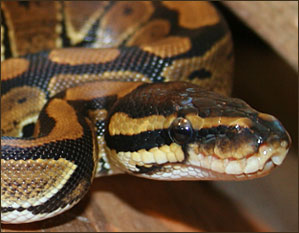 As recently as the early 1990’s, the now popular ball python was considered a troublesome captive, due largely to the prevalence of wild caught adults in the trade. Today it is widely bred in captivity, but certain of its natural traits continue to affect how we go about keeping it as a pet. We’ll take a look at some of those traits, and then go on to captive care in future articles.
Physical Description
Although small as far as pythons, go, this species is very thickly-built. Ball pythons average 3-5 feet in length, with occasional (and now only rarely encountered) specimens reaching 6 and even nearly 7 feet. It is the smallest African representative of the genus Python, but not the smallest African python per se. That title goes to the West African burrowing python, Calabaria reinhardtii, which rarely exceeds 3 feet in length.
Ball pythons are dark brown to nearly black in color and marked with numerous, generally oblong blotches of tan, light brown, reddish-brown or yellow-orange. The color of wild specimens varies tremendously among different populations, with pied and even albino individuals reportedly being encountered more frequently than is usual among other snake species. This may account for the ease in which captive color morphs are produced, although incubation temperature seems to affect the color pattern as well. The savannahs of Ghana are known for their predominance of yellow-orange ball pythons, which are much favored in the pet trade.
Range
Sub-Saharan Africa, from Senegal on the west coast northeast through Mali to western Sudan and southeast through Guinea-Bissau to the Gulf of Guinea, then east to the Central African republic, possibly Zaire, and Uganda.
Although typically described as being native to “Tropical West Africa”, the ball python actually has a fairly wide distribution across central and into parts of east Africa. In addition to the aforementioned countries, ball pythons have been recorded from Niger, Chad, Guinea, Sierra Leone, Liberia, Ivory Coast, Ghana, Togo, Burkina Faso, Nigeria, Benin and Cameroon.
Most of the parent stock of today’s captive population apparently originated in Toga and Ghana.
Habitat
Ball pythons are snakes of open, often arid habitats – savannahs and other grasslands, sparsely forested woodlands, overgrown fields and the borders of agricultural areas. They typically shelter in mammal burrows, termite mounds or hollow logs. Although largely terrestrial in some habitats, ball pythons will climb, and often occupy tree hollows where such are available.
Where undisturbed, they frequent barns, tilled fields and village outskirts, drawn by large rodent populations. Ball pythons do not occur in forests or thickly-wooded habitats, but will colonize such areas when they are cleared for agricultural use.
Status in the Wild
 This species is threatened across large areas of its range by collection for the food, leather and, in the past, pet trade. Today the vast majority of animals in the pet trade are captive bred. It is listed on Appendix II of Cites.
Diet
Grassland rodents comprise the majority of the diet. Recorded prey species include cane rats, Nile rats, gerbils, jerboas, jirds and zebra mice. They also feed upon shrews and ground-nesting birds, and hatchlings may take lizards. Wild individuals often favor particular prey species, and may be difficult to habituate to commercially available rats and mice when taken captive.
Ball pythons often inhabit areas subject to long periods of hot, dry weather, during which food is scarce. Animals in such populations may aestivate in mammal burrows or similar underground shelters for several months. It is theorized that the internal circadian rhythms of these pythons may be responsible for the long fasts that captive animals often undergo.
Reproduction
Females produce typically 6-7 large eggs at yearly or less frequent intervals. Eggs are typically laid in abandoned aardvark or rodent burrows, and hatch after an incubation period of 3 months. In common with other family members, female ball pythons remain coiled about the eggs during this time, providing protection and temperature/humidity modification.
Female pythons of various species have been shown to actively raise the temperature of their clutch by coiling about the eggs and “shivering”. In captive situations, I have observed incubating female blood pythons (Python curtus) and Burmese pythons (P. molurus bivittatus) to raise their eggs by 7F above the ambient air temperature. Field research conducted with ball pythons, however, indicates that incubation mainly functions to conserve egg weight by preventing water loss.
The young measure 10-17 inches upon hatching, and reach sexual maturity at 3-4 years of age, by which time they are approximately 3 feet in length.
Economic Importance
Ball pythons are heavily utilized as food by people throughout much of their range, and are harvested for the leather trade as well. Until captive bred stock became widely available, huge numbers were collected for the pet trade and exported to Europe, Japan and the USA.
Miscellaneous
 The common name of this snake is derived from its habit of coiling into a tight ball, with the head hidden within the center, when threatened. Once so situated, it is difficult to uncoil the snake, and it will remain so even if rolled about (not recommended!). However, some ball pythons surprise attackers (and annoying keepers!) by biting savagely when disturbed. Actually, a number of other pythons and unrelated snakes utilize a coiled defensive posture, but in none is it so well developed as the ball python.
An extensive CITES-generated study of ball python populations and management in Ghana is posted at:
http://www.stevegorzulapresents.com/study_royal_python_ghana.pdf




Really great article; we’ve recently written a profile on the Ball python ourselves and would love to hear what you think of it.
Check it out: Ball Python
Hello David, Frank Indiviglio here. Thanks very much for your kind comments.
I checked out your article…you’ve done a great job covering the basics. Since many hobbyists are aware of but confused about the UVB/UVA requirements of various reptiles, I usually find it useful to include some specific information. I’ll log onto your web site in a bit and offer a comment.
Thanks again, best regards, Frank Indiviglio.
loved the articles ,they answered most of my queastions.we got a good deal on gerbils at our local pet store.they had them marked down to under 3.00 ea due to the fact they had too many,plus a litter due to come down.thank you very much.chuck tice
Hello Chuck,
Thanks, much appreciated. Gerbils are simple to breed, and being active by day they are very interesting to observe. Complex social behaviors as well (you might enjoy these articles). Please let me know if you need further information.
Good luck, enjoy and please keep me posted.
Best regards, Frank Indiviglio.
my ball python percy he wont eat i had a snake that was a girl name katy perry she was a ball python we did it got her at store we got her at somebody house first she will eat she was it really moveing alot she was always cold all the time she always poops an pee on my her poop was yellow i know she was sick she would not shed she always open up her mputh then we got her food she would it eat she bite my shrit i know she was sick or i stress her out to much i hold like for 4 hours i did it know anything about snakes i was gonna get a chameleon but then she died she was to stress out she was my best friend so the day after she died we got percy at petco cost 75$ he was a really HEALTHY snake he ate at petco but we got him in October 6 2012 he would it eat for a month i dont want him to die but i sawd him open up his mouth 3 times i try feed him all the time but he wont eat an i really need help the guy said dont get him vitmins or he will get mad i need vitmins for he can eat he is really health he always move a lot i dont know what to do they said they said he can lived with out food for 3 month i dont want him to die he is my best friend he moves alot i think he is stress out he is just a baby i dont hold him that much only like for 15 or 10 min i try to feed him alot buy he wont eat should we get vitmins for him or not im really freaking out im only 13 years old
Hello Leia,
it’s important to keep the snake at the proper temperature and to provide it with a hiding place. Please see this article on Ball Python care and let me know some details about your snake – temperature, size of tank, type of hiding spot, etc. They do not need vitamins; mice provide a complete diet. I would not ask for further advice from anyone who suggested vitamins, as the care of ball pythons is well known.
Handling will not encourage it to eat; once well adjusted to captivity, you may be able to handle the snake regularly; but avoid handling until the snake begins feeding regularly.
Fasts of 1-2 months are normal for ball pythons (please see this article for more info); However, the only way to be sure that it is just going through a normal fast or is sick is to have a vet exam. Please send me the details I mentioned above and I’ll be able to advise you further.
Best, Frank
I have a quick question tonight I was feeding my reticulated python (I know this article is on ball pythons sorry) but the mouse bit my snake and when I went to get the snake out of the feeder box it struck me it’s never done that before I was wondering if it could have been because it was bit and mayb I scared it when I went to move it ty in advance sorry to change the python type