 That Reptile Blog – Reptile, Amphibian and Exotic Pet Care and Information

Welcome to our new blog location!
Please see here for more background information on this animal’s natural history and life cycle in the wild.
General
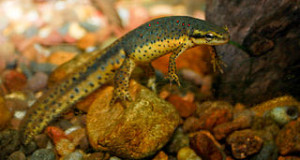
Despite living largely underground in the wild, captive spotted salamanders adjust well to artificial caves and shelters, where they are more easily observed. Well-adjusted capt ives quickly lose their secretive, nocturnal ways, and will eagerly accept food offered by plastic feeding tongs. If attention is paid to their needs, especially as concerns temperature (see below), these stocky, brilliantly marked salamanders make long-lived and hardy pets.
Space and Other Physical Requirements
If provided with a deep (6-12 inches) substrate, spotted salamanders will establish burrows that will be defended and used consistently. Products such as Zoo Med Eco Earth and R-Zilla Fir/Sphagnum Moss Bedding, with a bit of top soil mixed in, work well as substrates. The surface should be covered with living or dried sheet moss, such as R-Zilla Compressed Frog Moss. You can spot clean this type of set-up or occasionally remove the top layer of substrate – living plants in the terrarium will aid in absorbing the salamander’s waste products.
Another useful tip in maintaining cleanliness is to establish a colony of isopods (sow bugs or pill bugs) in the terrarium. These small crustaceans can easily be collected below rocks and leaf litter. They are excellent salamander food and avidly consume feces, dead insects and decaying moss (a bit of fish flake food added occasionally will keep them in top shape and assure that they reproduce).
Land snails are also excellent scavengers, and both they and isopods are fascinating creatures in their own rights. Snails usually reproduce readily in captivity, and small specimens will be eagerly devoured by spotted salamanders.
A single adult spotted salamander requires an enclosure of approximately the size of a 10 gallon aquarium.
Spotted salamanders may also be kept in ventilated sweater boxes on sheet moss or paper towels. Each animal should be provided an individual artificial cave or cork bark shelter.
Light, Heat and Humidity
Spotted salamanders favor cool temperatures, retreating far below-ground during the summer months. They do best at 60-70 F, and are stressed by temperatures over 76 F. Cool basements make ideal sites for their terrariums, especially during the summer months. My own basement maintains an air temperature of 50-54 F in the winter, during which time the salamanders continue to feed. The drop in temperature is good for their health, and helps to maintain normal activity patterns and to spur breeding.
Breathing largely through their skin, spotted salamanders require moist conditions – their terrarium should be misted with de-chlorinated (not distilled) water daily. Free-living adults rarely enter water other than for breeding, but a shallow, easily-exited water bowl will be utilized by captives.
Humidity should not be raised by covering the terrarium with plastic – salamanders require circulating air and should be housed in screen-covered enclosures. In stagnant air conditions, temperatures rise and fungus often attacks the skin.
Spotted salamanders do not require a UVB light source. If you keep live plants in the terrarium, be sure to use a low output UVB bulb, such as the Reptisun 2.0, as too much UVB can damage the eyes of these and other amphibians. Check also that the bulb does not cause temperatures to spike.
If you keep your salamanders in an unlit basement, it is a good idea to provide a light cycle for them in the form of a weak room light or fluorescent tank light. They will do fine in complete darkness, but a day/night period is preferable, especially if you plan on breeding your animals.
Check back next Monday for the conclusion of this article. The image above is referenced from the Spotted Salamander entry on Wikipedia.



Same question is asked on caudata.org, but I’ll second the interest on land snails. What species? Dart frog keepers consider snails a slugs a menace since they eat plants and will CO2 bomb tanks to get rid of them(and other nasties like proboscis worms). What is your take? I’m guessing with salamanders they are much less of pests as the young get eaten. I’ve seen some snails here that the adults would be bite sized for a spotted also though.
Hello Joseph, Frank Indiviglio here. Thanks for your interesting post.
There are many variables when it comes to snails in terrariums. Here in NY, and throughout the US, there are many introduced species…in the Northeast, most habitats have more European than native species. I have not identified most…I should, the American Museum of Natural History displays the shells of all NY species very conveniently in one case…someday hopefully.
I have 3 terrestrial species, collected in NYC and nearby suburbs, which do not eat living plants. Several have lived in one planted terrarium housing treefrogs for years without any supplementary feeding. They consume feces, decaying moss and dead plant leaves, the occasional uneaten insect, etc. One species I’m sure is European…I have used them in exhibits at the Brooklyn Children’s Museum as well with good results.
I’ve noticed that local terrestrial species do not breed very well…perhaps they need to be chilled for a time, or more food. Most aestivate for much of the summer, sometimes not moving about for weeks (same as with snails outside).
The larger European species here will even consume completely dried out dead leaves, at least when very hungry. Once while writing at home I heard a distinct “munching” sound and traced it to a potted cactus that I had brought indoors for the winter…a large snail was eating a leaf that had the consistency of cardboard…this sustained the creature for about 2 months, during which time it remained immobile.
A friend who taught me a great deal about poison frogs kept many terrariums for, quite literally, decades without substrate changes…he stocked each with a snail or 2…various species collected from all over, including Cuba (long story!); he even had banded tree snails. He was bed-ridden for many years, and figured out how to keep tanks going indefinitely without the need for much physical manipulation…going as far as to use an aspirator to suck up and deposit only a pre-determined number of 10 day old crickets into each terrarium!
Snails are intermediate hosts for a number of parasites, but I’ve never seen any sort of problems in this regard… most of the parasites involved are fairly specific as to host choice, etc. I’ve also used aquatic snails as food for reptiles at the Bronx Zoo….I hated doing this, but they are important for certain species, i.e. Malayan snail eating turtles (go figure!), Chinese alligators, various map turtles, giant musk turtles….without incident. Some zoos use a methylene blue bath before feeding crayfish/snails to their collections, to be on the safe side.
As you say, thin shelled snails and the young of most species are excellent food items for many salamanders.
I also have 4 species of aquatic snails that will not consume living plants, yet flock to a withered leaf of kale immediately (or as immediately as a snail can!).
Best regards, Frank Indiviglio.
hi i bougt a spotted salamander and he wont eat but if ulook at his skin there is no blisters
Hello Jake, Frank Indiviglio here.
Thanks for your interest in our blog.
Please write back with some details – temperature in the terrarium, set up (substrate depth, shelters, etc), type of food offered, when/how offered – and I’ll be happy to provide some suggestions.
Good luck and please keep me posted.
Besr regards, Frank Indiviglio
Hi Frank,
I have sucsessfully raised 5 spotted salamander larvae from eggs and they are only about 2 months old. They are all separated to prevent their cannibalistic ways and i was wondering…
1.How much/often should i feed them?
2.Is it ok for them to eat small ants?
3. Is it ok for them to eat small pieces of shrimp?
4. How often should I clean each of their small dishes of water they are in?
5. How soon will they metamorphoses?
Thank you,
Nina
Hello Nina, Frank Indiviglio here.
Thanks for your interest and congrats – not an easy task.
1. They are primed to grow quickly and leave the water (since they usually live in temporary ponds) so daily feeding is ok as long as you keep up with water changes. Amount really depends on size, temperature and so on, but they are very ada0ptable in regulating growth rate; a meal equal in volume to the size of the head is sometimes used as a rough guide.
2. Ants are technically ok, but are some may be rejected due to taste (noxious secretions) and you’d need to collect from a pesticide-free area. However, they do not provide as much nutrition as earthworms and blackworms, which are the best foods to use as a staple diet.
3. Pieces of shrimp are ok on an occasional basis, but shrimps purchased from food stores are marine species, and so not a natural food item; also, small whole animals are preferable to pieces of larger, so that the exoskeleton and organs are eaten. <a href="Hello Nina, Frank Indiviglio here. Thanks for your interest and congrats – not an easy task. 1. They are primed to grow quickly and leave the water (since they usually live in temporary ponds) so daily feeding is ok as long as you keep up with water changes. Amount really depends on size, temperature and so on, but they are very ada0ptable in regulating growth rate; a meal equal in volume to the size of the head is sometimes used as a rough guide. 2. Ants are technically ok, but are some may be rejected due to taste (noxious secretions) and you’d need to collect from a pesticide-free area. However, they do not provide as much nutrition as earthworms and blackworms, which are the best foods to use as a staple diet. 3. Pieces of shrimp are ok on an occasional basis, but shrimps purchased from food stores are marine species, and so not a natural food item; also, small whole animals are preferable to pieces of larger, so that the exoskeleton and organs are eaten. Canned and freeze-dried freshwater shrimps are a better option. 4. Cleaning depends upon size of container, feeding schedule etc., I’m assuming the dishes as small, so I’d say clean as often as possible, once daily or so. As they grow, they will be producing more and more wastes, especially ammonia, which is toxic but invisible, so up your schedule as time goes on. 5. In the wild they transform by the end of the summer (i.e. 4.5-6 months after hatching), but they will speed up the process if the water levels start to drop (some Tiger Salamander larvae, which are related to spotted salamanders, will actually develop broader jaws and longer teeth as water levels drop…thus allows them to eat other larvae and thus grow faster and leave the pond sooner.) In captivity, the timing changes – sometimes they take longer due to stable water supply, but lighting, diet and other factors can be involved; but usually within the natural time period. You’ll see the gills regress and faint color patterns begin to develop when they are ready. Please let me know when , this happens, it will be interesting to know the time frame. Canned and freeze-dried freshwater shrimps are a better option (canned preferable, in my experience).
4. Cleaning depends upon size of container, feeding schedule etc., I’m assuming the dishes as small, so I’d say clean as often as possible, once daily or so. As they grow, they will be producing more and more wastes, especially ammonia, which is toxic but invisible, so up your schedule as time goes on.
5. In the wild they transform by the end of the summer (i.e. 4.5-6 months after hatching), but they will speed up the process if the water levels start to drop (some Tiger Salamander larvae, which are related to spotted salamanders, will actually develop broader jaws and longer teeth as water levels drop…thus allows them to eat other larvae and thus grow faster and leave the pond sooner.) In captivity, the timing changes – sometimes they take longer due to stable water supply, but lighting, diet and other factors can be involved; but usually within the natural time period. You’ll see the gills regress and faint color patterns begin to develop when they are ready. Please let me know when , this happens, it will be interesting to know the time frame.
Please let me know if you need any further information. Good luck, enjoy and please keep me posted.
Best regards, Frank
Thanks for responding!
Of course I have only seen this now.
Well now I have 3 larvae and the largest is a little over an inch.
Recently I started to feed them blackworms and they loved them the first day but now not so much. Its been 2 days since they ate a large meal so…
Should i keep trying with the blackworms?
Should I be feeding them something else?
When would you say theyll metamorph? (The biggest appears to have shrinking gills on one side)
thanks
Hello Nina, Frank Indiviglio here.
My pleasure…thanks for the update. Blackworms are their absolute favorite so there is some reason behind their refusal to feed. Most likely they are beginning to transform (shrinking gills are a sign, as is their size). It is normal for them to cease feeding at this time. The exact timing depends on many factors – food availability, population size, temperature, water volume, but generally occurs by summer’s end; usually within a week or less of when the gills begin to shrink. Be sure they have an easy way out of the water, or they may drown. Please let me know if you need ideas on the set-up.
High ammonia levels or other water quality problems can also cause them to cease feeding. Best to check ammonia (simple tropical fish test kit) and do a partial water change if you are not sure.
Please let me know if you need any further information. Good luck, enjoy and please let me know how all goes.
Best regards, Frank Indiviglio.
I keep the water level very low.
Now they will eat a piece once and a while maybe 2 pieces each today. I dont think they will metamorph for a while though because the biggest is only 1 inch and many websites say they morph at about 2 1/2 so… also i clean the 5 gallon tank once a day. They do have lots of accessible rocks as well.
Hello Nina, Frank Indiviglio here.
Thanks for the feedback. Sounds like water quality is fine, so it is just likely that they are slowing down as they mature. Small chopped earthworms are also a good food item if available.
Size at transformation varies a great deal; I’ve seen a very wide range. Larvae seem very flexible in their responses to local conditions. Most amazing is a close relative, the tiger salamander. If water levels drop suddenly, some larvae will develop unusually wide mouths and longer teeth so that they can prey upon other larvae, and so will grow faster than when restricted to invertebrates as a food item; they also recognize kin and will eat them only as a “last resort”! Not as much work has been done on spotteds.
Place some moss or other cover on the rocks…emerging salamanders will seek shelter and may be stressed if unable to hide/burrow.
Please let me know if you need any further information. Good luck, enjoy and please keep me posted.
Best regards, Frank Indiviglio.
They all ate a lot (blackworms) now and are doing great. One of them is slightly more pale than the others but i think hes ok. I was also thinking of placing them in a large dish IN their new terrestrial tank when they were at the last stages of morphing. (So that they can have hides and land) Do you think thats a good idea?
Thanks for the kind words; happy to hear the news. A large dish within a terrarium is ideal, as long as you can keep it clean and they are not stressed by the smaller quarters; perhaps experiment with 1 animal and watch closely for a day or so. Otherwise, it’s fine to remove them within a day of their emergence (I get the idea that you monitor them carefully!).
Please let me know if you need any info on caring for the meta-morphs. Good luck, enjoy and please keep me posted.
Best regards, Frank Indiviglio.
I have 1 terrarium so i would have one at a time in the dish (in order of size/morph time) and have the other 2 in two smaller containers until their time comes. Thank you and if i have any other questions ill be sure to come here first. 🙂
Hello Nina, Frank Indiviglio here.
That makes good sense; I think it would be the best option and would avoid stressing the animals at this especially difficult stage of their lives (in the wild, transformation is a time of great loss to predators, cars, inability to find suitable habitat etc.)
Please let me know if you need any further information. Good luck, enjoy and please keep me posted.
Best regards, Frank Indiviglio.
1 other thing
Do you know any websites with really good spotted salamander/larvae pics?
Hello Nina, Frank Indiviglio here.
AmphibiaWeb has the most comprehensive info…much you may enjoy on larvae natural history. As for photos, I don’t know of any sources other than these posted on Google.
Please let me know if you need any further information. Good luck, enjoy and please keep me posted.
Best regards, Frank Indiviglio.
PLEASE HELP
the sickly salamander has died and he has a slightly curled tail. The other two have slightly curled tails. this only happened overnight so i dont understand. Please tell me if there is anything i can do 🙁
Hello Nina, Frank Indiviglio here.
Sorry to hear the bad news; transformation and the first year is a difficult time for them; there are often losses, even in wild populations. Curled tails/limbs often indicate a calcium deficiency. I suggest powdering all meals with vitamins/minerals, alternating between Reptocal or a similar high quality calcium supplement and Reptivite or a similar product.
Please let me know if you need any further information. Good luck, enjoy and please keep me posted.
Best regards, Frank Indiviglio.
I did add extra water yesterday and that may have scared them. I took the two left, put them in seperate containers and placed them in a darker room.
Hello Nina, Frank Indiviglio here.
As long as the water was de-chlorinated it is not likely involved in the problem (please see earlier post),
Please let me know if you need any further information. Good luck, enjoy and please keep me posted.
Best regards, Frank Indiviglio.
thank you so much. but is there any other way to give them calcium in a more natural way? i am not near a pet store of any kind for a few more days…
Hello Nina, Frank Indiviglio here.
Sowbugs or pillbugs are crustaceans and very high in calcium; can be collected most anywhere or ordered online; please see this article. Earthworms can be high as well, but depends upon diet. But supplements should be given once you can get to a store or can order online. In advanced cases of calcium deficiency, injections of Calcium Gluconate are the treatment of choice (not practical for tiny creatures, but some vets have experimented with drops as well).
Please let me know if you need any further information. Good luck, enjoy and please keep me posted.
Best regards, Frank Indiviglio.
They seem to be better but the tips of their tails are still curled. Ill see what i can do about the calcium
Hello Nina, Frank Indiviglio here.
Thanks, good to hear. They may be left with curled tail tips but that is not concern as long as the deficiency is corrected.
Please let me know if you need any further information. Good luck, enjoy and please keep me posted.
Best regards, Frank Indiviglio.
Thank you. Their tails have completly uncurled and they look healthy again. They are both eating well and I put some calcium powder in their blackworms. The bigger 1 1/2 inch ones gills are still red but have lost their feathers. Also his limbs are very thick. The smaller one is fine and eating a lot. Thank you for all your help.
Hello Nina, Frank Indiviglio here.
Thanks for taking the time to let me know; congrats…can be a difficult problem. Might be good to plan ahead …find source for 10 day old crickets, tiny earthworms (both can be fed calcium powder along with their food (fish flakes work well) and powdered before being used as well. Can also continue to use blackworms…offer in small jar lid, etc. Sowbugs are an excellent calcium source; you’ll need to breed them in order to get tiny ones…can order cultures or collect, please check this article if you’d like more info.
Please let me know if you need any further information. Good luck, enjoy and please keep me posted.
Best regards, Frank Indiviglio.
Hello again. I was looking at the largest (soon to metamorph) salamander and im not so sure they are spotteds anymore because his spots are not orderly or very circular and he has them on his head. He is about 1 3/4 inches and dark with these blotchy yellow spots. I live in New England if that helps. Do you have any idea what they could be. I was thinking marbled but im not sure.
Hello Nina, Frank Indiviglio here.
Nice to hear from you again. Spotted salamanders vary greatly in pattern and shape of spots…some have very few, and not always in rows; spots can occur on head. Intensity of color may change in time also. Marbleds have white or off-white blotches; Slimy Salamanders are spotted, but the spots are tiny and whitish. You can see photos of all CT’s amphibians here…please let me know what you think.
Please let me know if you need any further information. Good luck, enjoy and please keep me posted.
Best regards, Frank Indiviglio.
they are actually from new hampshire…but i guess they are spotteds. thanks
Hello Nina, Frank Indiviglio here.
Thanks for the feedback; Spotteds are more common than the other 2, although declining. All the species pictured on the CT site, including frogs, may be found in NH as well.
Please let me know if you need any further information. Good luck, enjoy and please keep me posted.
Best regards, Frank Indiviglio.
hello. i am now 100% sure that the larger salamander is metamorphing. over the past 3 days his gills have shrunken and this morning he shed his layer of stuff. (i am not completly sure what it is) he looks healthy and still takes 2 blackworms a day. any advice?
Hello Nina, Frank Indiviglio here.
Thanks for the feedback. The main thing is to be sure the salamander can exit the water easily…a sloping gravel bank or a small plastic aquarium tipped on one side to create a pool of water and land area will work well. Plastic plants in the water can help it to rise for air and gain access to land. They usually weaken and drown if forced to swim for long.
It may take blackworms left in a jar lid or such once it leaves the water; best to have small earthworms, sow bugs and crickets on hand also.
Please let me know if you need any further information. Good luck, enjoy and please keep me posted.
Best regards, Frank Indiviglio.
He is now in his terrestrial cage and has been for 3 days. I spritz him with water once and a while and today he ate 2 pieces of earthworm which was a lot for him. He stays curled up though is that normal?
Hello Nina, Frank Indiviglio here.
Thanks for the update; great sign that it is eating, transformation is a difficult time. Spotted Salamanders spend most of their time underground (Common name for their family, Ambystomatidae, is the Mole Salamanders). It doesn’t need to burrow in captivity, but provide a cave (commercial herp cave, broken clay flower pot w/no sharp edges, etc.); keep damp sphagnum moss in cave, can be used as a substrate also. Dead leaves and such work, but sphagnum is best for retaining moisture. Curling can also be in response to dry conditions., Substrate and salamander’s skin should always be damp.
Be sure to de-chlorinate the water used to spray the animal and tank.
Please let me know if you need any further information. Good luck, enjoy and please keep me posted.
Best regards, Frank Indiviglio.
Thanks! They are both doing great! The one in the water is getting black feet which means he is 1 or 2 weeks away from metamorphosis and eats a lot. The metamorph eats small earthworms and blackworms regularly and moves around healthily. The only other thing I have to do is name them so if you have any good names feel free to say… thank you again 🙂
Hello Nina, Frank Indiviglio here.
Thanks for the update. Congrats…even in zoos there are usually losses during transformation. You’ve done very well.
I have some salamanders in their 20’s and 30’s…they will respond to any name at all, as long as you dangle an earthworm while using it!
Good luck, enjoy and please keep me posted.
Best regards, Frank Indiviglio.
thanks for this blog gave me some kl ideas for mine
Hello Lanetta,
Thanks for the kind words,
Best regards, Frank
Hi! I found a vernal pool drying up WAY too early in this terribly dry NE spring, and felt bad for the egg masses along the shore drying up, so I collected some from the remaining water areas and brought them home to see what hatched. I was assuming wood frog for one type, as the eggs were clear, singly globular within the mass of 50 or more. As time is going by (about a week so far), it is floating. The other I suspect is spotteds, as it is milky white and sinks. The developing larvae are larger. This morning, I found that 3 larvae (salamander, no taddies) had hatched – I’m suspecting from the clear egg mass, which is starting to get algal growth around each egg and is losing its definition as a roundish globe. The milkier ones are still very defined in shape.
My problem….. the pool where these were laid is dry. I have a small pond in my yard that was created by the outlet of a curtain drain, emptying into a wetland. I have found small water bugs, teeny red worms, two lined salamanders and other associated pondlife in this pool (about 8 feet by 4 feet) shallow because it silts in from the deer using it as a drinking water source. The drain runs continually and never dries up, and the pond remains constant in depth. I have been using the water from this pond to supply fresh water for my eggs, transferring about 50% every few days.
My dilemma…. I may be able to get back to the area where the eggs were found, as there are many vernal pools in that area that would be easily acsessible to traveling phibs. Most are deeper than the one I got these from and might still be viable incubating areas. But since I have used the water from my pond, is it a bad idea for me to release them there?
Is it also a bad idea to release them into my little pool? I have about 3 acres of wetland/facultative upland around this pool. Raising them is really not an option. I have neither the room nor the time to devote to them.
I’m hoping there is another option other than flushing them.
Can you help? Also, what kind of sallies may the ones that hatched be? They are currently about a half inch long.
Thanks so much in advance!
Georgia
Hello Georgia,
There are always risks involved in releasing captives, but considering the short amount of time, small water volume and all, it would likely be fine to put them in another pond; you could set them up in your pond as well, but there may be a problem given that amphibs are not already utilizing it; (it may of course just be that additional sites are not needed by local populations). Adults may return to your pond to breed, or they may be “programmed” to go to original deposition site…not much research in this area.
Spotted salamander egg cases typically support green algae (there’s a symbiotic relationship between the embryos and the algae), so that is what you may have. Time of year, etc., is right as well.
Nice of you to help out; many similar situations this year. Please keep me posted, Best, Frank
Hi again Frank. I now have 4 little sallie larvae, but the rest of the eggs show no signs of hatching. I would like to wait till more are hatched before I return the whole thing to the pond, but don’t want to jeopardize the few that have hatched. None of the embryos seem to be wiggling, altho there was not much wiggling before the others hatched either. Since I look at them several times a day, I can’t really tell if the embryos are getting bigger. How can I tell if the remaining egg masses are viable, or if they have stopped developing and are essentially dead?
I separated the hatchlings from the egg masses and have them in a separate tank. I took a small amount of leaf litter from my pond and included some of the gel from the part of the egg mass that they came from into their tank in the hopes that there could be something edible for them. Is there something else I can do to aid their survival? Or should I just let them go and let nature take care of them?
Thanks for your help,
Georgia
Hi Georgia,
It’s common for eggs within the same mass to be infertile, or to not develop fully; some may take a bit longer than others (2-3 days), but if you gently prod the mass and see no movement you can assume they are not viable. The larvae eat tiny daphnia and other barely visible invertebrates. These will be present in pond water/leaf litter that can be added to the tank. However, the larvae need lots of food and are hard to raise; they will also begin to feed upon each other if confined closely, so I would say best to release them.
Best, Frank
Hi Frank,
I have (what i believe to be is) a Spotted Salamander egg mass. It is not illegal to possess them where I am at, I already checked the laws under the PA Fish and Wildlife Commission, etc. I did a lot of research on how to successfully hatch the eggs, but I was wondering if you had any advice? A few things I have lack of information on deal with humidity levels for the eggs before they are hatched and after, water temperature (I just have them sitting in a tupperware container in my room right now which stays at about 60-70 degrees at all times), what is good to feed them when the hatch and when do I start feeding them, how big of a tank will a grown spotted need?
Thanks!
Hello Karah
Thanks for your interest. The eggs are best kept with mild aeration in a tank of de-chlorinated water (please see articles below). Once they hatch, the larvae will need large quantities of live, chopped blackworms (use a razor as tiny pieces are needed. They are also highly cannibalistic; plastic or live plants will limit this a bit by providing shelter. It’s very difficult to raise an entire clutch – best to release most and focus on rearing only a few. Humidity is not a concern, as they will be in water. Room temperature is ok for now; once they transform into the land phase (by end of summer), typical room temperatures may be too high – 75 F or above can be stressful.
Once transformed, the salamanders will need tiny live crickets (sold as 10 day old size), chopped earthworms; blackworms may be taken fro a container sunk into the earth. We can go over more details as the time approaches.
For now, you’ll need to get a small tank, air pump and corner or sponge filter, and drops to instantly de-chlorinate the water (available at pet stores, or see product links in articles below). The info in this article on Breeding Axolotls (except for temperature notes) and the water quality info in this Newt Care Article are applicable. You might also enjoy this article on Spotted Salamander Eggs.
Please let me know if you need any further information. Good luck, enjoy and please keep me posted.
Best regards, Frank Indiviglio.
Hi Frank,
I think my eggs are doing pretty good…but I had some questions.
1. Is it okay that the eggs break away from the slimy glob thing protecting them? 8 of them have broken away and are individual eggs. You can see their body inside.
2. Is it okay for the egg to be a greenish color? I know that clear is good, and I have about 3 or 4 clear ones…
3. Is it okay that I have separated the eggs from each other… clear with clear, green with green, the fuzzy bad one by itself… I just don’t want any illnesses to spread. I was trying to keep healthy with healthy, sick with sick (just in case the bad eggs make it and actually end up being okay)
Hi Karah,
The ehggs that separate may hatch; fuzzy ones have fungus and will not hatch; best to discard them. Green color results from a unique partnership the eggs have with algae; please see this article for more info. The algae may die off if there is insufficient light.
Please keep me posted, Best, Frank
Also one more thing…
When they hatch and it comes time to capture the daphnia and other tiny organisms living in the water, how do i feed them or even breed them? I wouldn’t be able to return to the pond where I catch them every day. So is there a way I can breed them or feed a bunch of them to make them survive longer?
Hi Karah,
Unfortunately, you won’t be able to sustain them on daphnia or other microorganisms. Live blackworms, finely chopped with a razor, are the best food. As they grow, they can take chopped earthworms. They will also consume one another…lots of cover/hiding spots (plastic or live plants) will cut down on cannibalism. Please see the note on blackworms under “feeding” in this article.. They will take brine shrimp, but these alone do not provide sufficient nutrition.
Please let me know if you have further questions, best, Frank
My eggs still havent hatched, but I feel they will soon. I’ve had them about two weeks now, a little over. About 10 healthy ones have broken free, a good half of them a greenish tint. I’ve only had two bad ones. I can see their little bodies inside and I do partial or 100% water changes every day so all is good. When they hatch however which I imagine should be no later than early June, what should I feed them? I can’t get my hands on any blackworms because you can only order them online really, and my mom wont let me do that. Unless, is there a place you can find them in PA? And would frozen bloodworms be okay? Or freeze dried ones? I know they are easily bought in pet stores. Also, can i feed them earth worms if they are fairly skinny and chopped up pretty tiny?
Hi Karah,
Try calling That Fish Place-That Pet Place in Lancaster…if not close to you perhaps they can ship to you or refer you to another supplier. Earthworms are a good food, but you’ll have to chop them very fine – using an industrial razor blade, sold in hardware stores, is the best way to go. If your local store has live brine shrimp, these can be used – not ideal, but the larvae may put on enough size to start taking chopped earthworms. Worth trying frozen bloodworms…larvae often take live food only, but the scent may tempt some to try.
Best, Frank
Hi Frank,
Why can’t I use distilled water to mist the salamander with?
Thanks,
Sarah
Hi Sarah,
Thanks for raising this; distilled water lacks the various salts, minerals and other dissolved solids found even in all water. incl chlorinated tap water. Some of these same materials are within salamanders’ bodies. When the skin comes in contact with distilled water, these salts, etc. can diffuse out of the animal’s body via osmosis, through the skin. We don;t have any parameters on this, and it would vary by species, time exposed, etc., but the standard practice is to avoid distilled water.
Best, Frank
Thanks Frank,
So I have well water that is pretty rusty and it hasn’t been tested, so I don’t drink it. I only use distilled water for myself and for the other critters. Since I don’t have tap water available for use, what do you think I should use?
Thanks,
Sarah
Hi Sarah,
If you want to try the well water (if rust clears after running it awhile) you can use pH test strips and water hardness test strips…instant result which are accurate enough for your purposes.
Otherwise, bottled water – Poland Springs, Deer Park etc. – would be your best option.
Best, Frank
Hi Frank,
So the salamander is doing well with the new water, but I have a follow up question for you. I have had the salamander for a month and it has not eaten since acquired. I have tried crickets and earthworms with no luck. I am wondering if the salamander was acquired during the hibernation process and will not eat until it is warm outside. I am worried for its well being. Any advice?!
Thanks,
Sarah
Hi Sarah,
Thx for the feedback. Wild caught individuals may go off feed even if kept at temps where they would normally be active. Amphibs in this situation almost always regulate their metabolism so as to lose little if any weight despite not feeding. Keep trying once weekly or so, as the slowdown will may end well before spring, and keep the animal in the coolest part of the house. Medical problems can also be involved, but no real way to tell based on non-feeding alone. Hibernation in a refrig is also possible, but a bit more risky in some respects. Pl keep me posted, will be interesting to have updates, best, Frank
Hi Frank,
Thanks for the advice. I wanted to let you know that the salamander ate yesterday, he had a cricket. I only had one left so he only ate the one, but I did try to feed him worms and he didn’t take that. So I will proceed with crickets once a week.
Thanks,
Sarah
Hi Sarah,
Thx for the update, good to hear. Crickets alone are ok for now, but as its appetite improves you’ll need to add earthworms and other foods; Reptivite and Reptical, or similar supplements, on the crickets to help insure good nutrition, and feed the crickets for a day or 2 before using (let me know if you need details), Best, Frank
Hey there…
About 2 weeks ago, it got really warm here in SoMo, and it apparently encouraged the salamanders to breed. 3 nights ago, the vernal pool in the woods behind our house froze over, and the salamander eggs on the surface died because of it.
So 2 days ago, i went out and collected the rest of the masses that i could find. We had a horrible ice storm, and i knew the pool would most likely freeze through completely (which it did).
I currently have like 4 or 5 egg masses being kept in large jars, but a few of the embryos are dead, and other appear to be dying, and i don’t know why. They turned from crisp black dots, and are now getting white and puffy; a bit ‘moldy’ looking; while other embryos in the same mass are beginning to take on the shape of a salamander. Do you have any thoughts on what might be happening or how i can stop them from dying? I’m afraid that whatever has killed the few embryos already will spread to the rest of them…
Thanks~
Hi,
Thanks for the interesting note…they bred on February 10th in CT as well; hardy animals! Unfortunately, its difficult to control fungus or remove eggs from within masses. Some success has been had with methylene blue ( a fish medication, please see here http://blogs.thatpetplace.com/thatreptileblog/2009/01/14/methylene-blue-as-a-treatment-option-for-fungal-protozoan-and-bacterial-infections-in-frogs-and-salamanders-amphibian-health/) but I’ve not tried with this species. Ice/cold damage to developing eggs is also a factor. Heavy losses during some years are part of this species’ natural history; usually this is due to ice, as you describe, ponds drying up before transformation, etc. You may lose all of the eggs within the masses you’ve collected, unfortunately. You might try the methylene blue treatment, but the damage that has already occurred may prevent your saving any eggs. Check the pond in a few weeks..you may find that some larvae there, despite the rough conditions. Please keep me posted, best, Frank
Hey there again…
well it’s been a week; and you were right about the fungus. In total, i collected eight masses; ranging between 25 and 150 eggs in each, and i have figured out that they may not necessarily be Spotted salamander eggs, as Missouri apparently has a few other spring-breeding mole sals.
About 25% of the embryos were dead, right off the bat upon closer examination. Five days ago, we had yet another very feirce ice storm, and the ponds are still frozen over at the moment.
In two of the egg batches, fungus quickly formed in the center of the masses where the dead embryos were,, and spread quickly; consuming other embryos at a rate that i found quite unnacceptable. So, i have done ‘surgery’ on those two masses, and separated the live from the dead. (a very tedious task; within the mass surrounding each individual embryo bubble is very slimy goop). Each mass has left me with 30 living embryos; some are still within pieces of the mass, and others are just in their own ‘bubble’. We’ll see how they do in comparison to the others.
Every single egg mass has at least 5 moving baby salamanders, and their gills on many of them are plain to see now.
Another note: the smaller the egg mass, the smaller the % of fungi-infested embryos. So yeah; that is all. Thanks for your help!
Thanks for the feedback..great bit of info to have. I look forward to hearing how all goes, and to learning what species you have. Here is a link to photos/info on VA’s salamanders. All Ambystomids listed, except the Marbled, breed in early spring and produce similar egg masses. Tigers/spotteds generally earliest, but this can vary from year to year/: http://www.virginiaherpetologicalsociety.com/amphibians/salamanders/salamanders_of_virginia.htm gOOD LUCK, ENJOY, fRANK
Hello again~
The masses have begun hatching. Every one of them I have performed ‘surgery’ on, to stop the growth of fungi. Each mass, depending on the size, has (on average) 10 healthy baby salamanders growing. I noticed that the smaller masses had little to no fungus on them; but the larger ones lost a much greater percentage of eggs.
Anyways, i went down to our water garden and found thousands of these little red water bug things… they’re SO small. So i scooped them up, and will be using them as salamander food for a while. I have done some aquascaping as well with some really large salsa jars with sand and drift wood. if i have enough $ i might add some real plants. I’ve placed a few baby salamanders in them, and they seem to be doing ok, as you can see here:
http://muchtobedesired.tumblr.com/post/44960158435/amphib-post3
Also, i went ‘herping’ today, and found some salamander or newt larvae… they look like tadpoles, but they have the gills coming out of their ears and they have 2 tiny tiny front legs. Do you know what they might be?
Thanks again for your help!
Glad your surgery worked, congrats! The inverts you mention should be good food..as the larvae grow, add live blackworms (pet store, sold as fish food) if available, as they really pack on size, Chopped earthworms ideal as well. They are cannibalistic, so add lots of live or plastic plants as cover..the info on feeding axolotl larvae in this article is applicable.
Hard to ID the others you’ve found, as all start out with external gills, and the front legs appear first, in contrast to frog tads. Marbled salamanders breed earlier than others (eggs laid in fall, hatch as water rises in late winter), so fact that front legs are present points towards them, but just a guess…please let me know how all goes, best, Frank
I have raised spotted salamander eggs before, very successfully, this year i tried to do it again and my eggs have clouded up and died, what is causing this and how do i stop it and save the ones not yet spoiled/dead?
Hi Samantha,
Fungal and bacterial infections are usually involved; infertile eggs are most often attacked, but fertile eggs may be afflicted also. Gently removing the infected parts of the egg mass sometimes helps; depending upon the micro-organism involved, Methylene Blue may also be effective; please see this article and let me know if you need further info. Best, Frank
Ello again~
Yes, nearly all the eggs have hatched except one mass that i have not done surgery on. I have learned that keeping the eggs in a wide & shallow bucket as opposed to a tall and deep jar will, for whatever reason, enable the green algae to grow and deliver oxygen to the eggs. These eggs will not perish due to bacteria and that ‘moldy’ stuff.
It seems that the salamanders that i caught in the wild might be newts. They are quite large, and they seem a bit on the older side (well, for a larvae). They are feeding nicely on skeeter larvae for the time being.
One more question: What do you think the baby salamanders should be kept in? They are barely a sixth of an inch long lol
Thanks again!
Thanks very much for the update and for the useful observation…good point – greater surface area will allow more light to hit the egg masses and encourage algae growth. Mild aeration is also useful (small air pump) as the mass absorbs oxygen from the water as well.
I,m nit sure which animals you are asking about, re terrarium/aq design; pl write back, thx, Frank
Hi there again~
well i had planned on releasing some of the baby salamanders this weekend, but we got hit with snow, and the ponds froze over. yet again.
This is getting to be quite annoying; it’s spring!
Anywho’s…
I was referring to the baby salamanders in their aquatic stage. For the time being, they are being kept in jars, 3 larvae per jar. This way, there’s a less likely chance of them snacking on each other. The jars are fairly large, and they all seem to be doing ok; but i’m afraid that, as they grow, there won’t be enough oxygen or that their growth will be stunted or something.
Would it be better to set up an aquarium for them, and just stick them all in there together? i have a 30gal long i could set up with some sand and plants n stuff…
Also, since the ponds froze over, i can no longer get any pond bug things for them to eat; do you know of any other foods they might like? My bucket is quickly running out.
Thanks for the help again 😀
Hi,
Always a trade-off, but in jars they will track each other down sooner or later. In a 30 gallon you can provide lots of shelters, sight barriers in the form of sunken artificial plants, trop fish breeding grass by weighing each plant down with fish -safe plant weights (pet stores) or rocks. You’ll likely get better results than in jars, unless you keep each singly.
You can aerate jars by scooping out water and dropping it back in from above, but time consuming and less effective than a filter. Simple corner filter will work well in larger tank. No need for sand..bare bottom easier to clean, helps them find food. Food is a concern in large tanks..they are not very efficient hunters, so you’ll need to put in plenty. Chopped live blackworkms, sold as fish food, is the best diet; newly-hatched or perhaps adult brine shrimp will keep them going, but not as good for fast growth.
You can release once ice thaws, but be sure to add an equal amount of pond water into container..leave for 290 min so they can adjust to temp change and water chemistry.
Hope all goes well, pl keep posted, best, Frank
Ok! i’ve brought in my 30 gal and cleaned it all up. I’ll get it ready for them over the next couple of days /go spring break!
I have also decided to aquascape it with various live plants, drift-wood, rocks, etc. I am currently trying to figure out the best way to make it part water and part land (aquarium/terrarium combo – a ‘vivarium’?); so i’ll be looking at aquascaping ideas for the next couple days at least. hahaha~
Thanks for the help; this is turning out to be a very fun project haha~ :3
Hi,
Glad you are enjoying, but best to keep it simple while raising larvae…lots of plants to hide in, bare bottom, simple filter; once they transform, the salamanders will be entirely terrestrial (if spotted, marbled or related species); they are poor swimmers and need only a shallow bowl of water.
Best, Frank
Ohhai there again~
Well i will be releasing a portion of the larvae today; which is all too exciting for me! They are a little less then half an inch long, and cute as a button (in my opinion).
I was down checking out the pond yesterday, and the water had dropped nearly 6 inches, leaving behind a massive beach with about 12 egg masses on shore; They must have been laid in the past 2 weeks or so. Anyways, the ones that were not completely dried up, i put into deeper water. Most of them were salamander eggs, but 2 of them were also frog eggs :> I think that winter might finally be over lol.
Because there were so many egg masses, i took one of the masses home with me; it was a bit crusty on the outside and i’m not sure if any of them will hatch or not (the mass seems very murky), but i’d like to see if they are the same kind of salamander that i’ve raised already. haha~
Thanks again
Z~
Cograts, nice to hear! The egg loss that you note is common..it will be interesting to see if any of those you moved or have taken home will hatch..pl keep me posted. Some species can speed up development as water levels drop..some tiger salamander larvae actual undergo extreme physical changes – the jaws widen and longer, pointed teeth develop. This allows them to feed upon other larvae rather than inverts, speeding up their transfprmation – and it has been shown that they preferentially choose non-relatives as meals!!! lots more to learn – keep at it! best, frank
Well, out of the eggs that i found on shore, about 5/100 survived. So i got 10 little ones or so… -sigh-
The same was true for the ones left in the pond; most of them didn’t survive :T Saaaaadddd.
But other then that, the salamanders that i kept from the original batches are doing well eating little critters from the pond and such :> They do grow quite quickly haha, and they do a fairly decent job at eating all the food in the tank XP so yeh thnx again :>
Great to hear they are doing well..collecting their food from the wild is the best way to feed them, I’ll bet they grow faster than those I’ve raised on blackworms. As for the others, more survived with you than otherwise…they are well adapted to such things; some years many make it, others none at all. As long as we don’t do too much to their habitats, it seems to even out. Enjoy, and pl keep track of the time from hatching to metamorphosis if possible, I’m interested to see how all goes, best, Frank
Hello everyone:
I have had a trio of spotted salamanders for about 7 years. One is surely a male, while 2 I am pretty sure are females. For the first couple of years I kept them in my basement without much change in behavior. For about the last 3 years they have been in my lean-to greenhouse which, although it doesn’t freeze, is on a more natural temperature cycle. Last year, for the first time, I noticed one or two of them thrashing around in the aquatic portion of the tank for a brief period in February and March. I waited, but I saw no eggs. This year I added a misting system, which is set to spray for about a minute every couple of hours. I notice that this time of year, when the misting starts, they get very active. Am thinking of manipulating the timing of the spraying to encourage breeding. Perhaps steadier spray during the night? Any other suggested parameter changes?
Hello Derek,
Good timing…earlier tonight I took my 6 yr old nephew out to a spotted salamander breeding site in Westchester Co, NY. Males had deposited spermatophores, females may not have arrived yet. We found 2 males not far from the pool’s edge also; spring peepers going full force, wood frogs slowing down.
They are not easy to breed, as temperature and rain cycles very important; but interesting that you may be seeing some breeding behavior. In the NE USA, they usually move into breeding ponds after the first or second night of near continuous rain, as temps hit 45-50F. A long, cold cooling off period may be necessary if they are to come fully into breeding condition (gonad chganges, sperm formation, etc); but this varies a bit, and animals from the southern part of the range may be be less temperature dependent; steady, night-long misting would be worth a try now. Please keep me posted, enjoy, Frank
The temperature in their enclosure has been in the 40s and 50s since December, except for the few warmish days we have had this year. In fact the only reason I don’t keep them completely outside is that there are so many cats and raccoon around here. The large male has a very obviously swollen cloaca, as was the case this time last year. Curious: would the spermatophores be visible to the naked eye?
Hello Derek,
40’s could do it…no hard/fast rules with these, unfortunately.
The spermatophores are visible, about the size of a split pea; females take them into the cloaca…but most males lay quite a few, at least in the wild, and there are usually “extras” to be seen. Please let me know how all goes, hoping for good news, Frank.
I am a Dentist with a fresh/marine biology back ground. I live in Georgia. When I was a child , my parents sometimes fished with salamanders. They are not to be found now. I told the story to my son. He wants to raise them as a niche fish bait. I have land with ponds on it and can construct a wetland of any design. I can only find terrarium set ups for mature Tiger Salamanders. Is it possible to design an outdoor or indoor system for production of the aquatic stage salamanders ?
Hello,
Tiger salamanders are listed as a “Special Concern” species in Georgia and will likely be given full protection in near future (Federal regulation pending as well).
In any event, they are difficult to breed, indoors or out; adults require a dormant period before breeding, larvae highly cannibalistic and labor intensive to rear. Best, frank
hi frank
i have some questions on terrestrial newts and setup. not sure if this is the right place to ask…
my local petshop has Tylototriton shanjing. i was wondering if this is a aquatic or terrestrial newt?
also i am not sure of the temp range. i havent figure out how to cool down a terrestrial setup. normally i keep aquatic ones which can be cooled down via a cooling fan or ice probe chiller. not really sure if cooling fan is suitable for terrestrial setup…
thanks
Hello JC,
They are mainly terrestrial outside of the breeding season… can set up with moist sheet moss/sphagnum etc with a shallow water bowl. I’ve always kept this and related species in a cool basement, but those I’ve set up in zoos/aquariums have done well in mid-70’s (F). There are home aquarium water chillers, etc., but they do not seem necessary for this species. I’m not sure of the effects of temps over 78F, would avoid. Please keep me posted..very interesting species and in need of captive breeding attention, best, Frank
hi frank
thanks for your great advice again.
do you think MIST Fans(those fans with water spray) can be helpful for terrestrial setup cooling?
i haven’t figure out what is the best way for terrestrial setup cooling.
thanks
My pleasure.
I haven’t tried them..there are small reptile humidifiers/misters as well but unless they are drawing cold water from tap, I’m not sure how effective they would be. Folks far more mechanically inclined than I find ways to use aquarium chillers to run cold water beneath or through terrariums. An old friend kept temp sensitive rare salamanders in coolers, changing freezer packs as needed…for 30+ years!…one of his Black chinned red Salamanders (Plethodon ruber nitidus)is now under my care, aged 38-43! Let me know if you need anything , Frank
Frank,
From time to time, we see spotted salamanders in our unfinished cellar. Should I assume that if they found their way, they can find their way out? We have a stone foundation, and water can certainly find its way in. I think it’s usually when it’s been wet that we see them, though I can’t remember for certain. There’s a lovely one there now, and it has been wet lately. I wouldn’t want them to die there, but I don’t want to take them outside to the wrong location either.
Appreciate your expert insight.
Hi there,
I would move them outside. Quite often those little guys slip through a crack or get washed into a window well during storms. Try to find a nice shady area with moist soil some leaf litter, preferably close to a water source. They will be much better off there than in your basement.
– Josh