 That Reptile Blog – Reptile, Amphibian and Exotic Pet Care and Information

 Although my interests are wide, newts and salamanders have always held a special fascination for me. Beginning in childhood, I sought to keep and breed as many species as possible, and I focused on their husbandry and conservation when I entered the zoo field. In time, I wrote a book summarizing my experiences (please see below). The passage of so many years has not dulled my enthusiasm for these fascinating amphibians, and I can highly recommend them to both beginning and advanced herp keepers.
The following information may be applied to the care of Japanese Fire-Bellied, Eastern, California, Ribbed and Paddle-Tailed Newts, as well as most others that appear in the pet trade. Please write in for detailed information on individual species.
Newts as Pets
An ability to thrive on commercial pellets distinguishes newts from other amphibians, and endears them to folks who prefer not to handle live insects. All are brilliantly-colored, active by day, and usually live well in groups at average room temperatures. Most become quite tame over time, and will even accept food from your hand. Several California Newts in my collection have lived to age 20, and others seem bent on exceeding that.
Natural History
The term “newt” is usually applied to small, semi-aquatic salamanders in the family Salamandridae. This family contains 80+ species that range throughout North America, Asia and Europe. During the breeding season, males usually develop bright colors, and some, such as the Banded and Crested Newts, sprout fantastic skin crests. The Ribbed Newt may reach a foot in length, but others average 4-6 inches.
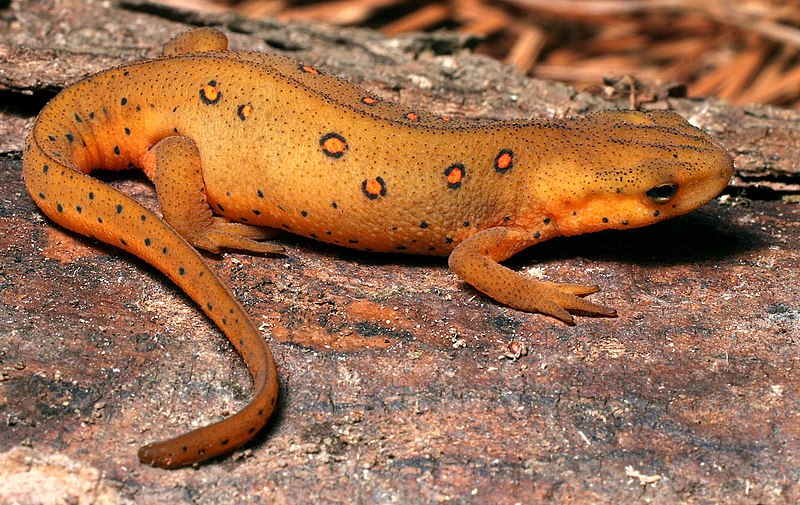
Newt larvae develop in water. Upon maturity, they pass through a land dwelling phase (see photo of Eastern Newt above) and then re-enter the water, where they remain for the balance of their lives. However, certain populations depart from the typical lifestyle; Eastern Newts on Long Island, NY, for example, skip the land stage.
Newts offered in the pet trade are usually in their adult, semi-aquatic stage.
Behavior
 Amphibians are not known for being especially active, but newts are always nosing about for food, exploring, and interacting with tank-mates. They see well and may swim to the aquarium’s side when you enter the room, in anticipation of a meal.
Handle newts only when necessary, and with wet hands so that the skin’s protective mucus covering is not removed.
Housing
Setting up the Habitat
Newts are well-adapted to life in the water, but do need a place to haul out and rest. The water in their aquarium can be deep, provided that egress is simple…cork bark, turtle platforms, and floating live or plastic plants all serve well as resting spots.
Newts are perfectly suited to aquariums stocked with live plants, and spectacular displays can be easily arranged (please see video below). Plants help maintain water quality, and the complex environments they create make life more interesting for both newt and newt-owner.
As newts readily climb glass, a secure screen cover is a must.
Substrate
 Smooth, rounded gravel of a size that cannot be swallowed is ideal; rough stones will injure the delicate skin. Bare-bottomed tanks are easily kept clean.
Water Quality
Newts have porous skins that allow for the absorption of harmful chemicals. Careful attention to water quality is essential.
An aquarium pH test kit should always be on hand. Most newts fare well at a pH of 6.5 to 7.5, with 7.0 being ideal.
Ammonia, excreted as a waste product and produced via organic decomposition, is colorless, odorless and extremely lethal to newts; a test kit should be used to monitor its levels.
Chlorine and chloramine must be removed from water used for any amphibian. Liquid preparations are available at pet stores.
Copper may be leached by old water pipes; a test kit should be used if you suspect its presence.
Filtration
Undergravel, sponge, corner, hanging and submersible filters can all be used in newt aquariums. Even with filtration, regular partial water changes are essential in keeping ammonia levels in check.
As newts are not strong swimmers, water outflow from the filter should be mild; plants, rocks and movable outflow attachments can be used to reduce current strength.
Light and Heat
Newts seem not to require UVB light. UVA light is not essential, but may encourage natural behaviors.
Most newts thrive at normal household temperatures, but fare best when kept cool (60-68 F). Temperatures above 75 F may weaken the immune systems of some. Please write in for information on individual species. A winter cooling period of 40-50 F encourages reproduction.
Companions
Although often sold as “additions” to tropical fish aquariums, newts do poorly in warm water and feed too slowly to compete with most fishes. Guppies adjust well to cool water, and their fry will be eagerly consumed by newts; limit the number of adults so as to avoid competition for food. Weather Loaches and Corydoras Catfishes will co-exist, and usually do not interfere with feeding.
Feeding
 I rely upon Reptomin Food Sticks as a mainstay for the newts in my collection, and for those under my care in zoos. Freeze-dried shrimp (included in Reptomin Select-a-Food) “gelled insects”, canned snails and frozen fish foods (i.e. mosquito larvae) should be offered regularly.
Live food, while not essential, is relished and will help ensure a balanced diet. Blackworms, bloodworms, earthworms, guppies, and small crickets will be eagerly accepted. Stocking the aquarium with live blackworms will keep your pets active and occupied.
Newt larvae and terrestrial sub-adults will usually accept only live food. Please write in for further information.
Health Considerations
Newt skin glands produce toxins such as Tarichatoxin, which can be fatal if ingested (so don’t eat your pet!). Do not handle newts when you have an open cut, and always wash well afterwards. Toxins transferred to the eyes via fingers have caused temporary blindness.
Further Reading
Please check out Newts and Salamanders, a book I’ve written on care and conservation.
Video: constructing an attractive, planted aqua-terrarium for newts
Video: male Banded Newts in breeding condition
Conserving the Great Crested Newt
Newt Toxins: personal observations
Eastern Newt image referenced from wikipedia and originally posted by Patrick Coin
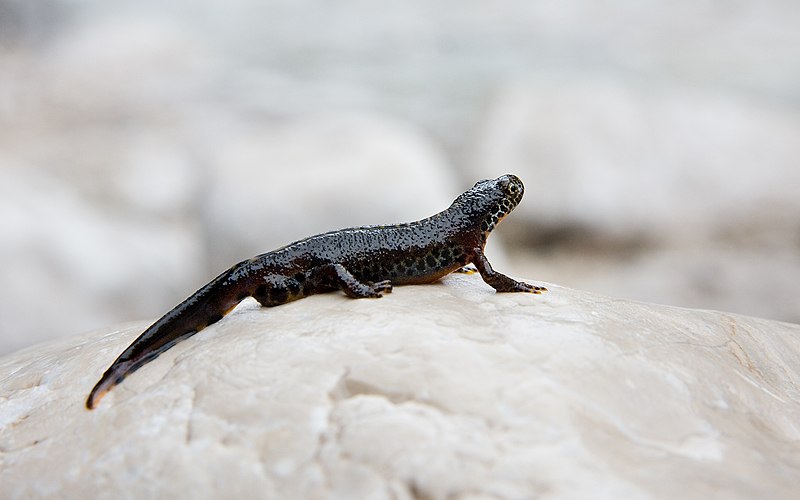
Alpine Newt image referenced from wikipedia and originally posted by Richard Bartz
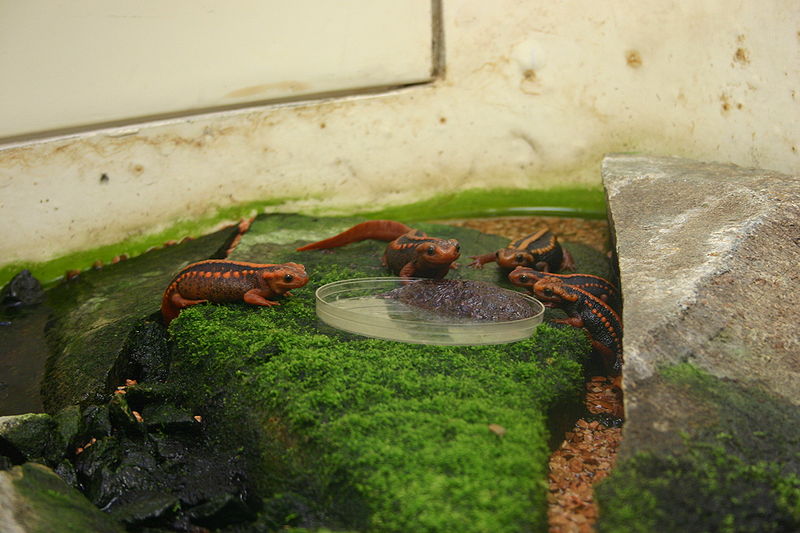
Emperor Newts feeding image referenced from wikipedia and originally posted by Ryan Somma



Newts used to be very popular here in the uk when I was a kid. However I fear that the large amounts of children that went out collecting Newts added to the decimation of their numbers. I have personally not seen any Newts for many years…. or common frogs for that matter.
I would suggest that people buy captive bred newts and frogs and not be tempted to collect their own.
Hello Joey
Thanks for your interest. Yes, Amphibian populations are in severe decline world wide and should not be collected other than in association with properly documented rescue efforts. Many species are protected by law here in the USA and in the UK. There are a number of very well-organized conservation efforts, some utilizing volunteers, in the UK at present – road-crossing tunnels for toads, road closures, wetland rehabilitation and so on.
Re snakes, this article on possible global declines might be of interest. I have posted 100 or so snake care, conservation and research-update articles here. Please let me know if any might be of use to your readers,
Good luck, enjoy and please keep me posted.
Best regards, Frank Indiviglio.
Hi Frank, John from caudata.org here. Great article as ever. As a long time fan of your newts and salamanders book I’m glad you are still flying the flag for these wonderful animals. I’m glad everyone is supporting captive bred. There should be little or no place for commercial collection of wild amphibians. That’s a mantra we stand by at caudata.org.
Hello John,
Nice to hear from you and thanks very much for the kind words. Interacting with caudata.org members these past years has been most interesting and rewarding, and I look forward to much more. Thank you for the fine work, please keep at it.
Best regards, Frank Indiviglio.
I just came across your blog. What a wonderful source of helpful information! Would you be willing to help out a new newt owner? My 8-yr-old son is crazy about newts, so we just set up a tank in our house.
Here is our set-up. We have four adult Eastern red-spotted newts in a filtered ten-gallon tank with gravel, fake plants, and a large piece of rock that leaves a strip about 2 inches by 6 inches out of the water for them to climb out on. The person at the vivarium said we should keep the tank temp between 70 and 75 degrees, so I have it set at 72. He also sold us tiny tadpole pellets, but they don’t seem to to notice those. They did, however, thoroughly enjoy a nubbin of frozen bloodworms that I put in for them yesterday!
Here are my questions:
1. The rock they sold us is very rough-surfaced. Should I find them something else?
2. Also, do they need more surface than what they’ve got right now? On one site, I read that half the tank should be water and the other half land, but I’m worried about reducing their water so drastically when we have four newts in one tank.
3. Should I reduce the tank temp? Your blog said 60-68 for most species, so I’m just double-checking to make sure that’s true for the kind we have.
4. With four in one tank, I’m concerned that they might reproduce. If one does become gravid, what should I do?
5. The vivarium guy said I shouldn’t feed them bloodworms more than once a week. Would it be okay to just give them Reptomin sticks on a daily basis? Do Eastern newts need anything else?
6. The vivarium guy said we should only do a partial water change every few weeks, but I’m concerned that newts are likely to leave a lot of uneaten food in the bottom of their tank. How often would you recommend cleaning out the tank?
If you can find the time to answer these questions, we would be most grateful! There doesn’t seem to be a lot of consensus out there about the best way to care for newts, so we’re very glad to have found you and appreciate your willingness to share what you know!
Best wishes and thanks,
Jenny
Hello Jenny,
Thanks for the kind words. Good choice; Red-Spotted Newts were among my first amphibian pets; as they are bold and out by day, your son will see much of interest, especially in a group situation.
Be sure to remove chlorine/chloramines from water (drops available at pet stores).
Cork bark (floating or wedged between glass) or a turtle platform is preferable to a rough rock. Tiny skin tears usually become infected.
They need only a resting area..size you mention is fine. They do not walk about or hunt on land in the adult aquatic stage. Floating aquatic plants, live or fake, are useful as additional resting spots.
Average room temperature fine; cool in winter is beneficial, they will remain active and feeding down into the 50’s. 72 F or a bit higher is also well-tolerated, but changing temps over the year suit them well, and may spur breeding. Let me know if you have very warm temps in summer.
Males in breeding condition develop swellings about the cloaca (vent, between rear legs) and the rear legs are thicker than those of females. You’ll see them clasping females with rear legs from above. Eggs will be deposited on plants. Adults will eat them, so they should be removed when seen…let me know if you see breeding behavior and we can go over egg care.
Reptomin and dried shrimp (included in Reptomin Select-a Food) is good as a base diet. Frozen bloodworms or other insect based foods can be used 1-2x weekly. Skip 2 days or so each week, or feed every other day. Watch for un-eaten food or bloated newts. Please see article above for other useful foods. Can drop the tadpole pellets…if very small will be lost among gravel.
A small, simple filter is the best way to go..see article for links to some useful ones. Even so, a 25% water change should also be done each week, or each 2 weeks at most. Ammonia is colorless but builds up very quickly, esp if they are being fed often and with large meals (as kids like to do!). Can sometimes do w/o filter if there are many live plants and with frequent water changes, but best to have a filter. Simple internal box filter is ideal, as water currents from larger ones disturb newts. Buy a “brine shrimp net” (fine mesh and sweep over gravel on occasion. Siphon based “gravel washers” are useful when doing water changes as they take debris right from gravel bed. With care, you won’t need to break tank down and clean.
See note in article re gravel size…newts may swallow small stones, esp when hunting live blackworms (a favorite); this can cause impactions.
You might enjoy this article on Eastern Spotted Newt Natural History as well.
Please let me know if you need any further information. Good luck, enjoy and please keep me posted.
Best regards, Frank Indiviglio.
Hi Frank,
Unfortunately, our newts aren’t doing very well. The most active of the bunch escaped the tank a second time when the tape loosened near the filter, and we didn’t find him in time. What a terrible death! I replaced my hanging filter with a submerged one and a full-screen top, and that seems to be doing a better job of keeping them in.
Once we put the turtle float in the tank, the fat newt spent all his time at the bottom of the tank, but the other three (then two) spent all their time curled up on the float. I didn’t think too much of this since I know they’re nocturnal, but then I moved the float during a cleaning and got a good look at them. They’re in terrible shape! One is so skinny, you can see his ribs. I’ve tried everything I can think of to get him to eat, including buying live blackworms and dropping them on his nose. So far as I can tell, he’s avoiding food completely.
Is there anything to be done? Do I need to do anything to the water to encourage them to get back into it? (Their tank is 68 degrees, with an ammonia level of .5 to 1.0.) Also, I now realize that the “fat” newt is actually the only healthy newt of the bunch, and his appetite is fine. Should I segregate him from the others? They’ve been together a long time now, so he’s already had plenty of opportunity to contract whatever they’ve got if they were sick when we got them. (My sharp-eyed son says the pet store guy fished one from the water and three off a rock when we got them, so it’s possible we got unlucky there.)
Hope there is something we can do and thanks once again for all your help!
Jenny
Hi Jen,
The ammonia levels you mention can be fatal over time; best to do a 50-75% water change right away. Filters are useful, but weekly partial water changes are the best way to keep ammonia near 0. Levels that might be mentioned on the test kit, as examples, are written with fish in mind – amphibians absorb toxins over a greater body surface than do most, and so are usually more sensitive.
If the newts do not perk up, the only way to access what else is going on is via a visit to an experienced amphibian vet. The vet may do a cloacal swab (as they are not passing stool) or administer a general antibiotic; please let me know if you need help in locating an experienced vet.
Newts in the trade are often in poor shape; care in selecting both the source, and the animals themselves, is needed. We can go over some fine points in the future if you wish.
Please let me know if you need any further information. Good luck, enjoy and please keep me posted.
Best regards, Frank Indiviglio.
Hi Frank,
I was wondering if you could tell me if my Red Eft (named Cougar) is changing into his Eastern Newt stage. He has been off and on going into an olive green color (one time his feet and belly were very very very green! But the next day, he was orange again) and he sheds weekly, which turns him back orange. But, I am putting a before and after picture up of him on the below links. The before was from around when I got him 3 or 4 months ago, the after is a picture from today, June 17th.
[IMG]http://i50.tinypic.com/1zccsxi.jpg[/IMG] (After Picture)
[IMG]http://i46.tinypic.com/2hgzg1w.jpg[/IMG] (Before Picture)
[IMG]http://i46.tinypic.com/f3xqag.jpg[/IMG] (Another Before Picture)
Thanks! If you can’t see the pictures or click on the links for some reason, try these below.
http://i46.tinypic.com/f3xqag.jpg (Before Picture)
http://i46.tinypic.com/2hgzg1w.jpg (Before Picture)
http://i50.tinypic.com/1zccsxi.jpg (After Picture)
Hi Karah,
In the after picture he appears to be a typical eft. Captive conditions can change the process a bit, which may explain what you are seeing. Keep water available – once he begins to transform, he will seek out water and spend most of the time there. Interesting…thanks and please keep me posted, Best, Frank
Frank,
Currently “Cougar” is housed in a mostly aquatic set up (as I thought he was changing) he has an island and bark he uses for his land…which is where he spends most of his time. Should I change it back to terrestrial using his water bowl, big enough for him to bath in? Or, should I keep it the same. Also, what are the signs that he is changing when the time should come?
Thanks.
I’d change back to terrestrial, as he’s done well there; living in a more exposed situation will likely be stressful. Movement to water usually precedes any change in appearance, so you may see him spending more time there. Color may lighten in tone, become yellow-green or rust; this is not necessarily associated with shedding; the tail will broaden laterally as well. These changes are stimulated hormonally, but the timing and sequence may be affected by captive conditions. Any notes you might take on the process would be very useful, as few people keep them from eft to aquatic stage.
Best, Frank
A few new questions, Frank. Eft is doing well, just got back from vacation actually and he lasted a week on his own. But, I was going to buy him a companion because they are social creatures. #1, is it okay to house him with an eastern newt adult form? I can divide the tank into about 3/5 water, 2/5 land, because my eft does like to swim around a bit, and the adult will be mostly aquatic. If this isn’t okay, question #2 is where can i get a CHEAP red eft? I called the pet store where I would be special ordering it, and they don’t get the efts because they are poisonous when eaten, they only do the adult form of the newt. Thanks for your help!
Hi Karah,
Thanks for the update. The main problem with leaving them is heat and dryness, which may be hard to counteract during a heat wave if one is away. Otherwise, food can usually be skipped.
They aren’t really social in terms of needing company; they do have complex mating and territorial behaviors, but live solitary lives and are fine when kept alone.
It’s difficult to house both together…efts drown easily in the amount of water needed by newts, and unless the terrarium is very large neither winds up with an ideal amount of space.
Efts are only rarely sold, usually by dealers advertising on Kingsnake.com who happen to come upon some while out collecting other creatures. The adult aquatic form is also highly toxic – many people do not realize this, as they associate bright colors with toxins (not a foolproof rule – marine and other toads are extremely toxic). I have seen an adult marine toad die within seconds of consuming an eastern spotted newt, and know of the same happening to a painted turtle.
Certain other small terrestrial salamanders, such as red-backs and, perhaos, duskys, 2lined, and 4 toed, sometimes co-exist with efts, if given plenty of room.
Best, Frank
so, in terms of catching one more eft, because i would like to have 2 newts in my tank, where would it be easiest to find one? it is summer, and the temperatures here average around 90 degrees. it does rain, and sometimes we have really bad storms, and then it drops to the 60s or so. (Fahrenheit.) I do not believe red-backs, perhaos, duskys, 2lined, or 4toed are common here in Pennsylvania.
Hi Karah,
All are very hard to find in the summer, except during/after rains as you mention; but they may remain inactive/aestivate even then. Please remember to check into the legality of collecting…may be prohibited; permits sometimes available through state wildlife agency.
Best, Frank
Yesterday at the swamp I found several newts that look a lot like the red eft but the coloring is wrong. With them we found several (10 or more) baby spotted salamanders. The newt was a blackish brown on top with a yellow white belly. He had the red orange spots of the red eft however, and dry bumpy skin of the newt. Is this a different kind of red eft because it has been living in mud under rotting leaves and picked up a different coloration? We found him in the mud under a wooden board . Or is he a different newt all together, just a relative of the red eft? Thanks
Hi Karah,
Please let me know what state you were in, and what region of the state – north/south etc.
Thanks, best, Frank
Central Pennsylvania is where he was found.
Hi Frank,
while waiting for your response I had done a little research of my own. I had remembered reading somewhere that the red-spotted newt and red eft are often confused for one another. I have found the red-spotted newt and am housing them with my red eft. Here are my questions.
1. The red-spotted newts are about the same size as my red eft, are they okay to be housed together (i do believe i read that they are related to each other)
2. Do the red-spotted newts require different care? More water? (I can make about 1/4 of the tank water, 3/4 of the tank land from a 10gal.)
3. Any tips?
Anything you have to suggest will be great!
Hi Karah,
Efts are the temporary, land-dwelling phase of the Red – Spotted Newt; please see this article for more on their interesting natural history.
They need very different care; the information in this article covers the basics. In a small terrarium, it’s very difficult to meet the needs of efts and newts together; usually neither winds up with the proper environment. It is possible in a well-designed 20-30 gallon aquarium, but in general they are best housed separately.
Please let me know if you need any further info, and please keep me posted, best, Frank
Frank,
I’ve noticed my smaller of the red-spotted newts, named Nova now, was laying with Cougar, Cougar’s head over Nova’s neck. I took this as a sign they were getting along smoothly. The other newt, Champ, is burried under the moss away from them and doesn’t seem too social. Occasionally I am seeing the eft or the two newts swim in my water dish (it looks sort of like a carved out rock and is rather deep for a dish and does allow for swimming movement) but they seem to spend much more time on land. This is a picture of the newt I caught, in case you were thinking it was a different kind.
http://www.google.com/imgres?um=1&hl=en&client=ubuntu&sa=N&channel=fs&biw=1024&bih=649&tbm=isch&tbnid=bs-Xz0i6esXKfM:&imgrefurl=http://www.giffbeaton.com/salamanders.htm&docid=T7f7w9C-RUIgiM&imgurl=http://www.giffbeaton.com/Salamanders/Red-spotted%252520Newt_2006-09-07-0051.jpg&w=576&h=306&ei=AJIBUMqyG4mK7AH3-OyKBw&zoom=1&iact=hc&vpx=85&vpy=293&dur=792&hovh=163&hovw=308&tx=149&ty=72&sig=117863543211287874467&page=2&tbnh=105&tbnw=198&start=15&ndsp=16&ved=1t:429,r:4,s:15,i:153
So if that is still what you were thinking of, should I provide more and deeper water? Maybe get a divider for the tank? When the tank was semi-aquatic, Cougar did swim some, and still ate healthily. So if necessary, I can change to maybe 1/2 and 1/2 or something. or 1/4 and 3/4. (the 3/4 being water, 1/4 being land)
Hi karah,
Yes, it is an eastern red-spotted newt. They are not social animals, so no need to worry about that aspect. They may get along, but in small terrariums skin problems often develop if they spend too much time in close contact – i.e. under the same shelter, etc. Seems related to skin abrasion, transfer of fungi, etc. In fact, we used the term “newt disease” in the old days, for animals that had been held in crowded pet store displays.
Filtration is important, as described in the article; ammonia builds up quickly. Also, water bowls rarely give enough swimming room. There are some very small filters available, but I don;t think all would work out well in a 10 gallon. A 5 gallon aquarium would be ok for a single, or perhaps 2 newts..half filled with water as mentioned in the article.
Best, Frank
Frank,
So since I have a 10gal (and already have a small filter for it that works wonderfully. Its actually a ground filter and it can cover either the full 10 gallons or just 5 gallons. pretty amazing) should I just make 5 gallons of it water, filled about halfway up to the top of the tank, and half of it land? How should I divide it? Using a glass divider? I don’t want the water getting into the other side and flooding it or making it too muddy. Thanks.
Hi karah,
Sorry if I wasn’t clear…it’s very difficult to do in a 10 gallon…water leaches into the soil and muddies the tank, moss etc. gets into the water and clogs the filter, raises the water’s pH etc, efts often drown, newts scratch themselves up on soil, rocks. You can use silicone to seal a glass divider into a tank, or install plastic containers within as land areas, but I do not recommend it, especially in such a small aquarium. best, Frank
Frank,
I am keeping two female adult red spotted newts in a filtered 10 gallon aquarium. I have a turtle dock as well as a pothos plant in gravel in a terra cotta pot to provide a haul out area. The tank has 8 gallons of water, which is planted, but I suspect maybe not enough, because the newts spend all of their time on the dock or in the plant. The temperature is kept between 70 and 72 degrees. I have been doing frequent water changes as I cannot seem to get the pH of the tank below 7.6. It has been as high as 8.3. I cannot figure out where this pH is coming from as I have tried filling the tank with distilled water and/or dechlorinated tap water unless it is from the gravel (polished river rock for use in ponds so that it is too large for them to swallow). They stay moist but I worry their skin will change to a more kerotinized terrestrial form over time. I am buying a nitrate test kit this weekend and a ton more plants. How do I get my girls back in the water?
Hi Chrystal
Sorry for the delay, glitch in system delayed me a bit. An elevated pH will keep them out of the water and can cause skin lesions and other problems. Do not use distilled water, as it will leach minerals and salts from the animals (through the skin). River rock and gravel sold for use with aquariums is rarely a problem, but you can experiment by putting some in a container for a time and testing pH.
Your local store should have products to lower pH (“PH Down”); or I can send you a link. Adding sphagnum moss or peat will also work, but it discolors water, can clog filter, and pH levels must be watched lest they drop too low. But best way is to use water that already in the right range. I’m assuming you tested the pH of water as it leaves the tap (well-water and certain other sources are usually of a high pH); perhaps try testing a few brands of bottled spring water?
Please let me know if you need more info, Best, Frank
Hello,
We purchased 2 Mexican Spotted Newts last year and now have about 2 dozen larvae that hatched from eggs. I have separated them from the baby-eating adults but would like suggestions on how to keep them healthy and grow into adults.
Do I need to put them in their own tank?
What do they eat, I don’t see any mouths!
Cathy
Hello Cathy,
Congrats…not common for folks to breed newts at home! It would be odd if the species you have is N. meridionalis, as they are considered d to be an endangered species (please see “related species” in this article ) but then again surprises do turn up. In any event, care is the same for most newt larvae.
They can be kept as described for Mexican Axolotls in the 2 articles linked below. They will not eat for a day or 2, after that finely chopped live blackworms (pet stores sell as fish food) are the best food. Live brine shrimp can be used if blackworms are not available, but they are not as nutritious. They may take dry food in time.
Best to move them to a bare-bottomed tank with mild filtration (see articles). Load the tank with plastic or live plants, to provide shelters/escape routes, as they are highly cannibalistic. Good luck, enjoy and pl let me know if you need further info. best, frank
http://blogs.thatpetplace.com/thatreptileblog/2009/02/13/breeding-mexican-axolotls-ambystoma-mexicanum/
http://blogs.thatpetplace.com/thatreptileblog/2009/01/26/captive-care-of-the-mexican-axolotl-ambystoma-mexicanum-part-2/
Hi, my backyard seems to encourage small slender newts to visit. We live in Northern California. We do not have a large water source for them live in. They look like earthworms. Do you know what they are called and what they perfer to eat, my son wants to keep it as a pet. I want to make a good habitat for it to be healthy and happy. I’m a snake and lizard kind of girl, never kept newts before always catch and released.
Hello,
You are likely seeing one of the Slender Salamanders (Batrachoseps spp.). You can see photos of 2 species here.. They do not make good captives…will feed only on tiny live invertebrates such as fruit flies, pinhead crickets, leaf litter invertebrates, etc….hard to provide dietary variety. Most are very sensitive to temperature…average room temps are usually too hot, stress the immune system’ etc. Please let me know if you need ideas for other species that are more suitable as pets, Best, Frank
Hey Frank, would you be able to email me directly at jm55068@gulls.salisbury.edu
I found and decided to keep 3 salamanders. ( 2 redbacks and one sledgeback ) in MD. I grabbed soil from the back yard and put it ontop of gravel. I’ve had them for about a month now on purely gravel and they have been doing fine. I was wondering if sudden influx of soil in which they were not found will be harmful due to PH. Is the wrong PH soil deadly? I do not believe the soil has any fertilizer or anything. Thanks!
Hi Jon,
Soil pH can affect them..you’d likely see escape behavior, wandering etc., but not always. I’ve not run into overly acidic or other problems, even when collecting in NYC, but there are no hard/fast rules.Letting the soil sit in some water for a time and then using a simple aquarium pH test kit or test strips may be useful, but I’m not sure how close the correlation will be.
I prefer to answer here so that others benefit, and this also helps me with time management, etc., but if there’s something you’d rather not post here you can send to findiviglio@thatpetplace.com.
best, Frank
First off I’d like to say I’ve learned more newts from you Frank, than I have in all the research I’ve done. So I was excited to write to you in hopes of advice for a juvenile red EFT I currently am housing alone in a 10 gallon tank. I was rescuing Samus, from a friend a threw together a semi aquatic tank with a slanted small gravel bottom, small side filter in about 6 inches of water, with about a 1/3 of the tank being the high ground gravel covered with moss and a bit of soil with live plants and a mountain prop to hide in. The tank is at about 70% humidity, I mist the tank twice daily and the room is from 70-75… I’ve been feeding samus flightless fruit flies, and their larva about 20 per every day or two.
I was wondering if I should restructure the tank to a total terrestrial tank or not because the EFT is not acting like I read they should be. Samus usually hides under the moss, or in a corner for the entire day in one place and only peps up for fruit flies going near by. What I’ve read sounds like he should be moving around a bit more…seems like he’s depressed if that makes sense? I believe I am doing everything right but am sure I can improve his health somehow, I definitely don’t want to lose him. I was thinking over two ideas…one being converting to an entirely terrestrial set up and getting another EFT or two for tank mates…. or increasing the depth of the water and getting some small fish mates while restructuring the land part with fresh substrate and moss?
Any thoughts would be awesome…I just hope I can provide a better life for Samus soon!
Hi Justin
Thanks very much for the kind words.
Best to lower the water…they only need a very shallow pool to soak in; as long as moss stays moist, a small water bowl (de-chlorinated water ) will suffice. They drown easily. They are not social so no need for companions.
Mention is always made of them wandering around, but actually they spend most of their time hiding below moss. They are only active when hunting, migrating from ponds etc..usually in rainy or damp weather, watch temperatures…over 75F can be stressful; cooler is better.
Fruit flies are a useful food, but should not be used as entire diet. try adding pinhead or 19 day old crickets, flour beetle larvae (cultures can be purchased online) and wild caught leaf litter inverts etc. The foods mentioned in this article on Poison Frogs are all suitable. Also, tiny earthworms or pieces of earthworm (see here re breeding, if needed); blackworms, sold as food for tropical fishes in many stores, are excellent; place in a jar lid or they will get lost in moss.
Pl elt me know if you need more info, best, Frank
frank hi my name is jessie,i hade a question about my california newt. i went to the river and caught a newt and made him my pet i have had him for 4month hes doing fine but when i caught him he hade a orangy belly and a bergandy back,his back isent that bergandy any more its black and his belly is also darker is there anything i can do to make him lighter againg please get back at me thank you…
Hi Jessie,
Californai newts undergo natural color changes before and after the breeding season; different populations vary quite a bit as to what changes occur, and when. Here is some further information on it’s natural
history, and that of 3 related species (click on name for detailed information),.
Be sure to wash your hands after handling (best not to handle unless necessary) as their skin toxins are very powerful, and should not be allowed to enter cuts, eyes or mouth. Please let me know if you need further information, Frank
Hi Frank,
I’m very glad to have found your website! Hope you can help… here’s the whole story… I moved into a house ( Nottingham, UK) in May that came with a small ( 5ft long x 2 ft wide x ~ 2 ft deep) garden pond. The pond was inhabited by a few newts ( both smooth and palmate as far as I could tell) and a bunch of frog spawn. The frog eggs all hatched and I had ~ 200 tadpoles for a while. The newts laid eggs all throughout June and July; I ‘harvested’ the eggs and put them into a little hatchery tub so that the tadpoles/ baby frogs wouldn’t eat them. I fed the newt larvae on baby brine shrimp and daphnia, and after they got to a decent size (1/2 inch) I put them back in the main pond ( after the frogs had left). They spent July/ August quite happily in the pond, though growing very slowly. I was feeding them blood worms, brine shrimp and daphnia but they honestly weren’t very bright about finding food.
3 weeks ago I realised that there was no way the young newts were going to be ready for the winter, since they all still had gills. And the pond will freeze to an ice block in another few weeks. So I found a second hand 50 gal aquarium and carefully migrated them all into it over the space of a week. They’ve all done really well, I only lost 2 out of about 40. The aquarium/terrarium has a gravel bank at one end, a nice big dead log in the middle and water at the ‘deep’ end ( which is only about 6 inches deep). I’ve got a little filter going and the water pH and NH3 are all OK.
The aquatic ones who still have gills have been doing well on blood worms and daphnia.
My main concern now is the ones that have become terrestrial. A lot of them have reached that stage in the last week. They snuggle up together on the log, high and dry. They are getting thinner and are starving as far as I can tell. The log was the only totally dry spot in the setup. So today I’ve made a ‘beach’ out of sand at the dry end of the aquarium that is continuous with their favourite log. Now they can get off the log and still not have to swim. On the beach I’ve sunk a small dish that contains a bit of compost and the white worm culture that I’ve started. I threw in some blood worms as well. The contents of the dish would qualify as ‘mud’ and it is full of yummy wiggling things. The baby newts can easily get in and out of it.
Do you have any suggestions on
1 – how long the young terrestrials might go without eating?
2 – should I get any other kind of food to interest them?
3 – how to get them used to finding their food in the dish – or wherever else you think I should put it?
Many thanks in advance for any suggestions,
Ava
Hi Ava,
I applaud your efforts. Unfortunately, young newts are not as easily kept as the larvae; best kept in a “forest floor” type set-up; damp, with a water bowl and lots of cover (dead leaves, caves, etc) When they bunch up as you describe they become susceptible to skin fungus and related ailments (rubbing skin causes minor abrasions, etc). While they make take white worms from a jar lid, it’s usually easier to interest them in tiny insects that move about. here in US pinhead crickets and flightless fruit flies are most common diet..also aphids (collected) and springtails. But they may not feed at all once transformed, if kept indoors…possibly on an “internal clock” and are looking to hibernate. They hibernate on land..might be best to release them in a suitable site…lots of leaf litter, logs etc..likely one nearby, since they bred in your pond. maybe retain a few if you wish, I can send more info if need be, but they are not easy…need lots of vit/mineral supplements as well, if they do feed, as it’s hard to provide variety. If you do release, do as soon,. so that they can acclimate before temps drop further. Best, frank
Hi Frank,
Thanks for explaining. I hadn’t really quite figured out that they wanted to hibernate. Today and the rest of the week is Indian summer weather, so I’ve gathered them up in a bowlful of grass and taken them outside to the log pile. They are slowly finding their way onto the new logs. Should be good!
I’ve still got about 2 dozen with gills though. We will have to see how fast they mature.
Many thanks again,
Ava
Thanks for the feedback, Ava. Glad you decided to do that; they should be fine. In natural situations, some larvae overwinter in the water, without transforming..may be related to food supply, water levels etc., but there’s quite a bit of variation in most populations. If yours do not transform in time to be released, you might try keeping the tank in a cool part of the house, feeding lightly (cannibalism will increase if they are too hungry, though)…they may remain as larvae until spring. if they transform in mid winter, it’s possible to “hibernate” them in a refrigerator..some rick, but it usually works out if done properly. Enjoy and please keep me posted…I’m interested to see what the remaining larvae will do, best, Frank
Hello! You may remember me from earlier this season–I have a terrarium with two red-spotted newt efts we call Fred and Ethel. The larger one was out quite a bit and took to eating wax worms dusted with Retrocal, but for a long time I didn’t see the tiny one; I figured he’d died–but after about 1.5 months he showed up again, still tiny but brilliantly colored. Now I see him out a lot but don’t see the larger one–and I’m really worried I might’ve killed him when rearranging some stuff in the tank. That’s karma since in my heart I know I shouldn’t take these things from the wild, but I consoled myself by saying they’d be safer in my tank than outside AND because they are so plentiful in my yard and woods. Having said that, I’ll probably get another one if it is true that Fred is gone, though once I figured out that’s probably what happened I cried for quite a while–I don’t want to hurt these animals. Anyway, my question is this: When these guys shed, do they stay hidden, or do they have a fresh new coat they can go around in right away? I’m hoping maybe Fred is hiding out for that or some other reason and, in fact, isn’t dead. Thanks for all your help!
Hi Mary,
Efts usually eat the old skin and do not need to hide for a time as do crags, crayfish, etc..they are ready to go right away. They can burrow deeply and disappear; food needs are low, esp. as temps cool. It’s good to bear in mind also that wild caught ones may be suffering from a range of parasites, internal problems that do not manifest quickly; we do not know too much about their longecvity in the wild, and not much has been done with them in captivity.
Best not to use waxworms as a steady diet; thick exoskeleton and high fat content is probably not ideal long-term.. Small earthworms are good as a staple, but try to add as much variety as possible.. wild-caught leaf litter invertebrates, as you mentioned in your other post, are one of the best foods. The suggestions in this article are largely applicable to efts; please let me know if you need more info and pl keep me posted…hope the other turns up, best, Frank
PS You may remember that the tank is set up with gravel at the bottom and then several inches of soil from my yard where the efts were captured–their natural environment–thus I’m sure we didn’t see Ethel for so long because there was plenty there for her to eat. But Fred really liked those wax worms–he was waiting for me the day after I gave him the first one with one of his feet on the side of the feeding bowl. The disappearance of Fred occurred while I was changing out some old moss with some new fresh stuff and had to move a couple of things around–I was careful but I THINK I saw some decomposed eft skin when I was searching for Fred exteriorly (through the glass) –it was under a rock where I was working but down 1/2 inch or so–could he have burrowed down in the moist soil? I had just seen him in the moss when I was working with those rocks, but the wet soil and the rocks I put there WERE close to that moss–I never dreamed he might have burrowed under there–It’s a gruesome topic but I keep hoping I didn’t squoosh the poor thing. Thanks–
Hello Frank,
Could I please ask your advice again? It is about 2 weeks since I last contacted you. I put most of the young terrestrial newts outside into a log/leaf pile 2 weeks ago, and I have not tried to investigate them. They are tucked into a log pile with a 12-inch deep blanket of dried leaves on top and around them.
But I still have about 6 ‘terrestrial’ newts who are living up on the sandy end of my aqua/terrarium, and another 6-8 ‘aquatic’ newts still with gills who are water-bound.
I did find two of them dead in the water yesterday – I could not tell grossly whether or not they still had gills. :-((
The average daytime temperature now is about 12 C, with the nights dropping down to 6 or 8 C. It is very rainy. Though we are still having occasional warm days, like today, where it was 18C ~ 65F.
So I was wondering..
(1) For the ones who are terrestrial and outdoors already…
(b) is there any benefit to dropping food into the log pile?n Wingless fruit flies and micro-crickets are both available
(2( for the ones who are terrestrial and still living on the beach in my aquarium….
(a) at what environmental temperature is it pointless to release young newts into the wild? I would happily turf out this half dozen if I thought they would do better than in captivity. But if they need pre-conditioning, see next…
(b) if I am to turn them out, should I try to feed them or condition them before I do? If yes, with what? As far as I can tell, none of them have eaten for at least 2 weeks.
(3) for the ones who are still aquatic with gills – there are about 6-8 of them still left…. honestly, I would love to try to grow them up till next spring, as I am fascinated by their whole biology. But just tell me if I am being stupid – I am actually a veterinarian, and can cope with complicated animal husbandry, but if it’s pointless, then it’s pointless.
(a) I am feeding them on blood worms mostly, which I can see them eating. I also offer them Daphnia, but I’m not sure how much they actually find and eat
(b) The water quality is good, and I have a good filter. I turn it off for several hours each day while the Daphnia are on offer. Presumably most Daphnia will get sucked up into the filter after a a couple of hours.
The whole tank set-up is in my sunporch, which is not heated. So the water temperature is about 55- 60 degrees F. I can easily set up a terrarium in the same room, which as you suggested previously, could be organised with potting soil and leaf litter.
Thanks for listening, and I look forward to any advice you can give.
Hi Ava,
Thanks for the feedback.
No need to check/feed those outdoors.
At temps mentioned, you can release others…always a gamble (even under natural circumstances, many do not survive hibernation) but also difficult to rear indoors at that size. Bloodworms in a jar lid, buried in substrate, may be taken, but not always. Probably best not to feed..if temps drop sharply before food is digested, food decomposes in gut, animals generally die. In wild some morph and hibernate right away, others do build up fat reserves first, but this varies by population, perhaps by weather as well. Most herps have an amazing ability to “tune ” their metabolism in accordance with food sources, availability. Gharials that I kept at the Bx Zoo refused food for 3 months each year, in tune with winter in N. India, but were kept at normal exhibit temps (hot) and remained active…they did not lose any weight; black rat snakes add size during 3-4 month long (lab induced ) fasts…many example. So, safest to release w/o feeding.
Aquatic larval development also somewhat flexible/…some species will remain as larvae far past normal morphing time if conditions – water quality, food, crowding – are good. Allows them to transform at larger size, etc. When temporary breeding ponds start to dry up, some tiger salamander larvae, Ambystoma tigrinum, quickly develop wider jaws and sharper teeth.,,…they can then consume other larvae as opposed to small inverts, and will transform faster…and they preferentially take unrelated larvae!!! So yours may stay in aquatic phase for some time. If not, can try bloodworms, fruit flies..may be able to order springtails, pinhead crickets, flour beetle larvae on line. Check this article for more ideas re small food items. Can also chill down in frig if all else fails.
Variety is ideal, but they may not be getting much nutrition from daphnia…you can offer, but beware of shutting filter down; after a time (varies, can be 15 min to 1 hr or so) the beneficial aerobic bacteria start to die off and biological filtration (ammonia to nitrites to nitrates) is impeded. This is filters most imp function. Be sure to do partial water changes as well, as ammonia poisoning is most impt water quality concern. Corner filters and sponge filters less likely to grab food, but sponge filters do not hold carbon, must be rinsed often. Blood worms, blackworms (tropical fish stores may have) are ideal; newly hatched brine shrimp ok; some larvae take dry food, i.e. softened Reptomin, but beware of fouling water if you try.
Please keep me posted, best, frank
Hi Frank,
Hope you are keeping well. Please could I ask you for some more advice re my baby newts?
i took your previous advice , and created a small terrarium for the baby news that had morphed to the terrestrial stage. Their terrarium is 1 ft x 2 ft x 6″ deep, and is composed of (fresh, store-bought) potting soil as well as some local fallen leaves and twigs. Also I have placed a terracotta plant saucer in one corner, which is the water bowl. The water is only about 4 mm deep and I change it every 2-3 days.
Now, in the terrarium, I have a dozen baby newts, all of terrestrial morphology. I am trying to figure out how often and what to feed them. Their environmental temperature varies between 15-18 C.
My question is – what and how much to feed them? Am i feeding for growth, or for hibernation maintenance? And what should I do about vitamins/ minerals?
– I had the opportunity to look at them all very carefully last night. About 1/2 of them looked reasonably hydrated and in moderate body condition. They were able to move away when they wanted to.
The other 1/2 of them looked thin or dehydrated. And they worried me with respect to their metabolic/ calcium levels and bone strength.
I can acquire a steady supply of wingless fruit flies and springtails – these are shipped in from a UK supplier. I’ve just started dusting the fruit flies in calcium powder before putting them into the terrarium. And they do seem to vanish, so I think my sleepy baby newts are catching a bite sometime? Not quite sure how to handle the springtails – all advice appreciated.
Thanks once again,
Ava
Hi Ava,
Thanks for the update. Those temps are within their normal range, so unless an “internal clock” intervenes, they will remain normally active; feeding hard to judge when you have a group..best to have some available on most days if possible. Pinhead crickets would be useful to add if available; best to powder all meals with Ca; use a vitamin/mineral supplement on alternate days as well. You might try putting springtails into a jar lid sunk into soil. If you can build up large numbers, seeding the tank with them is worthwhile..add a bit of fish food flakes and dead leaves as food. This is a tough time for them, even in wild…losses common in captivity. They can dehydrate quickly….cover soil with dead leaves, and keep them damp;..makes it harder to check on them, but they will shelter below and should do better. Check what breeder has been feeding springtails, and re temps/…they reproduce rapidly, but details vary as to species. please let me know if you need anything, best, Frank
hi frank i cought a newt from my back garden i currently have it in a jam jar (emptied an cleaned) with bits of grass an two biggish leaves i have had it for a few days now an have places a live thin earth worm in the jar with the newt but as of yet the newt hasnt eaten it what would u suggest?
Hi Lisa,
The various species have different needs, please send a photo to findiviglio@thatpetplace.com. I’ll be away from the computer for several hrs but will get back to you later today, best, Frank
I found a red spotted newt while doing yard work. I kept it and made a habitat. I have many questions can u get back to me before I start writing them. Its a beautiful creature and I want to make sure he survives.
Hi Patrick,
Please post any questions you may have, best, Frank
What kind of habitat would the red spotted newt I found ( he looks exactly like the picture on the top ) be the most comfortable I have him in a terrarium w saphgium moss two water dishes a feeding dish and artificial plants. Should I add a soil layer? Does it need filtered water? Also I have fed him freeze dried blood worms by tweezers but haven’t seen him eat anything else…what can I do to make him eat? I tried earthworms but it didn’t eat them. Also I was keeping the habitat moist w a spray bottle filled w distilled water but mold developed. Can u give me some advice please
Hello Patrick,
The animal pictured is the land phase (known as an eft) of the red spotted or eastern newt, Notopthalmus viridescens . After 1-3 years on land, they move into nearby ponds and change color/tail shape etc. Eft can be a bit troublesome to keep, as they take live food only, 10 day old crickets are sold in pet stores that stock reptiles, these can be used for part of the diet. Springtails can be collected or purchased, as can fruitflies. Aphids and tiny invertebrates found among damp leaf litter as well. hey are also sensitive to heat..average room temps may be too warm in summer, cool basements preferable. Do not use ditilled water, as it will leach salts/minerals from the body. Bottled spring water or tap water is fine as well if you use the instant de-chlorinating drops sold for tropical fish, or allow it to stand in an open container for 24 hrs. Mold forms readily in damp terrariums and is not usually a concern, remove as you see it. The aquatic phase would be a better choice for a first time owner….they take dry food, and adapt to higher temps. best, Frank
Frank,
Thank you for taking the time to help us.
My son brought home two eft’s from camp, so now I am trying to keep them alive. They are in a plastic tupperware container with holes until a tank arrives from Amazon. We have a mix of water (about 1/2″), tree bark, grass and plants from the back yard, and completely change the water every 2-3 days. We also let them walk around the backyard almost daily for about 30 minutes. We handle them with rubber gloves for their safety (and ours). I try to feed them worms and bugs from the back yard, but they do not seem interested and are getting thinner. Should I buy Reptomin food sticks or something else? Any advice is greatly appreciated.
All the best,
Adam
Hi Adam,
Efts are quite difficult to keep; they will not take Reptomin or other non-living foods, and need tiny insects..some pet stores sell 10 day old crickets, which is the correct size, and you can collect springtails below leaf litter or order them, and flightless fruit flies, online. Blackworms, sold live for tropical fish, may be taken from a small jar lid. All water used should be dechlorinated (drops from pet store, sold for fish) But the efts are delicate, sensitive to warm temps (best kept at 70 F or below). They should not be handled or put out for exercise..removes slime coat and is stressful in general.,. Best to release if possible or turn over to a nature center. I can send along suggestions for more appropriate species if you wish, best, Frank
Hi I had a question i am getting one red spotted eastern newt and I was wondering if the terrarium can be half water half land? And also I have a wild salamander that’s all black with yellow spots and I was wondering if they can go in the same terrarium? And can eft and red spotted newt be in the same terrarium? And can they eat small grasshopper and worms cuz that’s what I feed my salamander. And how deep would you recommend the water should be?
Hello Robert,
Eastern newts are mainly aquatic, need just a floating bit of cork bark or platform on which to rest. Best to keep in an aquarium type set up with a filter…usually hard to keep water clean in terrarium settings.
Spotter Salamanders (Ambystoma maculatum) live entirely on land and need only a shallow water bowl. Would not be able to mix with a newt; spotted would likely try to consume newt as well. Also difficult to keep efts with newts, due to different lifestyles. Efts need tiny live foods..springtails, 10 day old crickets etc and do not usually do well in captivity. Pl let me now if you need more info, Best, Frank
Frank,
I purchased some Reptomin and put a few sticks in their container. It seems to dissolve in water. Do they eat it dry or wet? They don’t seem the least bit interested in eating it. Do I leave the Reptomin in the water and eventually they will eat?
Thanks,
Adam
Hi Adam,
They will not take dry foods..lease see response to your earlier note for some ideas, best, Frank
How should I feed the adult red spotted newt and what kind of food? And how deep should the water be?
Hello Robert,
they will take all the foods mentioned in this article. Please also see here for a bit more detail. As long as the animal can easily-exit the water, depth is not all that impt; 2-3 inches or 8-10 works equally well. larger volumes are often easier to filter and keep clean, Best, Frank
What newt or salamander needs half land and half water could you tell me some?
Hello Robert,
The most commonly kept newts spend nearly all of their time in water, and do not need a large land area (eastern, California, ribbed, etc; the most commonly kept salamanders – tiger, spotted, fire, etc. live entirely on land; they need only a shallow bowl, and do not enter deeper water except to breed. Of all, the Emperor or Mandarin Newt splits it’s time between water/land a bit more than others, but it also doesn’t do well in deep water. best, Frank
Hi I have a friend that has two eastern red spotted newt and has a ten gallon tank and has the tank setup half land and half water and they look like there doing okay and I’ve seen wild ones that are on land and no where near water but I was reading other questions and your answer and what I’m under standing is that they should be in water with rocks sticking out so they could get out and rest and that it’s bad to have them on land and bad to have the tank setup half land half water I’m i right or they can have a tank setup half land half water
Hello Bobby,
In the newt stage (aquatic, adult phase) they do not need lots of land, so it’s preferable to set up as mainly aquatic tank…provides more room for swimming, foraging, etc. smooth rocks fine; but floating cork bark or commercial turtle ramps take up less water volume than rocks. Best, Frank
Oh and can they stay efts for there whole life?
Hello,
Captive conditions can affect timing a bit, but in general they remain in the eft stage from 1-3 years; length varies in different regions; in some places, i.e. Long Island, NY, the eft stage is skipped. Best, Frank
Thanks frank that helped a lot and I was wondering how would you feed the adults in water or on land can you tell me how to do both thanks.
My pleasure, Bobby. The adults will only feed in water..they will take dry foods, i.e. Reptomin, as well as live blackworms, etc.; but only in water. best, Frank
Could they eat blood worms or guppies? And could they eat earthworms in water? And thank you for answering my questions.
Hi,
They will eat live r frozen bloodworms, and small or chopped earthworms. They are not good at catching guppies, but will take pre-killed ones or babies that are born in the tank
I have recently purchased two fire belly newts not sure if Japanese or Chinese. They are in a 55 gallon tank with a 1/3 land/water ratio and I have purchased ocean nutrition frozen bloodworm cubes. I’m worried one has not been eating well in the pet store it is extremely skinny and neither will eat now. Do you have any tips on how to get them to eat?
Hello Russel,
Try live blackworms or bits of chopped earthworm first,,they usually take bloodworms, but may prefer live at first. Reptomin has a fishy odor and is often taken also. Water should be de-chlorinated and well filtered. Always a chance of internal parasites or other health problem..when in good health, they usually feed well. Amphib medecine is not well-established, but I can try to refer you to a vet if need be. Best, Frank
Hi I was wondering if the eastern water newt (adults) need a heater or is room temperature good enought?
Hello Robert,
No room temps fine; they do better on the cool side…60’s ideal but can take warmer. Pl let me know if you need anything, best, Frank
Can you tell me what kind of salamander name it’s all black with a yellow stipe on it’s back down to its tail
Hello Bobby,
Where did you see this salamander?..location will help narrow the possibilities. Best,m Frank
I caught it and I Live in Washington State and it’s all black with a yellow strip on it’s back down to the end of its tail.
Hello,
It may be a Long-Toed Salamander, Ambystoma macrodactylum; the eastern and western subspecies vary greatly in color and pattern, but sometimes look as you describe, best, Frank
Hello Frank,
Thank you for taking the time to answer every single persons questions here! You have become one of my new role-models. Unfortunately I live in NJ and cannot keep many reptiles/amphibians you detail. I’ve been working on a half aquatic, half terrestrial tank (siliconed plexiglass divider between water and soil) with a “forest floor” theme. This tank is 55 gallons (typical rectangle) and I’m left with very few amphibian choices (not interested in frogs). Could that size tank contain ~4 red spotted newt efts? And since half the tank would be aquatic (live plants mainly) should I create a barrier to prevent the efts from drowning until they’re in the final stage?
With your experience, would there be an animal better suited to a 55 gallon half aquatic tank? Turtles are also restricted but an option.
Hello Fossi,
Thanks for the kind words, much appreciated.
A permit would be required to keep efts in NJ as far as I know (see regs here,…they may be listed as red newts or similar). But they can be a bit difficult in any event…need a varied diet of tiny insects, and can be temperature sensitive. There are turtles you could keep, but planted tanks with earth etc are difficult…soil dragged into water by turtles, clogs filter etc, aquatic plants uprooted or eaten, etc. Fire salamanders ideal, but need easy access from water , most fare poorly at temps over 70 F, long term. Same holds true for most salamanders, other than the large aquatic species of the SE…amphiuma, sirens…they are very interesting, but need a fully-aquatic set-up. Fire bellied newts are captive bred, will breed, and can use land/water, altho they won’t wander much on land. Other similar news incl paddle tails, ribbed (these reach 1o-12″) California..all a bit more tolerant of warm temps. I haven’t checked regs re above species…pl let me know if you need more info, enjoy, Frank
Hi,
I just recently found an Eastern newt and it is still bright orange which I am pretty sure means it isn’t an adult yet. But my question is how do I take care of it, I really have no knowledge of these amphibians beyond what I got off Google and I am only going to have it for about a week before I give it to my girlfriend as a gift. I currently have it in a little white container like those you would get from a chinese restaurant. I bought meal worms for food but now when I look at the worms they look bigger than the newt’s head. I am not sure if this is the right food type or how to feed the thing also I wanted to know if you can give me a little tutorial on how to create a makeshift habitat with things found around the house. I don’t want to spend/don’t have too much money which is why I want to just make one at my house. And as I said before I only need to take care of it for about a week so if you could just give me care instructions for this specific type of newt it would be greatly appreciated. Thank you.
Hello Brandon,
Yes, that is the eft stage, which lasts 1-3 years before the animal takes up an aquatic existence. They are quite difficult to keep, protected in many states and not recommended for other than very advanced keepers. They need quite a bit of food…tiny (10-day-old) crickets, fruit flies, springtails; average room temps are too warm for them (in the wild they spend most of their time in cool retreats below ground) and they desiccate easily. Also cannot tolerate tap water unless de-chlorinated. it would be best to release the animal…they rarely live for long in captivity. I can suggest alternative species that are captive bred if you wish. Best, Frank
Hi,
I found the Red Eft up in the Catskills in New York and brought it all the way down to southern New York to give to my girlfriend as a gift. But as you told me they are difficult to maintain or live long in captivity I am not sure what to do because I don’t want to give her a gift that will just die in a few weeks or require all her days time to maintain but I also don’t have a lot of money to get the things that the eft would probably require to keep alive. Any and all advice would be greatly appreciated.
Hi, It would be best to call local nature centers, see if any will accept it. It is illegal to collect any native NY reptile or amphib, but nature centers will not look into that aspect of it, just explain situation. As you might gather, live animals make very poor gift ideas unless one is very interested and has done research re care beforehand. best, Frank
I live in trinity county northern ca on 40 acres laced with streams creeks springs trees and giant rocks (lookout type rocks) for the last several years I have been observing what I believe are newts they range from 1 inch long to 1 foot long I was wondering how long does it take them to achieve a size as great as a foot they do not seem frightened of me I don’t handle them just observe they appear to stay near one another but not right next to and seem to be creatures of habit one lives in a log just outside my back door and almost every night he sits with his head sticking out of a knot hole waiting for dinner I guess I can’t seem to post pictures here but I was wondering if you might identify them as to their proper name is there somewhere I may send some pics and thanks for all the information you have posted very informative
Hello Emily,
Northern CA is home to the Pacific Giant Salamander, world’s largest terrestrial species; this is the only species in that region that would approach 12″. Smaller animals are likely of another species, as Pacifics transform at a larger size. Photo ID can be difficult for smaller species, as many are similar and need to be closely examined, by you can email to findiviglio@thatpetplace.com, best, Frank
Hello Frank!
Wanted to thank you for the advice. I stewed for a couple months on what to actually obtain. Finally decided on adult Eastern spotted newts (NJ) with a mostly aquatic tank. The tank was up and running before I brought two of them. I didn’t divide the tank but added a floating platform and many hefty plants (Java fern and wisteria, some java moss that rotted and is very slowly coming back in patches). The tank is half filled with water (55 gallon tank- ~ approx 20 gallons water) and an in tank turtle filter with rocks propped up to slow the return water flow. Early on I was removing the newts from the larger tank to a 3 gallon tank with very little water to feed them (get them used to worms, reptomin). Every now and then they still snub the food when placed within the main tank.
Eventually added some glass shrimp and four danios. Just last night I believe one of the newts got peckish and offed one of the danios. No body. So I had a couple of questions. A new plant a friend gave me has snails (malaysian horn snails?) and from what I can find, it’s ok to have snails in newt tanks. I’m afraid they may choke on the shell although the newts are fairly big now (around six inches each). Would these “pest snails” be alright to put in there? The other question is about the floating land section of my tank, it’s very bare and any attempts at moist substrate simply end up in the water. At the moment it’s a section of empty plastic with a fake log for shelter. Is that enough?
Hi,
Glad to hear the info was useful and all is going well.
Snails are generally fine, newts tend not to eat them, or to take only tiny ones..remote chance of parasite transmission but I’ve never seen this at home or in zoo exhibits.
Bare land area is fine,….they may not use much in any event if there are floating plants. Enjoy, frank
Hello,
Thanks for all of the great information! I have four male red spotted newts in my science classroom and I was wondering if in the summer they could be released back into the pond I got them from. Will bringing adult newts into captivity make it impossible for them to be released, or should they be fine on their own? Also, if I was to find a female and breed them, would the offspring be able to be released into my pond? Thanks again.
~Katie
Hi Katie,
As long as they are healthy both adult and baby newts should have no problem being re-released. Just be sure that you release them in a suitable environment for them.
-Josh
Hi Frank
My name is Zach. I am very interested in raising a red eft, but I’m wondering if it would be safe for an eft to be housed in a 20 gallon tank that has a waters edge viquarium, where the tank would be half aquatic and half terrain. The last thing I would want would be for the eft to drown. I was considering having both in case I acquired a full grown newt and an eft. Would the eft stay on the terrain side of the tank as long as I provided hiding and another water bowl? The viquarium also has a waterfall/river apparatus in it. Thanks!
Also, what other amphibians would be safe to be kept in the same environment?
Hello, Frank
I am Kayla and I just found 3 adult red spotted newts in a pond near my house and I brought them home and set up a 10 gallon aquarium for them. I have a few questions.
1. I have read in other articles that they can feed on raw hamburger meat is this true?
2. I bought a water purifier from my pet store and the water stays around 69-72 degrees I haven’t bought an ammonia testing kit yet and I was wandering if I really needed one?
3. I have tadpols and tadpol eggs in the tank. They seem to enjoy eating the tadpol eggs (that’s why I put them in there) I was curious of what different types of food you would recommend keeping on hand for them?
Thanks for your helpful article.
hello, i have a few questions. we have an outdoor pond on our property – it is made of cement, not too big, maybe 14′ x 12′ or less, about 4-5′ deep. it was overflowing with water iris and i had someone dig most of them out the other day. in the process we found a good number of California orange bellied newts. i saved as many as we found and put them in a large fish tank and was going to return them to the pond when it was clear enough. the pond does not have a continuing water source – we usually let a hose trickle water in and it will overflow out into the garden. i don’t want to keep the newts too long in the tank (i’ve put some floating iris roots and a rock and some pieces of wood so they can get out of the water if they want) but i may have to drain the pond again to replant some of the iris that have floated up. how long can they stay in this tank and do i need to feed them something (i live in a small town and there is not really any place to get newt food.) i worry that they may die. the tank is in a shaded area…no direct sun…but sunlight. also the guys that dug out the plants put some soil back in (it was Miracle Grow) not what i would have chosen and now there are small bits of vermiculite floating on the surface. will this be harmful to the newts. one of the guys said they will be soon climbing out and returning to the forest anyway. not sure about this. any info would be helpful. thanks! sorry for the long message.
Hey Frank my names camille. I just got two california newts.. I have read your article but have a few questions.. the air or water temp needs to be 60 to 68? And if water then what does the air temp need to be? Also how often am I supposed to feed them? I tried small crickets they didn’t eat them I have been giving them blood worms the last 2 days and they like those. I have a 20 gallon tall tank with a small turtle dock and a large fake floating Lilly pad that takes up a 3rd of the tank. I also have a soft floating half log they like to crawl on. How much land vs water do they need as well? Is the 20 gallon tall a good size tank for then to be in? I have a turtle filter that suction onto my tank as well but saw a ladies post on her saying hers got stuck in the filter and died so I am looking into submergable ones. Thank you!! 🙂