 That Reptile Blog – Reptile, Amphibian and Exotic Pet Care and Information

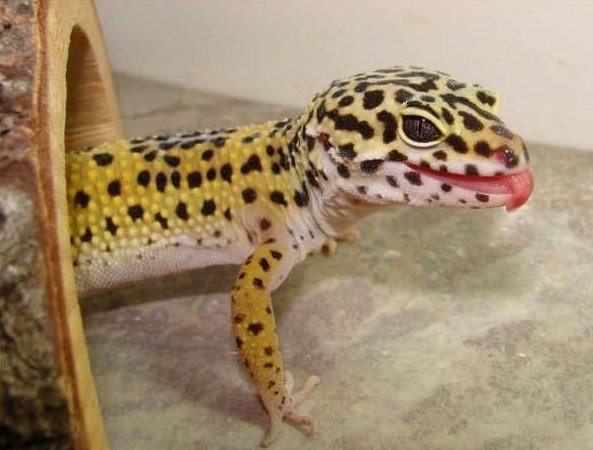 The Leopard Gecko, Eublepharis macularius, is one of the most popular of all reptilian pets, and much has been written on its care and breeding. But this lizard’s other side – how and where it lives in the wild – is less familiar.
Classification
First a bit on where the Leopard Gecko fits in among other lizards, and the species to which it is related.
Along with over 1,050 other species, Leopard Geckos were originally classified in Gekkonidae, the largest lizard family (please see article below). Today they are placed within their own family, Eublepharidae, along with relatives such as the Fat-Tailed and Banded Geckos (please see photo). Certain other family members are also commonly referred to as “Leopard Geckos” (i.e. the Vietnamese Leopard Gecko, Goniurosaurus araneus).
In addition to the Leopard Gecko, the genus Eublepharis contains 4 closely related species, the Dusky Leopard Gecko (at 10 inches in snout-vent length, the largest), the East Indian Leopard Gecko, the Iraqi Eyelid Gecko and the Turkmenistan Eyelid Gecko.
The Leopard Gecko’s Latin name is Eublepharis macularius. Five subspecies have been identified, but not all herpetologists are in agreement on this. Most of the Leopard Geckos in the pet trade today came from animals originally collected in Pakistan.
Comparison with other Geckos
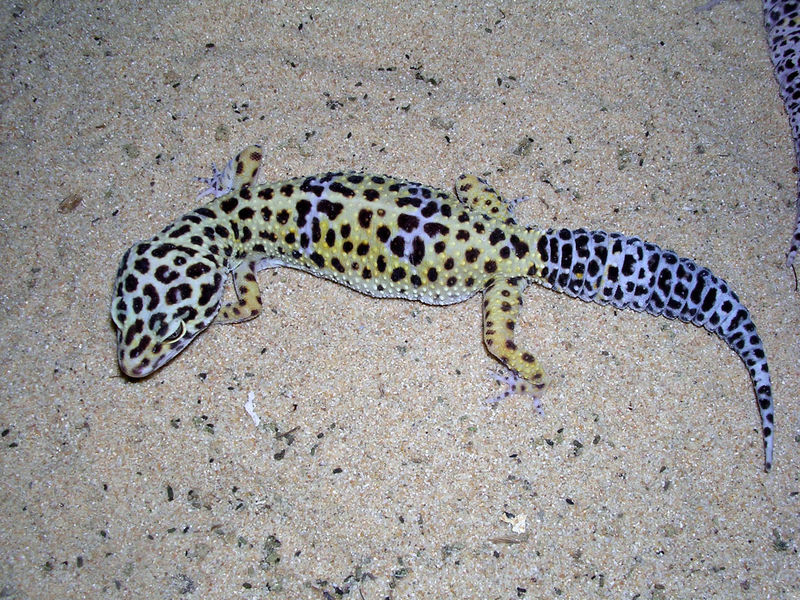 The Leopard Gecko and its relatives are the only geckos to have movable eyelids. The genus name means “true eyelid” while the species name translates as “spotted”. In all other geckos, the eyelids are fused into an immobile, transparent cap known as the spectacle. As in snakes, the eyes thus remain permanently open.
Also unique is the Leopard Gecko’s lack of adhesive foot pads, known as lamellae. Lamellae enable other geckos to perform such feats as climbing glass and running upside-down on ceilings. Herpetologists believe that these microscopically-grooved pads would not be effective in the dry, dusty places inhabited by Leopard Geckos.
Leopard Gecko ears are unusual in their alignment…at the right angle, you can look in one ear and see right through to the other side of the gecko’s head!
Range and Habitat
The Leopard Gecko is found in Southeastern Afghanistan, Western India, Pakistan, Iraq, and Iran, where it frequents semi-deserts and arid grasslands.
Leopard Gecko habitat is characterized by sandy-gravel, rocks, hard clay, coarse grasses and drought-resistant shrubs (please see photo). The lizard’s bumpy, spotted skin, which stands out so well in captivity, provides excellent camouflage against the substrates of its natural habitat. These are harsh lands, where food and water may be unavailable for months on end…perhaps the Leopard Gecko’s adaptation to such extremes explains its hardiness in captivity.
Widely fluctuating temperatures are typical. In the Peshawar region of Pakistan, for example, winter temperatures average 41-59 F but soar to 104 F or more in the summer. While captive Leopard Geckos generally remain active year round, wild specimens become dormant during the colder months.
Diet and Enemies
Leopard Geckos prey upon a wide variety of invertebrates, and store fat within the tail. Included in their diet are some quite formidable creatures, such as large spiders, scorpions and centipedes. Smaller lizards and perhaps nestling rodents may be taken on occasion.
Foxes, snakes, monitor lizards, owls and the large invertebrates mentioned above are the Leopard Gecko’s most likely predators, but field research is lacking.
Conservation
 Almost nothing is known of the status of Leopard Gecko populations; political instability and military conflicts are likely to prevent field research for the foreseeable future.
Further Reading
A list of all species in the family Eublepharidae and their ranges is posted here.
Gecko Overview: interesting facts and figures
Feeding Leopard Geckos
Female and Juvenile Leopard Gecko (banded) image referenced from wikipedia and originally posted by Jerome66



Its strange how common these guys are and yet we dont really know that much about them in the wild!
Hello Mike, Frank Indiviglio here.
Thanks for your interest in our blog. I like to focus on natural history of animals that are well-known in captivity; give a better understanding of captive needs as well.
Please let me know if you need any further information. Good luck, enjoy and please keep me posted.
Best regards, Frank Indiviglio.
wow, i have a leopard gecko and thought i knew everything about him. apperently not! so i think it’s fascinating how we think of them as helpless pets, but they can survive for 20 years in the desert! so thanks frank, now I really know more about my gecko.
Hello, Frank Indiviglio here.
Thanks for your interest and the kind words. I understand…they seem small, slow etc. But then when you consider that they have been around for eons, long before us, in a harsh environment – well, they must be doing something right! Here’s a link to a book I wrote on their natural history and care; you may be able to find it in your library as well.
Please let me know if you need any further information. Good luck, enjoy and please keep me posted.
Best regards, Frank Indiviglio.
Hi Frank,
I quite enjoyed your article regarding the leopard gecko and its behaviors in its native habitat. You have listed some great information that is not readily available in other sources. A simple search for “leopard gecko”, while pulling up thousands of articles, usually has relatively similar information. I haven’t seemed to be able to find any information regarding how males behave around a gravid female or harem of females.
In carefully observing my current gravid females, I have noticed that my male “stands guard” outside each females lay box until she has completely finished the process. I would love it if you could provide some insight or just some more information if you have time.
I seem to learn something new about my leos every day!
Thanks,
Kia
Hello Kia
Thanks for the kind words. I’m glad you found the article useful. An understanding of a species’ natural history is critical to keeping it properly in captivity. We know very little about many that are quite common in captivity; those that tend to do well, such as leopard geckos, are often ignored by field researchers. There is not much known about male-female interactions in the wild, for example, so your observations could be very useful.
Lessons learned with common species may also be applicable to the conservation of their rare relatives – leopard geckos are a prime example. Especially with herps and invertebrates, the new discoveries often come from hobbyists.
I’ve not read of guarding behavior in leopard geckos, but it is very possible. Body fluids released during egg-laying could very well attract the male’s attention; the question s whether he is investigating or actually providing protection. It would be very useful for you to take careful notes, and perhaps even experiment a bit, disturbing him when he is “on guard”.
In recent years, we’ve made some surprising discoveries concerning social behavior in lizards; in fact, male Rosenberg’s Monitors have been found to assist in the nesting process; please see this article. You might also enjoy these articles on social behavior in Great Desert Skinks and Prehensile Tailed Skinks.
I subscribe to the professional herp journals and will keep an eye out for any related observations. In the meantime, please let me know if you need any further information.
Good luck, enjoy and please keep me posted.
Best regards, Frank Indiviglio.
Hi Again,
Thanks for responding so quickly. I had actually thought a little about recording my observations. By trade I am a psychologist and am familiar with the scientific experimentation process. You’ve actually inspired me to keep a log of Buddy (my male) and his behavior.
I have one male and two females in this group. With both females he stood on top of the box (I have a large plastic container with a hole cut in the lid) and did not move from the time my females go in until they finish laying their clutch, however long that may be. When he is removed from his perch he becomes visibly and audibly upset, as he makes the screeching noise babies make when you are first training them to be held.
I have had other reptiles (snakes) off and on for a few years but have just recently discovered my love for leos. I began volunteering at a reptile store near where I live and found them to be so inquisitive! This is my first breeding season, so I will need to observe other mating behavior before I can determine if this happens frequently or is just a fluke with my male.
Thanks so much for your great advice. I will let you know what I discover…I’m sure Buddy has a lot to tell me!
Kia
Hello Kia,
Thanks for the feedback; always useful to bring other skills to bear (I took a detour as an attorney for awhile).
Sounds very promising; I’ll send you a note if I turn up any relevant studies. I look forward to hearing more.
A red/black night viewing bulb may be useful for observing them after dark.
Best regards, Frank Indiviglio.
My name is Caitlynn. I am a middle school student in Newburgh, Indiana. I have a Leopard Gecko and a Crested Gecko. I am currently doing research on my Leopard Gecko for my schools science fair project. I have some books on the Leopard Gecko in general, but I am needing some more detailed information. My teacher has told us that a good source of information is to contact specialists. I was wondering if you could help me?
For my project I am testing “Can Leopard Geckos see different amounts of movement in light conditions low enough where human’s cannot see?” The following are some questions I have:
First, is there somewhere I can get a diagram or pictures of a Leopard Geckos eye showing the different parts? I want this for my main display board, so I can accurately draw a picture of the eye and show the different parts.
Second, how sharp is their sense of sight?
Third, exactly how do their eyes function, so that I can explain how they are different?
Fourth, can they see color?
I would appreciate any help you can give me. Thank you in advance for your expertise!
Caitlynn
Hi Caitlynn,
The best source for a diagram of a lizard eye would be a herpetology textbook; most libraries will carry or can order via inter-library loan. You will not likely find a drawing of a leopard gecko’s eye specifically, but another nocturnal lizard will provide a general idea.
You picked an interesting topic, as the eyes of nocturnal geckos are unique. There hasn’t been much work on leopard geckos as far as I know, but most of the information in this article applies to them. Unlike many nocturnal reptiles, it seems that they do see color; it also discusses eye function.
In general, their vision is thought to be sharp, as they need to catch live, fast-moving insects at night. They also seem to detect non-moving food items (unlike some reptiles) but the sense of smell may also be involved in this.
Please let me know if you need further information, enjoy and do well, Frank
dear,
kindlly i want a Leopard Geckos in 300 or 500 Gram wight. where i find it, urgently
.
Hello,
Please check this list of Leopard Gecko breeders.
I hope all goes well, Best, Frank
in this: Leopard Gecko breeders. all are below than 85 grams. kindly i want abou than 300 gram.
Hello,
Unfortunately that link is the best source I know of. However, you might try posting on GeckoForum.
Best, Frank
Respected Sir,
I have many reptiles (leopard gecko ) but very little sizes 50 to 70 gram. Please guide me for feed so soon improve body.
thanks.
Hello,
Please see this article on Leopard Gecko Diets and also the articles linked at it’s end. Also, the suggestions in this article on Chameleon Diets apply to leopard geckos.
i hav leopard jecko, weight up 2 100 grams, what i can i do?
Hello,
I’m not sure what it is you are asking, please clarify,
Best, Frank
Hi Frank,
Thanks again for a great piece – as has already been stated, there’s not a huge amount of information on the natural history and only through proper understanding of wild conditions can we offer better captive care for ouyr charges.
We’ve just rescued a couple of females that were somewhat neglected and unwanted pets, bought on a whim – NEVER a good idea and highlights a duty of care that should be required by all vendors of living animals, “Can my customer demonstrate sufficient knowledge of the captive care of this animal?”
Anyway I digress….
How social are these lovely little lizards in the wild? I ask because the ones we rescued show an insatiable curiosity toward anything that goes near them. While most animals shy away from intrusion, the geckos seem to want to investigate it (sign of intelligence?). I’m not usually one for handling my reptiles or inverts but decided to gently stroke the top of the head of one of the curious beasts. She immediately came out of hiding and wandered in a full circle, seeming to enjoy the light stroking, before heading back into her hide. The animals had never been handled before which made me wonder whether there is a natural tactile interaction between in their natural environment.
Thanks,
Dave
Hi Dave,
There’s quite a bit of variation in their behaviors, and now that so many generations have been captive bred I believe we are seeing more of what you describe. Some interesting studies have shown that inverts also exhibit individual behaviors..please see this article and let me know if you need any info on Leopard gecko…I have a few articles and a small book published on them, best, Frank
Hello, I hope you can help – I am utterly desperate. I have lots of gecko’s coming in and out of my house and I am always happy to have them. At about 7:00 am on Tuesday, I tried to rescue an adult and a baby from my dogs. I panicked a little and, during the process, I must have hurt the adult (I believe it is the Mummy). She stopped running only a slow circular movement, but she stayed in the same spot. I left her and went to work, thinking that she was in shock and would recover during the day. When I arrived home, the gecko was still in the same position, although I could see that she had gone in a circle. I positioned her near my couch where the gecko’s usually take shelter. I also managed to bring the baby there, but I have not seen
Hello,
Unfortunately there is likely nerve damage or perhaps damage to the spine…both are common when other animals get at them, or if in a rush to help one is grabbed in a delicate spot. There’s no way to treat such [problems at home…but they can be very resilient; releasing it in a sheltered location would be your best option.
Sorry I could not offer any better advice, regards, Frank
Frank, thanks so much for your prompt reply. I do not have the heart to end her little life and I do believe she deserves the best chance at recovery which I am not able to give her with my extremely limited knowledge. Although I obviously do not like to release her without knowing that she’s okay, I will put her in a sheltered corned in the garden tomorrow morning (It is the middle of the night in South Africa), and I hope she will recover and thrive.
All the best to you
Broni
Hello Broni,
I’ve found many lizards and other reptiles alive and seemingly well despite very severe injuries- injuries which would seem to require euthanasia were they pets;…hopefully the gecko will recover.
Any reptile observations from S Africa welcome (cooling off there, I imagine…barely spring here in NY)
Best regards, frank
i want to know about gecko price … weight 100gram and 150gram
Hello,
Prices vary widely among dealers, stores and various countries, and according to color. Unfortunately, there is no way to provide a price range, best, Frank
i have 200 gram gecko . i want to know his price . please tell me about …….
Hello. Do you know how many morphs there are? Like TRUE morphs? I have a mack snow leopard gecko and am not sure if its a real morph, or just a morph out of other morphs. I have heard of there being 100’s of morphs, while only just about 20 morphs.
Hello Chris,
Sorry, but I’ve completely lost track, and am not really sure of the various distinctions; breeders tend to make up names that are useful in terms of sales, so I’m not sure how valid most of the classifications are. Best, Frank
Hello,
Can please anyone tell me that where can I find geckos in pakistan? Any specific city or village?
I have a few questions that are really bugging me, you have obviously done a lot of research into Leopard Geckos, i would like to know once and for all, are they nocturnal or crepuscular?
If nocturnal, how would they get their Vitamin D3 in the wild?
Would you say a low level U.V.B bulb is beneficial?
I dislike using supplements, i don’t know if they are getting enough or getting too much, with U.V.B they can self regulate?
Really hope you can help
Thanks, Woogie 🙂
In the wild, leopard geckos are crepuscular, in captivity most leopard geckos would be observed to be nocturnal. Most keepers do not try to replicate dawn and dusk with their lighting cycles (and this is by no means necessary), but if they did: you would probably see the geckos demonstrating their crepuscular nature. As far as D3 goes, wild leopard geckos are able to use the calcium present in the harder shelled insects that they eat. They also will lick the minerals in their surroundings in order to ingest some extra calcium. They will bask for a while in the evening when the sun is setting, so I’m sure that they would benefit from a small amount of UVB light. Here in our reptile room at That Fish PLace – That Pet Place I often see leos licking small amounts of the calciumin their tanks, essentially supplementing themselves. Therefore I would say that supplements are fine, just make sure that it is high quality (I like Zoo Med’s Reptivitie item #239543) and keep it to about once a week.
Let me know if you have any other questions.
-Josh
No thats great, thank you for clarifying!
Yes sorry, by supplements i meant the Calcium with D3, it all seems like guess work, i would rather use a U.V.B light to provide D3 rather than dusted livefood 🙂
You get so much conflict on the net on the subject though, i was starting to doubt it an ditch the U.V, nice to hear it from an expert!