 That Reptile Blog – Reptile, Amphibian and Exotic Pet Care and Information

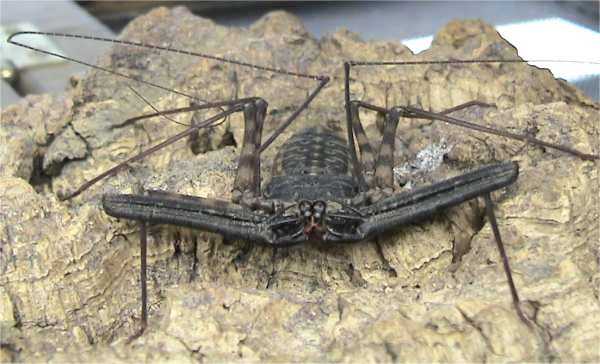 Having long worked with a variety of the world’s most unusual invertebrates, I had imagined myself ready for any and all surprises that might be offered by these fascinating creatures. Yet the first tailless whipscorpion that I encountered in the wild – a huge specimen that met my gaze inside a hollow tree in Venezuela (where I was searching for yet another bizarre beast, the giant vampire bat) – stopped me in my tracks.
Although relatively harmless, these most unusual Arachnids certainly are formidable – some might say “nightmarish” – in appearance. If you are looking to add an animal that borders on the unbelievable to your collection, look no further than these fascinating spider relatives.
Description
Tailless whipscorpions are members of the Arachnid order Amblypygi, related to but distinct from the spiders and scorpions. The incredibly long front legs have evolved into sensory organs, and are slowly moved back and forth, touching this and that, as the animal senses its way about. It really is quite a sight to behold – one simply has no frame of reference, no matter how many odd creatures have crossed one’s path.
These specialized legs may cover a span of over 1 ½ feet. Some of the larger tropical species also sport 8 inch long “regular legs” and flattened bodies exceeding 2 inches in length – very impressive beasts over-all. Huge pinchers, kept close to the body until needed to grasp meals, add to the effect.
Tailless Whipscorpions in Captivity
The huge Tanzanian giant tailless whipscorpions (Damon variegatus and D. diadema), are becoming increasingly popular with invertebrate enthusiasts, with captive reproduction now regularly recorded. I have housed similarly-sized individuals in groups without incident, and was even successful in breeding them in this situation (I removed the youngsters to prevent predation).
In common with all related species, Tanzanian giants are arboreal, and need wide, flat climbing surfaces. Cork bark slabs are ideal. They should be provided a varied diet consisting of crickets, waxworms, roaches, locusts and wild caught insects.
All species kept to date require very damp conditions and temperatures of 72-76 F. Despite their tropical origins, tailless whipscorpions are most often found in caves, wells, hollow trees and other cool micro-habitats. Most fail to thrive if kept warmer than 80 F.
Although lacking venom glands, tailless whipscorpions can break the skin with their formidable front claws. For this reason, and because they move very quickly and shed legs easily, these odd creatures should not be handled.
Further Reading
You can learn more about the natural history of African tailless whipscorpions at http://www.arc.agric.za/home.asp?pid=4078.
Image referenced from Wikipedia and originally posted by Luis Fernandez Garcia




I kept a pair of these which sadly perished when the house got too cold. I will say they were by far the most interesting invertebrate pets I have ever had the honor of observing.
Dr. Linda S. Rayor has done quite a bit of research using these discovering that female Damon diadema…and other tailess whips actually form a long term family bond with the young, caring for the up till maturity. But adults she claims will eat eachother(I heard from a petstore of this happening on occasion but I’ve also heard from people like yourself who have kept them communally with no problems.) My pair was put together for several months for mating, then the female was seperate until she laid and then aborted an eggsac. Put them together after she molted and they mated again before disaster struck and I lost both of them. But they seem to form a strong pair bond and get along for the most part while they were together. They’d often sit facing each other and occasionally keep in touch with their “antennae”. The mating dance was also quite neat to see.
I would love to try another one of this weird group again…perhaps the NA species unless I am sure of being able to keep stable temps(IME between 65-80 was fine).
Great post highlighting a fascinating creature that hopefully becomes more available as CB specimens.
~Joseph
Hi Frank,
In order to force the odds of a sexed pair I bought 4 sub-adults of these superb animals (D.diadema) about 2 years ago and, as they were all of similar size, housed them together in an 12x12x18″ tall enclosure with a lot of vertical pieces of bark as hiding places.
Within 30 minutes of introducing them to the enclosure, 2 went straight into courtship – a lovely thing to watch with the male making “come here” gestures with his pedipalps while showing off how big they were. Both male and female did a lot of gentle probing and caressing with the modified forelegs. I watched for a good hour before leaving them to it.
Unfortunately one of the unpaired couple was killed shortly afterward, presumeably by the dominant male, so I separated out the remaining single specimen leaving the bonded pair with the run of the enclosure.
About 6 months later I was greeted with the appearance of the female along with about 25 pea-green helpless offspring clinging to its abdomen – a wonderful day!
I’ve left them all living communally, offspring and both parents, with minimal losses and have noticed (even after 12 months) the female often interacts with all captives (the offspring are now around the 2cm body length).
The adults have again started to show courtship behaviour so I’m keeping a close eye out for any signs of cannibalism after which I’ll separate out last year’s young into several similar enclosures with around 5 or 6 in each.
They’re a fascinating captive that exhibit a level of social interaction way beyond that usually found in arachnids.
If you’d like to see some photos (which you’re more than welcome to use on your blog) I’ll email them to you seperately.
As always, superb blog – many thanks,
Dave
Wow!…thanks for the wonderful observations and the kind words, Dave, much appreciated. I’ll keep your info handy and pass along to others. Please continue taking notes..I have many contacts who are interested in this and related species, both in zoos and private collections. My email is findiviglio@thatpetplace.com…looking forward to some photos, thanks very much for offering. best, Frank