 That Reptile Blog – Reptile, Amphibian and Exotic Pet Care and Information

 A recent article in the journal IRCF Reptiles and Amphibians (V17, 1) provides evidence that the African Rock Python (Northern African Python, Python sebae), may have established a breeding population in southern Florida. The huge constrictors are adapted to take small antelopes and other large animals, and have been killed and consumed people in their native habitat.
Florida’s Introduced Constrictors
At least 45 species of non-native reptiles and amphibians have established breeding populations in Florida; many others have been observed but are not known to be reproducing. Among these are 2 of the world’s largest snakes, the Burmese Python and the Boa Constrictor. Other large constrictors, including the Green Anaconda, Yellow Anaconda and White-Lipped Python, have been found at large in Florida.
Anacondas and others Established?
Given the extent of Florida’s wetlands and other densely-vegetated habitats, it is not unlikely that reproduction of other species has occurred unseen. Anacondas, being aquatic, are especially difficult to find. Years ago, I was told by a reliable source that an entire litter of Green Anacondas escaped from a roadside zoo near Florida City in the early 1970’s…nothing would surprise me at this point!
Northern African Python Study
The article mentioned above looked at Northern African Python sightings and captures in south Florida from 2002-2009. In that period, 7 individuals were found in a small (less than 10 square miles) area in Dade County. Among the captured snakes was an 15.5 foot-long adult female with eggs forming in the oviduct, reproductively active males, and several young-of-the-year. The ages and sexes of these snakes, and their proximity to one another, suggests a breeding population.
Also notable is the fact that the capture sites were less than 1 mile from the border of the Everglades, an immense habitat that could easily hide other African Rock Pythons.
Recent meals – a Domestic Turkey and a Boat-tailed Grackle – were recovered from 2 of the snakes.
Python Hybrids
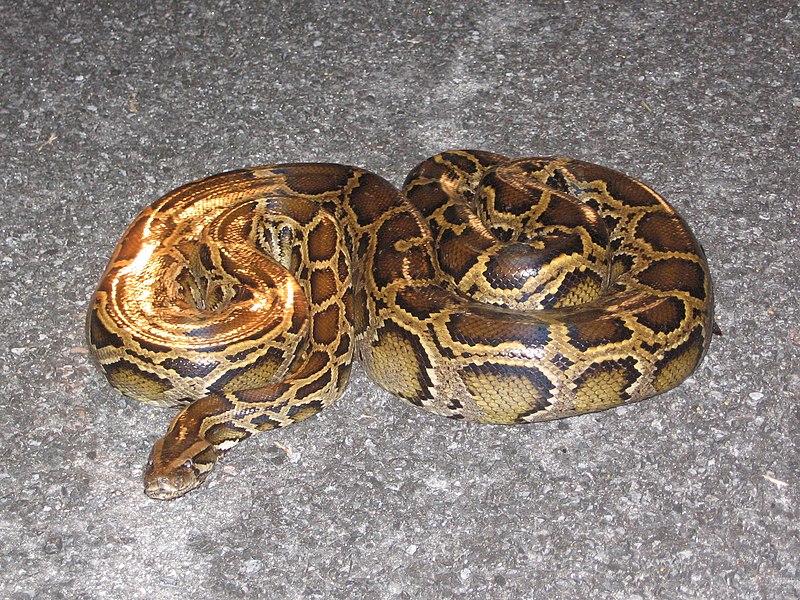 The African Rock Pythons were found in an area that abuts or overlaps with the range of Florida’s introduced Burmese Pythons. The 2 species will mate with one another in captivity; the fertility of the resulting hybrids, and their possible affect on south Florida ecosystems, bears further study.
Further Reading
The African Rock Python in Florida (National Geographic)
Video: Rock Python found in Florida
News Article, Photo: African Rock Python Captured in Florida
Study: Burmese Python Winter Tolerance
Python Sebae image referenced from wikipedia and originally posted by Brian.Gratwicke