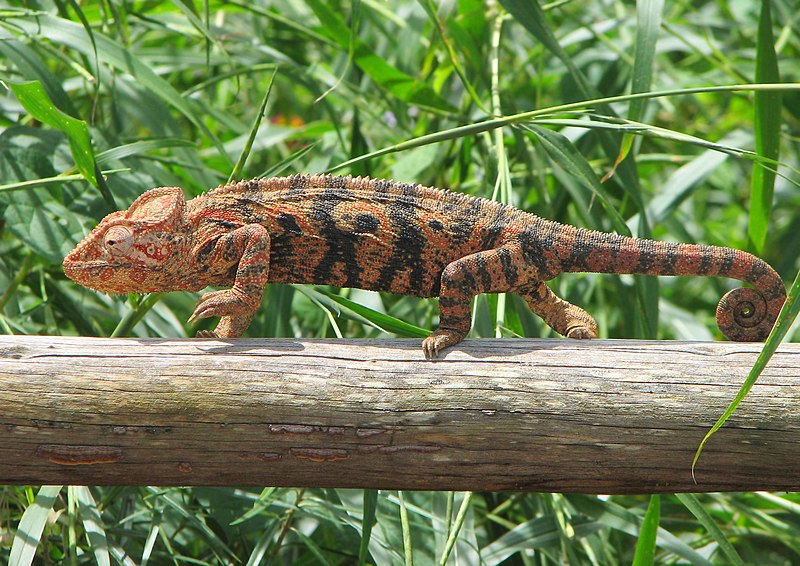
Today we’ll take another look at those oddest of lizards, the chameleons (Family Chamaeleonidae), followed by some tips on the care of the Senegal Chameleon (Chamaeleo senegalensis).
Eyes
The cone shaped torrents that enclose the chameleon’s eyes are actually made up of fused, overlapping sets of eye lids. By covering all but the eye’s pupil, they offer excellent protection to this most important organ.
Chameleon eyes contain far more visual cells than do our own, and can be rotated 180 degrees. Uniquely among all animals, the eyes can focus either independently (on different objects) or together.
Vision, Learning and Hunting Accuracy
When a chameleon focuses both eyes on an insect, it hits its target 9 out of 10 times. In laboratory situations, accuracy falls to 0 when 1 eye is covered. However, by the second day hunting accuracy rises to 20%. On day 4, the one-eyed hunters successfully capture insects on 50% of their attempts.
Senses of Hearing and Smell
Chameleons do not hear well …like snakes, they detect air vibrations and low-pitched sounds only.
The Jacobsen’s organ, which allows many other reptiles to “smell” chemical particles in the air, is vestigial (much reduced) in chameleons. It is therefore assumed that they do not detect most odors.
Distribution
Madagascar is the center of chameleon diversity, with over 75 species, many endemic, living there. Neighboring Africa, despite being vastly larger, boasts only 100 or so species. Only 2 species make their homes in the Middle East, 2 in Europe and 2 in India and Sri Lanka.
At least 2 species of chameleon have established feral populations in foreign habitats. The veiled chameleon (Chamaeleo calyptratus) thrives in Florida, Hawaii and Mexico, while the Jackson’s chameleon (C. jacksonii) has been breeding on Hawaii since the 1970’s and has recently been discovered in California.
The Senegal Chameleon, Chamaeleo senegalensis
Hailing from tropical West Africa (Senegal to Cameroon), this dark-spotted, tan to olive chameleon inhabits brushy savannas and forest edges. Often abundant and easy to collect, it has long been a pet trade staple.
Some Cautions
Despite its long history in captivity, the Senegal does not breed regularly, and presents some problems as a pet. Wild caught specimens should be avoided, as they are usually heavily parasitized and afflicted with stress related ailments.
Captive Environment
Senegal Chameleons need quite, heavily planted screen cages or an outdoor aviary , abundant UVB radiation and should be kept well-hydrated via frequent spraying or the use of a mister. An ambient temperature of 76F with a basking site of 85F and a nighttime dip to 69-70F suits them well.
Breeding
If you are lucky enough to obtain a breeding pair, you’ll have your hands full…healthy females may lay 20-70 eggs at a time, twice each year! Incubation time averages 6 months at 77 F, and sexual maturity may be reached by 5 months of age.
The Smooth Chameleon
The range of East Africa’s Smooth Chameleon overlaps that of the Senegal in Cameroon. Formerly classified as a subspecies, the smooth chameleon has now been given full species status as Chamaeleo laevigata.
Male Chameleon in Madagascar image referenced from wikipedia and originally posted by Mbz1
Veiled Chameleon in Madagascar image referenced from wikipedia and originally posted by Billybizkit
 That Reptile Blog – Reptile, Amphibian and Exotic Pet Care and Information

 The Senegal Chameleon (Chamaeleo senegalensis) has long been common in the pet trade, yet there remain significant roadblocks to longevity and breeding. I recently re-read a 1990 study on prey choice in this species. I then considered it in light of newer research that established a link between Vitamin D levels and chameleon basking behavior. I believe both contain important findings that may be applicable to many species.