 That Reptile Blog – Reptile, Amphibian and Exotic Pet Care and Information

After shedding, leopard geckos (Eublepharis macularius) sometimes exhibit a condition that superficially resembles what snake owners know as “retained eye caps”. However, the structure of a leopard gecko’s eye, and that of the closely related banded and fat-tailed geckos, is nothing like that of a snake’s, and problems following shedding must be addressed in a very different manner.
Leopard Gecko Eye Structure
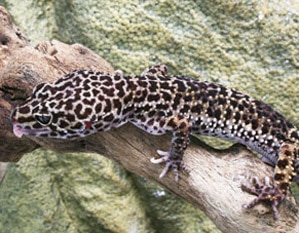 Leopard, banded and fat-tailed geckos are classified in the gecko subfamily Eublepharinae, and differ from all other geckos in having movable eyelids. In fact, the genus name, Eublepharis, means “true eye lids”. The eyes of all other species in the family Gekkonidae are covered by a transparent cap, or spectacle, which is fused to the eyelids (like snakes, they cannot blink their eyes).
The eyelids of leopard geckos and their relatives are lined with a thin layer of skin. This eyelid liner is replaced along with the rest of the gecko’s skin when shedding occurs. However, if conditions are too dry in the terrarium, the eyelid lining may stick to the lid and be retained after shedding. This will lead to an irritation. Eventually, an infection will set in and cause the eye to swell.
Diagnosis and Treatment
The retained skin is thin but visible, so check your gecko carefully after it sheds. Geckos so affected will also blink a great deal, and may rub the area.
While experienced hobbyists may be able to remove retained eye caps (brille) from pet snakes, retained eyelid liners are an entirely different matter. This problem must be attended to by an experienced veterinarian only.
Avoiding Problems: Humidity and Diet
An overly-dry environment seems to be the main factor leading to retained eyelid liners. Although geckos are native to quite arid habitats, like all desert animals they are able to find moist retreats, usually below ground, when necessary. It is easy to overlook this when keeping desert animals. For years zoos kept Gila monsters, native to one of the driest places on earth, in bone-dry exhibits. Field research showed, however, that these lizards actually spend 90% of their time in burrows where humidity levels are quite high.
Shedding aids are useful for lizards of all types, especially desert-adapted species.
Low Vitamin A levels have also been implicated in gecko shedding problems. Be sure to provide your lizard with a varied diet and appropriate vitamin/mineral supplements. Please write in if you need detailed advice on feeding your gecko.


Hello,
My leopard gecko has had unshed skin on her toes for possibly a year now. I was wondering if I could still get rid of that skin using the shedding aids you mentioned, or if it’s now too difficult to remove without the help of a vet.
Hello Ron, Frank Indiviglio here.
Thanks for your interest in our blog. I suggest a vet – often after that length of time, the old skin constricts blood flow to the toe, causing necrosis. The toes sometimes fall off, or may need to be amputated. Geckos can survive this, but infections/fungus can also take hold beneath the skin…best to have a vet check the animal. Please let me know how all goes, and we can discuss possibly preventing this in the future.
Please let me know if you need any further information. Good luck, enjoy and please keep me posted.
Best regards, Frank Indiviglio.
I rescued a-leopard gecko . It has no eyes . We hand fed it at first now he eats on his own. He won’t eat crickets of any kind worms in a can and wax worms are all he will take .we use vitamin powder and give him plenty of fresh water . He’s now even affectionate in a way . Is there any thing else he needs to be healthy and happy ?
Hello Dawn, Frank Indiviglio here.
Thanks for your interest in our blog and my compliments on your efforts. Continue to try and tempt the lizard to eat a wider variety of foods, as waxworms alone are not suitable long term. Keep him hungry for awhile to encourage this…geckos usually have plenty of fat stored in the tail, so fasts of a week or more are of no concern. Please check this article for further info. Since he’s on a limited diet, it would be best to alternate between several supplements for now, i.e. Reptivite w/D3 and Reptocal.
Please bear in mind that leopard geckos will not usually drink from a bowl, but rather lap water from rocks and the aquarium’s glass when theses are misted.
They do not need a UVB light source, but be sure to provide a warm spot of 85F or so, with a background temperature of 74-78 F and a slight dip at night.
Please let me know if you need any further information. Good luck, enjoy and please keep me posted.
Best regards, Frank Indiviglio.
when my gecko sheds, skin gets stuck on his toes. Should i try to get it off?I know his toes are extremely delicate, but I’ve been told the skin may cause blood to not flow to his toes, and they fall of. I don’t want that!!! what should i do about this? the more he sheds, the more skin on his toes.
Hello, Frank Indiviglio here.
Thanks for your interest. Unshed skin can constrict the toes, but this takes some time to occur. Try softening the skin with a shedding aid (or a bit of olive oil) and then see if you can gently peel it back without pulling too hard. If it appears that there are several layers of skin present and it will not slide off, it would be best to see a vet. Please let me know if you need help in locating a reptile-experienced veterinarian.
Also, set up a cave or hide box and keep it ½ filled with damp sphagnum moss. Geckos will often seek damp areas before shedding, in order to loosen the old skin.
Please let me know if you need any further information. Good luck, enjoy and please keep me posted.
Best regards, Frank Indiviglio.
I have an albino gecko who just shed, but his eyes are completely covered. He also had scabs on his mouth which I treated with hydrogen peroxide and antibiotic ointment and that has resolved, however the eyes are not fixing. I have been soaking him twice daily and put vaseline on his eyes as I was told to do by a pet store near me. I live in an area with no herp vets so I am just following books and pet store people. He is not eating at all.
Hello Amy
Thanks for your interest and sorry for your troubles. Unfortunately, this is not something you can treat at home. Topical antibiotics may have helped the skin condition, but scabs etc. may indicate an internal bacterial or other infection, which must be treated by medications prescribed by a veterinarian. The fact that the animal is not eating supports this. The eye condition may be retained eyelids, or infection related. Either way, it will not resolve with vaseline. Soaking is likely stressful, and may worsen the condition if the animal becomes too chilled, as its immune system is depressed now. If you’d like, please let me know what state you are in. I’ll try to find some instate vets for you..even if they are not near, one may be able to recommend someone closer.
Best regards, Frank Indiviglio.
Hello, please help! I have a feamale leopard gecko who had a shedding problem over one eye. We got the impacted skin out but the eye is permanently damaged now. It is pushed in and won’t open all the way now. There is no sign of infection or anything but she has not eaten since it happened. Will she eat once she goes through her fat reserves? I am getting really worried it has been about 3 weeks since she has eaten. She.only gets mealworms and supplements. She won’t eat crickets or anything else…
My leopard gecko recently had eye issues. When I checked on him after shedding I noticed his left eye appeared to be covered in dried blood. I took him straight to a local vet who identified an ulcer and prescribed antibiotic eye drops 3 times a day. A week later the eye drops have definitely had a positive effect. The eye is clear again and no sign of any blood. The ulcer seems to have healed nicely.
However I’m worried because the eye now looks quite different to his healthy right eye. The eye is much flatter and no longer has the clear dome covering.
I’m worried he has permanent damage to his eye now. Does it sound as though the actual cornea is damaged?
Hello Matt
Thanks for your interest. Infection is the main concern, so you have taken the right steps. Even with an exam, it’s often difficult to determine if the infection, even though healed, caused structural damage. I have noticed changes similar to what you described in a variety of lizards after treatment. As long as the unfection is gone, the lizards should get along fine, whether he has poor or even no vision in one eye. You’ll need to watch it closely after shedding, however, and have the eye checked again at that time if you notice anything unusual.
Please let me know if you need any further information. Good luck, enjoy and please keep me posted.
Best regards, Frank Indiviglio.
Dear Frank,
I have a female leopard gecko that I have had for seven yrs. She was fully patterned when I bought her so I’m guessing she may be < 10 yrs. But over the last year she has lost her eyesight without any complications involved. I had a vet tell me she has lens thickening. I believe she sees very little but has adapted to tweezer feeding. But about three wks ago I took her in because she wasn't swallowing her food well. She was eager to grad it but seemed to have trouble swallowing. They gave her a steroid and antibiotic shot but it hasn't really gotten better. If I don't place the cricket or worm almost completely in her mouth she shakes and drops it. Any ideas or is this possibly just the end stages of her life?
Hello,
Aging could very well be involved, esp considering the eyesight problem. They can reach their teens, and a few have approached 30, but 10 is well on in years, and yours may be older than that. Similar symptoms (swallowing) in frogs and toads have been linked to Vitamin A deficiencies, but not much is known and treatment is not well-established; not sure if it has been tried with lizards. I can refer you to a vet who has done work in this area, and who could likely consult with your vet via phone (he is in Az) but the treatment may be more stressful that continuing to feed as you have been.
Best regards, Frank
Hello again! My gecko shed today, using the water dish as it has in the past, but I noticed afterward that a portion of the tail downward to the tip was shiny and slimey. A few pieces of skin remained attached to the segment of the tail where the slimey texture started.
A while later, I notice the gecko was picking at that remaining skin, so I moved him to his moist hide. Upon checking him again, I noticed he was actually biting his tail, with the tail laid across his mouth – upon releasing, this left a broad indentation on the tail.
Later still, I noticed the gecko had continued to tear at the tail, where the skin bits remained, and the area was now pinkish raw, and bleeding a bit. There is no remaining shedding skin, but he still goes after the tail every now and then.
How can I best clean up and care for the raw wound? Is antiseptic (hydrogen peroxide) or antibiotic (neosporin) and a wrap (paper tape) appropriate? There are no vets open today, unforunately, and I want to act as soon as I can.
Hello,
Neosporin or peroxide is fine, neosporin stronger, but you don;t want the lizard to ingest much. Perhaps restrain it from biting for 10 min or so if need be. It will likely bits at a bandage, and tape is tough on the skin. Check with a vet when possible, so that infection does not set in. In future, best to remove remaining skin with help of the shedding aids linked in this article (tail skin comes off fairly easily by hand, toes and eyelids require some experience). Good luck, pl keep me posted, Frank
I washed the wound with warm water and hydrogen peroxide and bandaged ot, which he promptly took off.
The tip of the tail now resembles thread from being crushed in its mouth. He’s still gnawing at it.
Any idea why this region of the tail remains slimey? I never saw that in previous sheds.
Hello,
No way to tell w/o an exam; some fungal/bacterial infections may give that appearance; perhaps something had been incubating prior to the shed. Put the animal on paper towels to minimize substrate sticking etc.and continue Hy peroxide rinses. I have had reports of various lizards doing this after an injury. If an emergency vet clinic is avail, perhaps they can remove a section of the tail and securely bandage. if not, it may continue for a time. The damaged area may fall off, or if not will be removed by the vet. Other than distracting the lizard, not much you can do at home, unfortunately.
Best, Frank
I was checking out my gecko today and I noticed that when he looks into the light, his eye gets milky white. I can’t tell if it remains milky white while in the dark due to poor visibility. Is this a sort of second eye lid or does he have shed skin stuck in it? When he closes his eyes, I can see the film bulge out a bit rendering him unable to fully blink. I want to make sure his eye sit won’t be affected. I cannot afford to bring him to a vet because I’m only a teenager and my parent’s don’t want to pay the bill for bringing him in. If there is a problem with his eyes, what (if anything) can I do to fix it? The other question I have is when does a gecko reach adult-hood? I have had mine in my possession for about half a year and I got him from a friend who had him for a couple months prior to me having him (I think). Please let me know as soon as possible because I want to make sure he is healthy. Thanks!
Hello Chad,
Unfortunately, it’s difficult to determine whether an unshed eyelid covering or another problem is involved; a vet visit is really the only way to be sure. Geckos sometimes develop fat deposits in the eye due to a diet too high in fatty foods, esp. pinkies and waxworms. It may clear up with a better diet. An unshed lid covering, however, needs to be addressed by a vet. Please see this article (2 Parts) and write back with some details concerning diet and also tempertaure.
Maturity varies a bit with diet, growth rate and by sex, but takes at least 1 year. This article describes how to differentiate the sexes once maturity is reached.
Best, Frank
I have just recently bought gut loaded crickets from a local petco but before that I fed him meal worms and he ate them frequently but as of the last month or so he has eaten less and less. I had my dad take a picture of him so you can accurately assess what I should do. As for temperature, the aquarium I keep him in feels too cold and I have been using a heating lamp but it doesn’t feel as though its working. I will try to buy a heating mat to put under the cage when I get the chance to. His Hemipene bulges are clearly visible at the base of his tail and his stripes that he had as a baby are nearly gone but he isn’t more than a year old (as far as I know). What is the best way to get the pictures my dad took to you? Another thing I have noticed is a big change in his behavior. Up until very recently, he would never allow me to handle him; he would struggle and try to bite me. But as of yesterday he doesn’t struggle (very much) and he will not try to bite. He just sits on my hands and crawls around a little bit. I’m not sure if he is acting this way just because I have had him for a little over 6 months now or not. But as I said earlier, I can’t afford to bring him to the vet, its too expensive for me to pay for and my parent’s aren’t willing to help.
Hello Chad,
You’ll need to monitor the heat with a thermometer..how it feels to us is not at all reliable. Teh warmest side of the terrarium should be 85-90F, the cooler 75F or so. It can drop to 70 at night. Heat pads are okay as a supplementary heat source, but they do little to heat the air. Best to use incandescent bulbs; start with 50 watt and check frequently. At night, a red/black bulb can be used if house temps go below 70F.
Please check the diet article I linked last time – crickets and mealworms alone are not an ideal diet. Mealworms should be used sparingly if at all. You can keep crickets and feed for several days to improve their nutritional value (let me know if you need details). Calcium and vitamin mineral supplements are also necessary – gut loading alone is not sufficient.
Reduced feeding and lethargy when handling can be due to low temperatures or an intestinal blockage (mealworm-heavy diets have been linked to this). Unfortunately, a photo would not enable me to diagnose the problem. There really is no way to treat the eye or diagnose whether a blockage is present without a vet exam.
Best regards, Frank
My African fat tailed gecko has been having shedding problems with his head. His eyes have what looks like thin dark skin covering them, and whiteness around his eyes, like lids (but I don’t think he has lids). Also, all around his mouth the skin seems rock hard. He can’t see to catch crickets and does not want to eat hand fed meal worms, and is losing a lot of weight. He uses a homemade “reptile sauna” for moisture, has a UVB light, a regular 60 watt light bulb for heat and an under tank heater. I’ve taken him to a vet twice since April. The first time he was de-wormed and given an antibiotic to take by mouth and another for his eyes. He recovered, but then the eye issue returned a few months later, as well as the new issue with his mouth. The vet did nothing this last time except give more oral antibiotic and said to keep using the antibiotic eye med. He is very slightly improving, but is losing weight. What can we do?
Hi Julie,
The eyelids are fused and therefore not obvious (as in snakes); retained eyelid linings are difficult to spot but I’m assuming your vet checked. Shedding aids or a bit of olive oil can be used to loosen dry skin. Eye infections, if that is the problem, can be difficult, so it is best to continue the drops;
Weight loss and loss of appetite is cause for concern but can be linked to any number of problems; infections, parasites or an intestinal blockage, for example. A radiograph will reveal if a blockage is present.
What are your daytime/night temps…under-tank heaters may do little to warm the air, so perhaps it is dropping too low at night?
I can try to direct you to a local vet for a second opinion if you wish. Best, Frank
How do i get shed skin of the top of my leopard gecko’s tail.
Hi Alex,
Some olive oil or a commercial shedding aid will loosen the skin so that you can slide it off by hand. Check the toes as well. Best, Frank
Thanks. I soaked her for 15 min earlier, got most of it off but now there is some in the creases of her tail. How would i get that off?
Olive oil or shedding aids should work well, Best, Frank
What would i use to rub it off with? I don’t want to hurt her.
Rub some oil, etc. on your fingers, or a latex glove…this should allow you to gently ease the skin off,
Best, Frank
that just pissed her off it didnt come off.
Hello Alex,
Try leaving the lubricant on for 15 minutes or so, then attempt to remove the skin again; you may need to repeat, no immediate health risks, you can take your time. Lizards will always resent being handled in this manner, no way around that. Best, Frank
I am so glad I stumbled upon this post. My leopard gecko has recently had some problems shedding. I’ve had her for almost 6 years and she has never had problems before, but the last 2 sheds she has had problems shedding around her snout, eyes, and this last time, her feet and toes as well. I actually had 2 leopard geckos, but one (that ive had for 5 years) past away 2 weeks ago. she always had problems shedding, but never around her face area until her last few sheds. so now that my normally healthy one is having problems too, I got very nervous. especially when her eyes started looking like they do. your post and advice in previous comments helped A LOT. I went ahead and changed out her substrate and replaced it with paper towels… damp on one side of the tank, as well as soaked her in a shedding aid for 15 min. the skin finally broke on one eye, but the other is still covered. I will give her a break tonight and will try again tomorrow. if it doesn’t get better, I will take her to a vet. I’ve been told we don’t have a very good herp vet here in Memphis, TN, so if you have any recommendations, I would be very grateful. THANK you for sharing your knowledge and advice!!
Thanks for the kind words , Amanda. You’re doing everything right, yes best to see a vet if the eye situation does not change,
please keep me posted, best Frank
My new Leopard gecko was shedding when I got it. After two weeks of not eating, I go concerned. She almost shed on her head but needed a little help. It totally revived it. It is very active and loves water. But she still isn’t eating, that I can see. We bought two geckos, and thinking the larger was getting all the food, I separated them. But now I’ve noticed that the gecko in question seems to be keeping its eyes half shut. I didn’t notice this right away, since she had half shed over them for so long. She appears to have little appetite, but she is fast, active, and seems fine otherwise…. except she is pencil thin with a wire thin tail. While the other gecko is growing rapidly and easily twice the width even though they were the same size a month ago. Any ideas?
Hi Andrea,
It’s not possible to diagnose a health concern by those symptoms, unfortunately, as not-feeding is typical of most ailments. The this tail is especially troubling, as this indicates that the animal has used up it’s reserves, and will start to decline rapidly. Intestinal blockages – insect parts, sand etc. packed into the digestive tract – will stop a lizards from feeding but it will not show other signs of illness until it begins to weaken from lack of food; but that is just one (common) possibility. You’ll need to bring the animal to an experienced vet..please let me know if you need help in locating one. Best, Frank
After shedding my leopard geckos ridge on her top left eye was kind of pushed down, and flat. She cant fully open her eye bc of it. She got all of her shed off her head without my help. Is this normal?
Hello Cami,
That’s not something that would normally occur…if it is not due to skin remaining there, an unrelated problem is likely present…infection, soft bones due to a Calcium deficiency, etc…no way to diagnose w/o a vet visit, however. Let me know if you need any help in locating a vet, Frank
I have a female juvenile leopard gecko and i am about to get a hatching leopard gecko and i was wondering if i could house them together
Hello Cami,
It’s not a good idea…sometimes works out, but larger often stresses the smaller, out-competes for food etc even if there’s no outright aggression. best , Frank
My juvenile leo ALWAYS poops in her meal worm dish, why is that? And is there way i can change that? I have to clean it out every morning
Hello Cami,
Once they choose a place it may be difficult to change the behavior…best to add another bowl for feeding. However, mealworms are not a good food item, should be used very sparingly, Please see this article and let me know if you need more info, best, Frank
Is it safe to feed my leos crickets/mealworms/waxworms bought from a bait shop? Thank you for answering all my questions by the way! You are such a big help!
Hello Cami,
Bait shops are fine as they and pet stores purchase from the same few breeders. But use mealworms very sparingly, wax worms only 1x weekly or less, and feed crickets well for 2 days or so before use. Please see this article for additional food sources and let me know if you need any info, best, Frank
I found a goo like substance in my calcium bowl, and right beside it was poop, could it be parasitic? Or maybe just the leos pee mixed with the calcium?
Hello Cami,
Dropping vary in appearance and can be semi-liquid in form; females may pass undeveloped eggs, but these are generally larger, very noticeable. Best, Frank
My hatchling leopaed gecko has snot i think in its nose and its blocked both nostrels, what can i do to remove it
Hello Cami,
Unless it is a bit of un-shed skin, best not to try to remove yourself but instead have the animal checked if there appears to be a growth of some sort, Best, Frank
My male leopard gecko (about 4 months) licks his private area, is this normal? What does it mean?
Hello Cami,
They use the tongue to clean off the eye cap (fused eyelid) but I can’t say I’ve ever observed what you described…may be a normal behavior, but I’ve nor read anything related; watch for any signs of irritation, redness, discharge, best, Frank
My gecko has what her vet called “eye caps”. I was told to attempt to hand feed her, but she isn’t people friendly at all. The vet told me to call back in a week, but I really feel I should call back ASAP to get the medicine he said he could prescribe her. I tried for an hour to get her to eat something and she just couldn’t find it. She’s never had any eating problems before, and I’m really worried about her. What should I do?
Hello,
Perhaps she is referring to unshed eye caps?..the caps are actually the eyelids, which in this species are clear and fused. The eyelid lining problem is another matter, but either way attention is needed. if the caps are unshed, they will not come off on their own, except perhaps at the next shed. If a lining is involved, that too will need vet attention.
No need to worry about missed meals, a well-fed gecko can go for weeks w/o food with no ill effect. However, if either of the above problems are present, they should be attended to. Please let me know if you need anything, I hope all goes well, frank
my gecko has skin stuck in her eye lid but she can open it and i was wondering how to get rid of the skin?
Hello Hannah,
If it’s just a small bit of dry skin you can try wetting it with a bit of olive oil or a shedding aid and removing gently with a forceps/tweezers that will not later be used for people. Use to people, so that the lizard can be held stable and still. Or spray the animal a bit each day with warm water to see if she might rub off herself. If it looks to be the actual eye cap, you’ll need to see a vet. Please keep me posted, frank
hey frank my gecko isn’t the easiest to keep still so it isn’t off yet so any other ways?
Hi Hannah,
You can try spraying as I mentioned but with 2 people working the animal should be easy to control. Best, Frank
Hey Frank! I’ve got an African Fat Tailed Gecko and recently noticed the top of his head is a little white. I rubbed it lightly but I don’t think it’s skin. I waited until he shed again but unfortunately the whiteness didn’t disappear. It didn’t get any worse, though. It’s on top of his head and down to his nose, not covering completely just in little spots. I’ve given him two bathes in warm water and gently wiped at it with a Q-tip but nothing seems to help. He’s kept in a large tank with a heat pad under a rock hut type thing, as well as a blanket over his cage to keep the heat in. He doesn’t seem to like misting so I haven’t done that. I was wondering if you could suggest something to do for him? I don’t think there are any rep. vets in my area so I’m not sure where else to turn too. I can’t find anything on the internet and the pet store we got him from said it’ll go away with time and to just keep bathing him.
Hi Leah,
I have seen areas of discolored skin on this and other species; if it doesn’t seem to be spreading, I wouldn’t worry. I’ve not had any good explanations from our vets at the zoo in the past, but most of the time a harmless skin pigmentation change is involved. I may be able to refer you to a local vet if you wish to have the animal examined.
Don’t continue rubbing/bathing, but you should mist the cage daily and the animal as well on occasion.
Best, Frank
hey my leopard gecko has some sort of cut/scratch/bitemark on her eye and i was wondering if there was anyway to treat it without hurting her
Hello Hannah,
best not to attempt care involving the eye…minor injuries often heal w/o incident, but if you think the animal needs help a vet visit should be arranged. Let me know if you need help in finding an experienced, vet. Happy, healthy New Year, Frank
Hi Frank! I took your advice and with misting once a day or so the whiteness came off with his last shed. It ended up coming back but I’m not too worried about it. He seems to be fine besides that. He eats normally, though he tends to miss striking more often than not.
Thanks for the advice! Happy New Year!
Very good to hear, Leah, thanks for the update! A happy, healthy new year to you and yours also, Frank
Hello, today I noticed my leopard gecko, freckles, has his right eye as a different color, kind of cloudy black looking. He had shed recently and was wondering if this would be skin in the eye and what to do. Thanks
Hello Zach,
It’s possible, but you’ll need a vet to diagnose it for sure. Removing the liner is quite difficult and should not be attempted at home. Please keep me posted, Frank
Hello again. I went down to the pet store and asked thier reptile expert whilst I was getting him some food. They said to bath him and place water in the eye. Having done this for a couple of days I have noticed the eye has gotten to normal size but still appears black and he wont close it properly. Haven’t seen him eat but has been drinking. Will get him down the vet as soon as possible.
My female leopard gecko is about 10-12 years old and she has been having issues shedding for a few years now. She shed about a week ago but the skin never shed off her right eye and I can usually soak it to help her out. It’s pretty much stuck on there. I know I don’t have the best environment for her and I am looking for someone who could take better care of her. Any suggestions on how to get the skin off of her eye? I just gave her a liquid vitamin drop and she didn’t like that very much, keeping her head raised and shaking her whole body. Not sure what to do. Thanks!
HELLO MICHELE,
YOU CAN TRY USING A SHEDDING AID OR A DROP OF OLIVE OIL, ASSUMING IT’S JUST SOME SKIN AND NOT THE EYELID LINER MENTIONED IN THE TEXT. LET ME KNOW IF YOU NEED MORE INFO, FRANK
Hi frank! All your info has been great to read. I have a 5 yr old female leopard gecko who just went through a shed, she still has some shed over one eye and nose but the other eye that lost the shed is half way closed, it seems to bother her, i find her licking that eye and keeping it closed. What do you think has happened and what should i do? When she sheds do i help her shed or leave her be? I just got her from a girl that couldnt take care of her anymore, so im new to this. Please help!!!
Hello Kristin,
Thanks for the kind words.
If there is just a bit of visible dry skin, that can be removed gently (works best with 2 people)..you can use some olive oil to loosen. However, the closed eye/rubbing could indicate an eyelid liner has been retained..this is not something you can do at home. Watch t for another day, and f there’s no change you should see a vet..let me know if you need help in locating an experienced local vet. A hide box stocked with damp sphagnum moss can be useful prior to sheds..let me know if you need any info on care, diet, temps, etc as well Best, frank
My leopard gecko shed about a week ago,but still has some skin on top of his head(top of the neck to nose) what should I do,I’m very concerned for his health!!
Hello Tevin,
Sorry for the delay, your comment slipped by me. A bit of skin will cause no problems; spray the animal lightly each day and it should come off. You can moisten with a bit of olive oil or shed aid if you prefer, and remove by hand. Let me know if you need more info, frank
I’ve been recently having lots of problems with a gecko and learned the consequences of my carelessness and my gecko has skin on his head tail stomach eyelids and toes and I’m afraid this is too much and it might be the end please help thank you!
Hello Theo,
Bits of left-over skin as you describe are not a major concern…the retained eyelid lining mentioned in the article is a different condition. You can moisten with a bit of olive oil or a commercial shed aid and remove by hand (easiest using 2 people) or provide a cave filled with damp sphagnum moss..lizard may use this to loosen old skin. best, frank
Hey Frank. I’ve had a leopard gecko for close to a year now and I’ve noticed recently that she tends to keep her left eye closed or semi-closed. She will open it but it looks darker and like she has it kind of pulled back. also around her eye lids she seems to have a blackish line around her eye (inside of the eyelid) I’m not sure what to do and I would really like some help. Thanks!
Hi Branden,
Unfortunately it’s very difficult to tell if a retained eyelid liner is involved, or merely a retained eye cap, or other problem. Best to have the animal checked by a vet..please let me know if you need help in locating a local reptile practice, best, frank
hi I just bought a baby leopard gecko and he has recently just shaded, there its a piece of shed skin on top of his eyelid. not in his eye or anything like that but a tiny piece attached to the top of his lid I was wondering if I should be concerned or what I should do. Thank you I hope to hear back soon
Hi,
It’s not a problem and will probably fall off in time. If you wish, dab it with a bit of olive oil and remove gently by hand..easier to do with 2 people. Best, Frank
Ok so i keep reading your posts about not using mealworms as a regular food source. I 1000% disagree. If the mealworms are properly gutloaded and sized correctly for the gecko eating them then they work as a fantastic food source. I have 10 geckos as of now ( 1 almost paid off from geckos etc and 1 egg in the incubator as well )and i hand feed them everyday without any issue. Mealworms should be gut loaded with carrots and other fresh veggies ( i also drop 1-2 drops of liquid calcium in the water that the carrots are in ) and then calcium powder every other feeding. Crickets are nasty creatures that generally annoy geckos if left in large numbers in tank and even bite them! Large crickets and waxworms ( also gutloaded ) should be used for preganant or gravid geckos to keep weight up. The issue with mealworms are that most people keep them.cooled in the fridge and dont bother to gutload them. They.can retain ALMOST as much nutrition as a cricket if fed properly. All im saying is, you shouldnt deter people from mealworms. Their cheaper, easier, and while they may not be a active food source, my geckos still go through a 500 count deli cup in about 10-14 days. You should post a proper gutload post, the better the food is , the healthier the gecko.
Hello,
Thanks for your interest. Studies on a variety of species, and anecdotal experience from many zoos, does not support the use of mealworms as a steady, long term diet. It is difficult if not impossible to correct their poor calcium:phosphorus ratio, and digestive difficulties have been documented in a variety of taxa. Your best source of peer-reviewed articles re this (abstracts only online, generally) would likely be the journal Zoo Biology and the European Centre for Zoo Nutrition. best regards, Frank
Im a new gecko owner and my geckos feet and eyes look pretty bad the previous owner wasnt a good one so I bought it I need some help thou it looks smaller and its feet dont look good and her eyes are almost covered
The easiest way to deal with these types of issues would be to provide a humid hide for the gecko to retreat to when it is in need of a little bit more moisture. You can make one of these pretty easily from an old tupperware style container. Just line the bottom with damp sphagnum moss (Item # 246150) and cut a hole in the lid that is just large enough for the gecko to crawl in and out of. If you want something nicer looking, Exo Terra makes a very realistic looking gecko cave (Item # 260271). The top lifts off easily so that you can have quick access to the inside.
If the gecko is still having issues getting the shed off of its feet after providing a humid hide, you can try soaking him for a bit. Make sure that the water is lukewarm and only deep enough to cover the gecko’s feet (they don’t like being in water very much). Allow him to hang out in there for five to ten minutes, then gently use a q-tip to try and rub off some of the stuck skin.
As for the eyelids, that is really something that you should consult a vet or an experienced breeder to do for you. The eyes are very sensitive and it is easy to accidentally cause damage.
I hope this helps!
-Josh
Over the past couple of weeks I’ve noticed that my gecko has not been acting the same. He eats mostly mealworms because he won’t eat crickets usually. I tried making his diet consist of mostly crickets and he would just let them run around most of the time. he gets placed in a seperate carrier when we are going to feed him crickets so that he is getting some variety of food and for whatever reason is the only way we can get him to eat crickets. He always has fresh water and he has a rock filled with moss that gets misted that he uses when he sheds. Recently I noticed that his left eye is very swollen and looks foggy with gooey stuff inside. The other eye is slightly swollen but not as bad. His mouth also has something on the side in the upper corner that looks as though something is stuck. Now that I have been reading about what it could possibly be im concerned he has an infection and if he does is it serious? I plan to take him to a vet soon but my concern is will he be ok by the time he gets to go to the vet?
Hi there,
It sounds like he may have a bit of a infection due to the eye and mouth discharge. This can often helped by increasing your temperatures slightly and making sure that your ambient humidity is not too high. Make sure that you are using a very accurate digital thermometer, and make his basking area about 90 degrees (providing that he still has and area around 75 degrees to retreat to) Doing this should help his body better deal with illness, and could even prevent a veterinarian trip.
Good Luck,
Josh
Hello there,
My leopard gecko is having an eye problem. He has pieces of shed skin I think stuck on one of his eyes. I’ve noticed him trying to rub it off and lick it off but it won’t come out. This really scares me because he’s had it for a while now. He also has a lump on one of his legs and is starting to concern me.
Hi,
Make sure that you are providing your gecko with a humid hiding area. You can do this by putting some damp moss in an old tupperware style container, just cut a hole in the corner so that the gecko can get in and out. Also, I recommend supplementing with a good multivitamin such as Reptivite. If the skin remains in the eye much longer after making those changes, you should probably consult a vet to have it removed.
-Josh