 That Reptile Blog – Reptile, Amphibian and Exotic Pet Care and Information


Recent studies at Australia’s Melbourne University have now brought us back to square one. Although the foregoing information holds true, it seems that at least 1 species, Smith’s dwarf chameleon, Bradypodium taeniabronchum, does indeed specifically change its color to match its background when threatened. Not only that, but it also tailors the degree of change to the specific predator. When faced with a sharp-eyed predator such as a bird, the lizard’s color changes to match the stick upon which it rests perfectly. Less well-sighted animals, such as snakes, elicit a less-perfect camouflage.
It seems that color change exacts a heavy toll, physiologically, on the chameleon. This is likely the reason that it does not employ “perfect” camouflage unless forced to do so by the nature of its enemy.



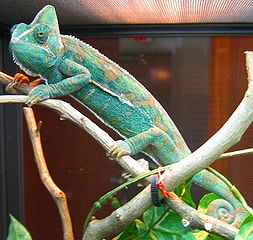
Chameleons hold a fascination for many people because of their rather over exaggerated ability to change colour. While they may not have the ability to match all the colours of the rainbow instantly some species do not need to: they are already half way there.
Hello, Frank Indiviglio here.
Thanks for your interest in our blog.
Good point – the natural colors of most offer great camouflage without embellishment.
Good luck and please keep me posted.
Best regards, Frank Indiviglio.
First off what a great site, so much information about so many different reps and phibs…Brilliant.
I have kept many Chameleons and have studied and researched them extensively. Have a look at my site i too have researched this topic and we seem to have found the same report.
http://www.yourchameleon.com/how_do_chameleons_change_colour.html
Very interesting article indeed.
Keep up the good work.
Dave.
Thanks for the kind words, Dave; I’ll check your site, best regards, Frank