 That Bird Blog – Bird Care and History for Pet Birds

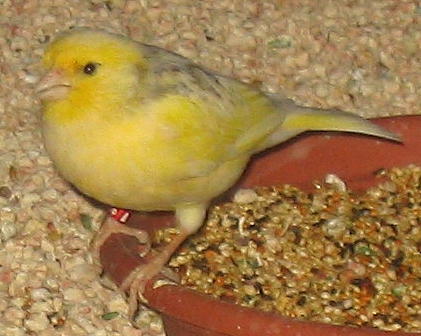 The Canary (Serinus canaria), known the world over for its fine song, has another side – certain individuals not only become quite tame, but can also learn a host of tricks. Most of the older bird keepers I worked with at the Bronx Zoo had honed both breeding and training skills on these delightful little birds. Space for parrots was not always available to those of us growing up in NYC, and Canaries were far easier to manage.
The Basics
Training Canaries takes a great deal of patience. Despite centuries of captive-breeding, they retain typical finch wariness, and are not as well-suited to training as are many parrots. However, in working with them you will develop skills that will be very useful in your future dealings with birds of all types. Hand-raised Canaries are another matter –they will readily bond to their owners, to the point of “courting” them during the breeding season!
A key point to bear in mind is that Canaries do not respond to punishment…slow, deliberate movements and rewards are absolute essentials. Training sessions of 15-30 minutes in length are ideal; anything longer will usually be stressful and unproductive.
Memories of a Talented Canary
I recall very clearly a female Canary that was kept behind-the-scenes in one of the bird exhibit buildings when I was a keeper at the Bronx Zoo. You’d never guess that the bird’s owner had not hand-reared her, for her repertoire of tricks and trusting nature were truly amazing. This Canary’s wings were not clipped, but she was extraordinarily tame…in most cases, it will be easier to work with a clipped bird.
The first trick my coworker’s bird learned was to obtain food by removing the plug from a glass test tube via pulling on a string. This trick was chosen as the first because it was very direct – the Canary could see the food within the tube. My coworker believed that allowing the bird to watch him pulling the string had hastened the learning process. I can’t say if this is so or not, but the next trick seems to confirm that the bird did indeed learn by observation.
The next trick was to teach the Canary to choose the correct container from a group of three. The treat-bearing container had a white top while the others had black tops, and the food was not visible within. After watching the container being filled with food, the Canary immediately went to over and pulled the string securing the proper cover. In time, the bird unerringly pulled the correct string when presented with containers filled outside of her presence.
Keeping Canaries
Healthy, well-kept Canaries make the most responsive pets. Although they often adjust to small quarters, Canaries are really most at ease in spacious flight cages. Be sure also to provide a healthful diet comprised of a high quality Canary Seed Mix, Egg Food, Fresh Sprouts and fruit.
Further Reading
For more tips on hand-taming Canaries and other finches, please see Taming Canaries and Other Finches.
You can also help to improve your Canary’s song – please see Teaching Your Canary to Sing for details.
An amusing video of a Canary that crosses the line from “tame” to “bold” (He’s named “Psycho Pete!) is posted here.


hey Frank 🙂
i was just wondering why is it that birds sometimes have downtime?
i mean like one day a bird accepts interaction and can proceed in taming, and then the next day a bird seems uninterested and becomes scared of the owner…
i keep having this problem. i understand it won’t last long but its annoyingly frustrating!
Hello Raymond, Frank Indiviglio here.
Nice to hear from you again. I’ve noticed the same with many cage birds, parrots and also zoo animals that I hand raised for use in education programs – owls, crows, beavers, servals, raccoons. Animals respond to cues that we are not aware of, can sense things that we cannot, and also have their own internal “lives” for lack of a better word, all of which affect their reactions. This is one of the reasons, I believe, that, potentially dangerous captives, even dogs, sometimes in jure or kill handlers after years of peaceful interaction. Best to proceed as you are – back off and try again later. Especially where birds are concerned, forcing is never useful.
Please let me know if you need any further information. Good luck, enjoy and please keep me posted.
Best regards, Frank Indiviglio.
thanks for the reply Frank… ^_^
so now i was just wondering:
when taming a bird, do i have to wear the same shirt?
i always wear white shirt when interacting, but those shirts sometimes have pictures or writings so they’re not exactly same.
my bird is distant again and so i was wondering could this be the reason…
Hello Raymond, Frank Indiviglio here.
Thanks for the interesting thought. I haven’t noticed that to be important, but it is useful to follow the same routine, whistle the same way to alert the bird that you are entering the room, and so on. You reminded me of my time working with condors that were being hand-raised and were then to be released. In that case, I hid behind a curtain and fed the birds via a hand puppet that resembled an adult condor’s head – to prevent imprinting. But canaries and most birds respond to general appearance and such; avoiding surprises in most impt.
Please let me know if you need any further information. Good luck, enjoy and please keep me posted.
Best regards, Frank Indiviglio.
hello Frank!
i’m sorry to bother you again but i want to know is it possible to pet (as in carress) a tamed bird?
because i’m glad my canary can finally do step up on my finger and began to let my fingers get closer to her.
maybe i could touch her a bit?
thanks 🙂
Hello Raymond, Frank Indiviglio here.
Thanks for the feedback – that’s very good news, and impressive progress. Some birds do enjoy a scratch along the top of the head, but this usually applies to highly social birds such as parrots, which are groomed by their mates/flock members very often. Social grooming is not as well developed in canaries, so the bird may see a touch as a threat. Try feeding it a treat while it is on your finger, as a way of getting her used to being in close contact with your fingers, then try a gentle touch on the head.
Please let me know if you need any further information. Good luck, enjoy and please keep me posted.
Best regards, Frank Indiviglio.
Oh, I would love to tame my canaries………..
They are so scared when I try to catch them to clip their nails……………
Hmmm……………
LuLu.
Sanded perch covers, placed on some of the perches, may help with the nails (they never adjust to nail clipping!); Please let me know how all goes, enjoy! Best, Frank
Hello Frank.
I am getting more busy these days, so I think it is not possible for me to tame one bird at a time like I used to do anymore.
As always, my bird of choice are canaries, and will always start with youngsters of one month old or older. Lets say I get 2 – 3 of them, and put them in a spacious flight cage. Every morning, I will gently stick my hand in with their food and sit patiently, taking advantage of their hunger.
Would you say its possible to have them tamed? Of course I will never expect them to be like hookbills, but at least they should be fond of my presence, not fly away, and will come to me for food.
Thanks in advance!
Hi Raymond,
That’s a reasonable approach…in a large cage they have more room to stay away if they wish…this lessens stress and may help them to adjust…in a small cage a hand is often frightening. Of course, individuals will vary, but I hope it goes well,
Good luck, enjoy, Franl