 That Bird Blog – Bird Care and History for Pet Birds

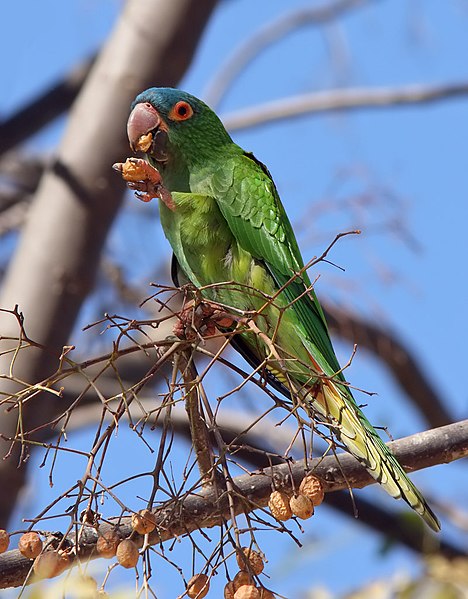 The Blue-Crowned Conure (a/k/a Blue-Crowned Parakeet, Sharp-Tailed Conure, Aratinga acuticaudata) has always had fans among parrot enthusiasts, but its popularity exploded in 1998 with the release of Paulie, a movie that featured one as the main “actor”. More recently, The Wild Parrots of Telegraph Hill, a documentary, also highlighted this species. Unfortunately, this type of publicity is not always ideal, as pets are often purchased for the wrong reasons (owl sales soared in some places after Harry Potter was released!). Blue-Crowned Conures are little studied in the wild. I’ve had the good fortune of observing both free-living and captive individuals, and today will focus on their natural history, and summarize their care needs.
Description
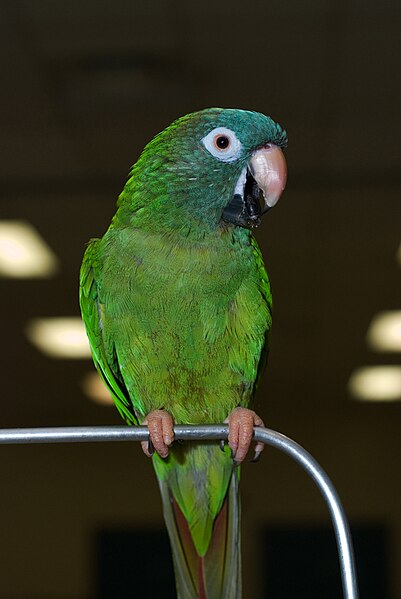
At 14.5 inches in length, the Blue-Crowned Conure is one of the largest species in the genus Aratinga. In common with other conures, it sports a heavy bill and long, tapered tail, but the sky to dark blue coloration on the crown and cheeks is unique. Various shades of green color the body plumage, while the undersides of the tail feathers are reddish-brown and tipped with yellow. All-in-all, it is a very attractive parrot.
Range
The range extends from northern Venezuela and eastern Columbia south through Paraguay and Uruguay to northern Argentina.
Five subspecies, differing somewhat in coloration and size, have been described. While working in Venezuela, I had a chance to observe A. a. neoxina in riverside thickets and even well out into the llanos. On nearby Margarita Island, I caught a glimpse of several of the few individuals that manage to survive there.
Feral populations are established in Florida and southern California, USA.
Habitat
The Blue-Crowned Conure is adapted to arid habitats, and may travel extensively when pressured by the lack of food and water. It is most often associated with deciduous forests, but also frequents riverside scrub, wooded grasslands, farms and city outskirts. In Bolivia, desert fringes are occupied (a relative, the Cactus Conure, A. cactorum, is a true desert bird; please see article below).
Conservation
The Margarita Island population, threatened by rat predation, habitat loss and collection, is believed to number less than 200 individuals. Other populations have not been well-studied.
In some regions, Blue-Crowned Conures are considered to be crop pests, while elsewhere they are valued for consuming weed seeds. The species is listed on Appendix II of Cites.
Ecology
Adaptability has likely assisted the Blue-Crowned Conure in surviving where related parrots have disappeared. It forages on the ground or in trees, taking a wide variety of seeds, tree and cactus fruits, berries, and some insects. Where roosting trees are scarce, Blue-Crowns pass the night in shallow caves.
Outside of the breeding season, flocks of up to 200 individuals form, sometimes in association with White-Eyed, Mitred and other Conures.
Breeding
The breeding season extends from September to February. The 2-3 eggs are deposited in a tree hollow and incubated for 22-25 days. The chicks fledge in approximately 8 weeks, and are fed by the male alone for some time thereafter. Two (rarely three) clutches are produced annually.
Vocalizations
 Field studies (please see article below) have revealed that this species utilizes 8 distinct vocalizations, and variations of each, to communicate with others.
The two alarm calls provide flock members with information concerning predators’ location and distance, and may also identify the type of threat (i.e. hawk vs. snake). Other vocalizations call the group together, with variations being utilized when flock-mates are in or out of view. Coordination of flight direction and mate-contact are also accomplished via unique calls. I’m sure that further research will reveal an even more sophisticated communication system.
Blue-Crowned Conures as Pets
Most conures have great pet potential, and the Blue Crowned is no exception; please see this article for a description of popular species. Many conure specialists consider the Blue Crown to be the friendliest and most intelligent of all. It is also a better mimic than its relatives, but cannot be considered especially “gifted” in this regard. Hybrids with other species, such as the Golden-Crowned Conure, have been produced.
Prospective owners should bear in mind that, despite their small size, Blue-Crowned Conures have very loud voices, are extremely active, and can reduce furniture to wood chips in no time flat. Like all parrots, conures need a mate or near-constant association with a favored person if they are to thrive. Please see the articles below and write in for specific care information.
Further Reading
Video: wild Blue-Crowned Conures
Field Study: Conure Vocalizations
The International Conure Association
Blue Crowned Conure image referenced from wikipedia and originally posted by Hakan Sandin
Blue Crowned Conure image referenced from wikipedia and originally posted by Bram Cymet
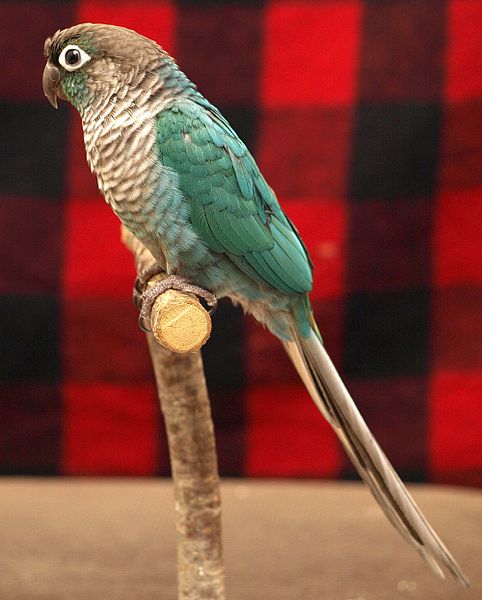
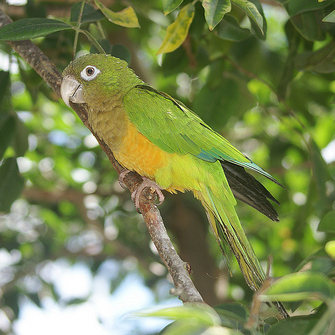
 Conures in the genus Aratinga are often suggested as birds to purchase for those who wish to keep macaws but lack experience (Aratinga means “little macaw”). Brilliantly colored but quite loud and with an indomitable spirit, conures do indeed resemble their larger cousins in many ways. Most do best in
  Many popular pet conures belong to the genus Aratinga, which means “little macaw”. Certainly they have outsized personalities, and “act” as though they are as large as macaws – if anything, they are even more boisterous.