 That Bird Blog – Bird Care and History for Pet Birds

See Part 1 of this article: Taming and Training Canaries and Other Finches, Part I
Last time we discussed some finch training basics…getting your pet to calm down when near people and out of its cage. Please see Part I of this article for further details.
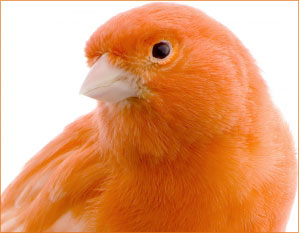 Returning to the Cage
As mentioned in Part I of this article, canaries and other finches are much easier to train when outside their cages. If your bird is to become truly tame, it is essential that it return to the cage on its own, and not be chased there. This may take a great deal of time, and will require you to be very patient.
Use treats to lure the bird inside. Canaries and finches often relish egg food, and may respond quickly when it is offered. Many finches cannot resist small insects. A convenient way to keep these handy is to utilize canned insects most silkworms are nearly always a big hit.
Your pet may also respond to fruit treats – freeze dried mango, coconut, papaya, blueberries and others work well for many species.
If you must net the bird, darken the room and try to be as quick and careful as possible.
Calling your Bird to Hand
The treats mentioned above may also be used to induce your pet to fly to your hand. If you call the bird each time food is presented, it may eventually fly to you when called, even if it does not see food in your hand. Continue to provide a treat each time it responds, but, as time goes on, hide the treat until your pet actually alights upon your hand (or head, as the case may be!).
Again, canaries are most apt to respond to this type of training, but I have also run across surprisingly responsive spice finches, Java rice birds, zebra finches, fire finches and others.
Further Reading
Although canaries are perceived to be natural songsters, a good deal of learning is involved…and you can help (no, you needn’t be a good whistler!). Learn more about improving your canary’s singing abilities in my article Teaching Your Canary to Sing.



Thank you this has realy helped me with my Zebra finches. if you can email me and tell me more i will be happy thaks!!!!!!!!!!!!!!
Hello David, Frank Indiviglio here.
Thanks for the kind words; I’m glad you found the article useful. Please write back with any specific questions you may have, and I’ll do my best to help.
Good luck and please keep me posted.
Best regards, Frank Indiviglio.
Hello Frank:
I’m so glad to have found an authority on finches such as yourself! We have a non-hand-fed nor reared female green singer (acquired in Sept. 2006) whom we have somewhat tamed. The taming stages are succinctly chronicled in my “Finch” playlist on You Tube (at http://www.youtube.com/user/CVersailles#grid/user/7DD42C08B7A359CA). For almost 3 years now, the finch has been let free from 9 to 5 in our living room (a sunroom) or dining room, along with our budgie. She is now well cued to our schedule and “modus operandus” and knows to get back in her cage on her own when needed. She is “desensitized” enough to be taken in the car, to people’s houses, on vacation, etc. She may experience stress and discomfort in certain situations, but she no longer “panics.” At onset, we noticed the bird refused to go to the bottom of her cage and would not feed in feeders placed near the bottom. So we put her in a cage where the feeders are not as low and enclosed in transparent “bubbles” that provide “a good view.” Yet, the bird’s feeding habits are like “a gazelle at the waterhole” (i.e., she feels “vulnerable” while feeding). My problem is that I have not been able to positively reinforce the bird with treats. On the one hand, though she eats very well and seems in perfect health, she is not very food-oriented and doesn’t like anything enough to be considered a real “treat” (forget about dried fruit, bugs and the like, nothing really does the trick.) She will accept food within the cage or on her cage porch, but when I try to “treat” her outside the cage with “rewards” (e.g., dehulled millet), she gets all stressed out while eating the treat, jumps back in her cage and will no longer interact (I have not gotten passed 3 treats in this manner and, usually, by the second one, she is too nervous to continue). Is it possible that this is a consequence of her associating “feeding” with “vulnerability” and “danger”? Your thoughts, opinions and advice will be greatly appreciated. Thank you!
Hello Claire, Frank Indiviglio here.
Thanks for the kind words and your most interesting observations and video links; all will be of great value to other bird owners.
I believe you are correct in your beliefs about the bird’s nervousness when feeding out of the cage. Natural instincts are often modified by captivity, and so are sometimes expressed differently – but, as you were able to deduce, the underlying principles still hold true. I’ve observed a great many other animals, long term captive birds, reptiles and amphibians, that refused to feed when outside of their cage, even though well-adjusted to people. In zoos, animals often will not leave their cages id a door is left open (although sometimes they will, as I learned when I working with a Kodiak Bear!) and escaped animals often try to get back into their enclosures.
You’ve done a great deal more with your finch than most accomplish – thanks for the note and please check in again,
Good luck and please keep me posted.
Best regards, Frank Indiviglio.
Hello again:
Thank you for such a prompt reply, confirming that my observations are not mere “ramblings.” Note that she WILL nibble on food outside the cage, but only if I put it in a certain tree perch that overlooks the whole room and the garden. If I put it on a perch near a corner or in the middle of the room, she will not go. And she will not accept it “from our hand” in such circumstances. So, I feel that when we have our little morning sessions, dealing with me is already somewhat stressful and the added stress that she perceives while “feeding” is just too much for her to handle at once… I guess we will just continue with praise, relationship building and bonding, and forget about the treats! (P.S.: Thank you for YOUR kind words!)
Hello Claire,
Thanks again, I’m sure the height/view is important as well, look forward to hearing from you in the future,
Good luck and please keep me posted.
Best regards, Frank Indiviglio.
that is cool. send bach soon.
Hello Gracie, Frank Indiviglio here.
Thanks for your interest in our blog. And the kind words…I look forward to hearing from you in the future.
Good luck and please keep me posted.
Best regards, Frank Indiviglio.
i have just got 4 zebra finches on friday is it possible to train all 4 at same time? they stay in my bedroom so i cover the cage at night as well is that necessary to do so ? and how long before they use the feeder compartments on the cage ?as i filled up some small bowls at bottom of the cage 1 food and 1 water any advice im a novice with this sort of thing
Hello Lee, Frank Indiviglio here.
Thanks for your interest in our blog.
Good questions….it is more difficult to train finches in groups, as there will surely be at least 1 shy individual, which may panic the others by its reactions. But you can try…4 together will provide you with lots to observe, even if training is not possible.
They usually take to feeders well – once 1 starts, the others will follow….cut back on food in bowls and remove the bowls on a day when you can be nearby to observe.
You might enjoy reading The Unknown Side of the Zebra Finch (history as a pet and lab animal).
Good luck and please keep me posted.
oh really good idea. But is that worked in the real world?
Hello, Frank Indiviglio here.
Thanks for your interest in our blog. Birds are very individual in their responses to people, but in general canaries do tame down fairly easily. Even wild birds can be induced to feed from the hand with care – please see this article for details (bird in photo is feeding from my hand).
Please let me know if you need any further information. Good luck, enjoy and please keep me posted.
Best regards, Frank Indiviglio.
Hi can you send me alot of tips because would if my zebra finch crawls in small tight spaces, would if it goes inside a crack in the wall can you give me more information to me please
Hello Alex, Frank Indiviglio here.
Thanks for your interest in our blog. It’s not a good idea to release a bird into a room unless it has been carefully “bird-proofed” by sealing all possible hiding places and removing other hazards.
Please let me know if you need any further information. Good luck, enjoy and please keep me posted.
Best regards, Frank Indiviglio.
Hello Frank:
My latest You Tube upload shows how our female green-singing finch can perform an action on cue without seeing her reward beforehand, the result of several weeks’ work. This is a significant step, as she is not easily motivated!
The video, at http://youtu.be/BCPqxhDFJKI, was shot 3 days ago as a “demonstration,” but I have very slowly been increasing the distance she has to travel…
I hope you and others enjoy it!
Best regards, Claire.
Hello Claire
Thanks so much for sending this along…very impressive, congratulations! I’ll be sure to forward it to others who may be interested; Looking forward to your next,
Good luck, enjoy and please keep me posted.
Best regards, Frank Indiviglio.
Hi Frank,
Our female green-singing finch Biquette will be 6 this summer: she has always had her (almost) daily bath in a small tub that fits on her cage door; she knows to have her bath quickly in the morning if she wants to come out, because there is only 1 door to her cage! We have often tried setting out a tub outside the cage on a table, but she has always shied away from that. For some time now, we’ve had a young female budgie temporarily under our care. Our own budgie always refused to bathe and he is therefore showered in his cage. The “guest budgie” also refused to bathe until I discovered that a “herbal bath” is what she craves: quite a large container with a fair amount of water, a piece of fennel and some lettuce. You can imagine our astonishment when we observed Biquette frolicking in that big tub! What has now become a daily early-afternoon scene is documented in my latest You Tube upload, at http://youtu.be/CuztosQQL64.
I wonder: Is Biquette especially stimulated by the competition provided by this female budgie? Or it may be that she’s just a sucker for “herbal bathing” herself! I tend to opt for the former, because of similar observations I have recently made: with 3 birds instead of 2, I decided to put out 1 bowl of veggies on the table in the morning, instead of individual feeders in each cage; the result has been decisive and the birds eat 2 to 3 times as many veggies than when they have their own little bowl in the cage (they have cage doors open during the day and simply go to the cages to feed). The budgies love the “freely-available” veggies, and the finch also seems to thrive with this system. She must find her “window of opportunity” and this seems to correspond more to her “innate” behaviours.
I may be kidding myself, but I’ve decided that when our “guest budgie” leaves, I will continue to put out a single bowl of veggies for my 2 birds, as I’m now convinced that this “modus operandus” better coincides with their natural instincts.
Do you agree?
Best as always,
Claire
P.S.: I hope you enjoy the video!
Hello Claire,
Nice to hear from you…thanks for sharing the story and video!
Competition could definitely be involved…I’ve seen the feeding reactions you’ve described in all manner of creatures. Poultry and other farms have used similar scenarios to increase food intake. Birds and a surprising variety of other animals can also learn by imitation, so there’s always a chance that was involved. You might enjoy this article on tortoise learning abilities.
Enjoy, Best regards, Frank
Greetings again Frank:
Many thanks for your insight, and I very much enjoyed the article about the tortoises. It’s too bad our budgie Babi does not go for this “imitation” principle: he sees the others enjoying the bath but he remains undeterred! We’ve tried every trick in the book over the years to get him to bathe on his own, but to no avail… (He will soon be 7, and pretty set in his ways…) One thing is certain, our “guest budgie” has learned at least 500 things by “imitation” since she has been under our care!
Thanks again for your very prompt reply,
Claire
Hello Claire,
My pleasure, glad you enjoyed…perhaps your guest will impress her owners and be sent back for an occasional “class”!
Best regards, Frank
LOL! Actually, the bird is a “lost-and-found parrot” who was (thankfully) put under the protection of “Perroquet secours,” a non-profit that handles such cases province-wide and for which we are a volunteer “transit home.” This is our 3rd “lost-and-found parrot” since last summer (2 budgies and 1 cockatiel). This budgie is now advertised on their site for adoption (see http://perroquetsecours.com/forums/viewtopic.php?f=31&t=3480) but cannot leave its transit home before a period of 2 months, deemed a “reasonable” amount of time to find its owner according to our laws (The Quebec Civil Code).
This bird, approx. 8-9 months, will be assured a great permanent home (Perroquet secours rules are very strict) and, whatever her former background, she is now well socialized and will make a great addition to any family.
We are thrilled to take part in this program: according to their stats, most lost parrots have wings CLIPPED, so you can imagine their vulnerability in the “wild” (of downtown Montreal or elsewhere). Because of the very clement weather we experienced this year, the “lost-and-found parrot season” began much earlier than usual, and this particular bird was found near the end of March!
I think I will soon have an update of our finch’s “recall” skills, as she is now willing to travel a somewhat greater distance all the while not seeing the treat beforehand.
I’ll keep you posted!
Claire
Hi Claire,
Thanks for the feedback…very admirable work you’re involved in. Very good, I think, that there are regulations governing such things…not much in that regard here.
You’ve likely read about the Monk Parrots established in NYC and elsewhere; here’s more on their natural and un-natural history.
Best, Frank
Bonsoir Frank:
Yes, I was aware of the NY quakers, and our local parrot club even organized a trip to NY a couple of years ago, but we did not go. I read both parts of your article with great interest, as I did not know they had spread as much as reported… Fascinating… I’ve also heard about thriving budgie flocks in Florida, apparently originated from “escaped” birds.
There’s no doubt in my mind that birds are among the most adaptable species on earth…
Cheers,
Claire
Hi Claire,
Glad you enjoyed. Florida leads the world in exotic species – an astounding 70 parrot species have been observed at large in Florida, with appx. 40 being established and breeding; you might enjoy this article.
Larger numbers of reptiles and amphibians, insects and fishes have also been introduced, along with other birds and even mammals (capybara, of all things, pouched rats, armadillos and more….).
Best regards, Frank
That is truly amazing! I knew about the budgies, but African grays in Florida? For some reason, it sounds “OK” that South American species would find a home there, but Australia and Africa, that just boggles the mind!
Your articles are just the best!
Claire
Hi Claire,
Thanks for the kind words, much appreciated. I know what you mean…there are African Starlings and Pouched Rats there as well, very odd indeed…
Best, Frank
Bonjour Frank:
As promised, here is our female green singer Biquette still hard at work towards obtaining her master’s degree in “flight recall”: http://youtu.be/19DMGkl3nhE.
Note that she consistently travels twice as far, but my husband close by pointing the camera at her makes her very uneasy and she does not want to fly closer to where HE is…
Cheers!
Claire
Very good to see, Claire,
Thanks so much and keep at it!
Best, Frank
Hello Frank,
Thanks for your helpful blog. It’s really great!
I have a 4 months old canary, I bought it one month ago. He flies all over the house and returns to his cage whenever he wants. But I don’t know how to call him to my hand. I prepare food in my hand and make sounds! When he flies somewhere else I follow him and stand near him to attract him to the food. but there is no respond. : (
What should I do?! and how much time it takes to work?
Thanks again and sorry for my terrible English 😀
Good luck
Amir
Hi Amir,
Thanks for the kind words
Canaries vary a great deal, but it’s a very good sign that the bird returns to it’s cage. it may just take time..try using a favorite food that it does not get otherwise – many enjoy various greens; also try when it is extra hungry – perhaps delay a meal, etc. Best not to follow the bird around, let it come to you.
Please keep me posted, enjoy, Frank
Hello again Frank,
Thanks for your help and your quick answer!
I don’t make it scare by following, I just go where it can see the food in my hand. Does it matter?
And you talked about making the bird hungry. So I want to hide the cage but I don’t know how many hours can I hide it that doesn’t hurt my canary?
Good luck,
Amir
Hello Amir,
My pleasure, thanks for the feedback. It’s fine to move around as long as you are not stressing the bird. You might try removing the birds food dish for an hour or 2 before letting him out and trying to attract it to your hand. As long as it is in good health, 2-4 hours without food will do no harm (actually, they can go for longer, but no need to push it too far).
Best regards, Frank
thank you Frank, That really Helps.
You’re welcome..enjoy and please let me know how all goes, Frank
Really helpful!
Hi Frank,
I’ve sent you one email about me considering a lovebird, but after reading your posts a bit more I began to reconsider again… Because a tamed bird that attacks other family member will not be tolerated, even by me…
Not to mention I’m quite busy
So perhaps I should stick with canaries? I do have this one very intelligent yellow canary that I just got last December… Still young, but is already learning to sing and hop up my hand when fed (when he’s kept alone)
So if he were to become a substitute for lovebird, is it ethical to trim its wing feathers? I know a tutorial video that explains with the right method of trimming the bird can still fly, but not gain height, so wing exercise is still possible.
Hi Raymond,
We crossed emails….
Glad to hear you were able to work with your canary; they can make quite charming pets, and it’s a nice accomplishment to have one that trusts you. In most homes, I’d recommend them over most parrots…
Trimming is fine if done properly; once the bird adjusts, life is generally less stressful for both it and owner,. Trimmed wings can complicate mating if the male is unable to balance himself, but otherwise he should be fine, Best, Frank
Hello and thank you for the reply Frank.
Yes, in the video, the trimmed wing feathers are the second, third, and probably fourth one from the edge, and its done to both wings.
So should the bird try to fly, they can only glide but is well balanced, thus will receive no injury if they land…
After the trimming, the interaction session can be as usual yes?
Is it true that trimmed birds tame faster?
Thank you
Hi Raymond,
It’s often said that trimmed birds are easier to train, the main reason being that they are more accessible, easier to get close to etc…however, if the process is rushed it can be very stressful, as they cannot eascape as easily and will sense this; so bets not to push him; also, trimmed or untrimmed much will depend on the bird’s individual personality/”wiring”
Enjoy, best, frank
I see, thank you for the reply Frank!
So if it depends on the bird’s personality, which one is best trimmed?
– one that is calm, but shy and timid
– or one that is more outgoing, and has started to sing at an early age
I’m just going to try on one bird. if it does work, it would help me for the next ones.
Thank you
I Raymond,
Unfortunately there are no hard and fast rules, but if I had to choose I would try the calmer bird,
I hopa all goes well, best, Frank
Hi Frank,
Can we have friendly finches if we spend a lot of time in the aviary?
Let’s say I’ll make an aviary large enough to have a table and some seats.
I’ll make it as comfortable enough so that I can spend a great deal of time in there, and everyday I feed the birds (canary; java finch; gouldian finch too) their food on top of the table.
They’ll have to come near me as I sat beside their food minding my own business (reading, browsing, etc) and of course moving very slowly and gently.
I’m not asking for them to come when called, do tricks, or anything like that…
But at least they won’t be freaked out when I enter, greet me everyday, and play near me. Will that happen? Thank you
Hi Raymond,
All sorts of animals can become habituated to people in that manner…I even saw this with bullfrogs that lived in an artificial pond near where I ate lunch daily at the Bronx Zoo. Looking directly at birds can be stressful at first,..they definitely notice eyes, and associate a look with danger. A long out of print book Hand Taming Wild Birds at the Feeder has many useful tips, perhaps available on Amazon or your library?…Best, Frank
hi i am writting because i want to know What are the different types of finches im trying to collect the i have two spice fiches ni fell in love with them so of you can please help me out with the name of each finch that will be great
Hi Andrea,
Well…great question, but the answer would take up many pages! “Finch” is a general term that we usually use for birds in the families Fringillidae and Estrilldidae; birds in other families may be called finches as well, but most are not sold in the pet trade. You can check these families online, for a list of their many species; MANY GREAT BIRD ENCYCLOPEDIAS AVAILABLE AT LIBRARIES and for sale as well. Hundreds of species are bred world-wide for sale in the pet trade. This article:
http://blogs.thatpetplace.com/thatbirdblog/2009/10/06/finches-sampling-the-incredible-diversity-of-species-available/#.Ue1KvG2cXLM gives information about a few less commonly kept types that I enjoy.
For an example of the species that are offered for sale, please go to this site and click on Africa, Australia, South America, Eurasia and Hybrids…drawings of each are shown as well.
Please let me know if you need more info, best, Frank
Hello Frank,
I have been struggling to train my Fife canary for the past year now, and I was wondering if you could give any advice?
Basically, my (male) fife canary is three years old, and lives next to another canary (both are in separate cages) and he is called Pepper (his neighbour is called Salt). Pepper is a very calm bird, but he loves to sing, and I have been trying to train him for a very long time.
I usually hold BIG piece of broccoli in my hand against the bars of the cage, so that he knows that my hand provides treats and it is good. He did go through a phase where he would eat out of my hand (in the cage), but now he seems to not want to ):
And that’s why I really need your advice, I’ve been so patient, and I just want to know whether I’m doing the right thing?
I can’t really take him out of his cage, because every room in my house is not really bird proofed, except for the bathroom, all I need to do is cover the mirror and switch off the light, (our windows are frosted so the they aren’t transparent) and close any holes or gaps in the room. Do you think this would be a good idea? This would be the second time Pepper is allowed to free flight.
Also, I want to make sure that my parents don’t mind my canary flying around our bathroom, so I may not be able to use it for every training session.
Thank you so much and sorry for my ramblings!
jazzycanary
Hello,
You are going about it in the right way, but canaries vary greatly in their acceptance of humans, etc…many will not tame down, even though they may accept food from hand while in cage, etc. Free flight is not a good idea unless the bird is accustomed to handling, etc; a bathroom would likely be too small for a bird that has not been out much – they tend to bang around, wind up on floor, too close to people, etc. perhaps best to do as you’ve been…let them get used to you, but don’t focus on training, handling. Best, Frank
Thanks for the advice and the quick response!
I think I will stick to taming him in his cage, until I find a larger and more suitable room for him to train in!
Thanks again,
jazzycanary
My pleasure…please let me know if you need anything, enjoy, Frank
Hello Frank:
It’s been a while since our last exchange… This time, unfortunately, I bring very sad news indeed: our female green singer Biquette passed away on March 5 as she neared her 8th birthday. Our final tribute to this incredible bird is at http://www.youtube.com/watch?v=pWuf7g18LK0&feature=share&list=UUzbtOyNJry_Si1OsCKdHjAA
There is nevertheless a bright side to offset these painful times: we’ve had a song canary at home for a week now, a rescue bird found outside in minus 20 C temperatures. If he is not claimed within the next 6 weeks, we will officially adopt him. He’s cute as can be (orange color) and he sings like a God!
Best as always,
Claire
Hello Claire,
Sorry for your loss and thank you for the link; I’m sure the bird had a fine life…and I’m happy to hear you are continuing to help others; good luck with the new one, enjoy, Frank
Hi there!!
i recently got a canary from my uncle who breeds them and the bird is a month old and has been in the same cage since it was born.. i want it to get used to its new area and want to let it out but will it go back?
also the bird seems to be very scared of any human so any suggestions to help it get over the fear will be appreciated
Thanks a lot
Hello,
If released it will not likely go back unless gradually acclimated to a new room, given time to realize food is in cage etc. best to start by just remaining near bird, in same room, working slowly around it and in cage, gradually offering favored treats by hand…they can be difficult to approach, but do not try to rush the process. I hope all goes well, frank
Hi Frank,
Thank you for the quick reply and sorry to bother you again. The canary seems really scared and agitated what should i do ? classical music doesn’t seem to help and would a bedroom be an ideal place for it ? again sorry to bother you with all my stupid questions . i just want to raise this bird well 🙂
Thanks
My pleasure..please write in anytime.
The quietest room in the home is best for now..classical music is a good idea if there are unexpected noises…cars, loud radios etc – I used it with great success at the zoo, with mole rats of all thing! 10-12 hours of darkness, in a quiet location, is important at night. Nervousness is normal for a time, especially aftet a move. Please keep me posted, best, frank
Hello,
Just in case you still respond to comments on this blog, I have a question. I have had a goldfinch for the past 3 or 4 years. I never tried to tame it. It no longer panics when it sees me or members of my family. Is it too late to try and tame it? Thanks!
Anne