 That Bird Blog – Bird Care and History for Pet Birds

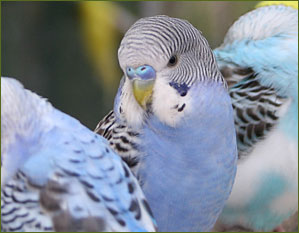
Swollen areas and assorted growths are regularly seen on the otherwise hearty budgerigars (parakeets) and, less commonly, on other parrots, finches and softbills. Ranging from harmless to quite serious, these typically arise from trauma, abscesses, tumors, ruptured air sacs, hernias, cysts or egg-binding, but other -less obvious maladies may also be at work.
A Caution
The following remarks, while written with budgerigars in mind, are applicable to all types of birds. Please note that they are provided as guidelines, to help you understand what might be happening… only a veterinarian can accurately diagnose your bird’s medical problems.
Even benign growths, if accompanied by shivering, loss of appetite, breathing difficulties or similar symptoms, are cause for concern and necessitate an immediate visit to your veterinarian.
Ruptured Air Sacs
Budgerigars and other birds may rupture air sacs by flying into windows or other obstacles during their time out of the cage. Bird-proofing flight rooms and gradually adjusting your pet to such will go a long way in alleviating this problem. Less commonly, air sacs may be damaged when startled birds crash into cage bars or walls.
A swollen area along the breast, which emits a characteristic “crackling” sound when gently touched, is a sure sign of a ruptured air sac. Unless involving a huge area, air sac damage usually resolves quickly on its own.
Hematomas
Trauma-related injuries that do not involve air sacs may result in hematomas…swollen, blood-filled injuries below the skin (in people, such are often called “black-and-blues”, but skin color change will not usually be evident in a bird).
Resulting from broken blood vessels, the pooled blood typical of hematomas is usually re-absorbed by the bird without incident.
Abscesses
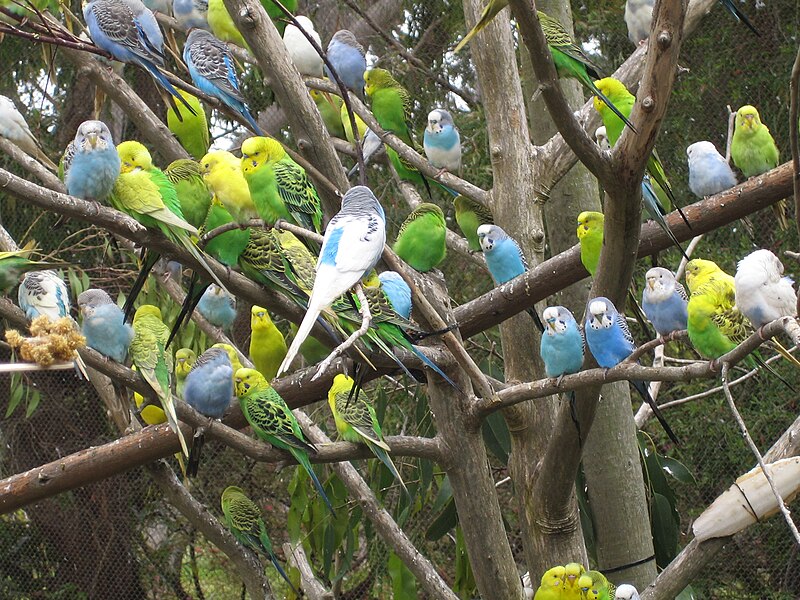
Avian abscesses present as swollen, painful, reddish areas that are warm to the touch. The swollen area, or abscess, is filled with white blood cells and other blood borne compounds produced by the bird to battle infection. The abscess usually also contains dead tissue and living and dead bacteria or other pathogens. Budgerigars often exhibit abscesses below the eye, but they may also occur on the feet, in the mouth and at other locations.
As a defense measure, the abscess has been walled off from the rest of the bird’s body, but the toxins and bacteria contained therein can escape and spread via the blood to vital organs. This can happen very quickly, and usually has fatal results. Therefore, all abscesses should be treated promptly by a veterinarian.
Gout, a disease that takes hold when uric acid is stored in the joints and internal organs, sometimes produces abscess-like growths on the feet of budgerigars. Known as tophi, these growths will bleed extensively if impacted or cut, and should be addressed by a veterinarian.
Tumors
Tumors are often difficult to identify specifically, and may arise from a wide variety of diseases and conditions. Fatty tumors are usually benign and require monitoring but no other treatment, while others may be malignant.
Any unusual growth or swelling that you notice should be examined by a veterinarian. A biopsy may be used to confirm the doctor’s diagnosis if there is any doubt as to the nature of the problem.
Next time we’ll complete our review of noxious bird bumps with a look at feather cysts and cloacal swellings. Until then, please write in with your questions and comments.
Further Reading
You can access a detailed article concerning the types of tumors that afflict budgerigars here.


my budgie has a cyst under its wing, it keeps scratching it,and has made it bleed. i have another bird in its cage with it also. is it contageous?
Hello Joanne, Frank Indiviglio here.
Thanks for your interest in our blog. Cysts are typically not contagious, but its important that a vet examine the birds to be sure that what you are seeing is indeed a cyst and not a symptom of another condition. Also, infection via the open wound is a serious concern…many travel fast and can be fatal rather quickly. Please let me know if you need assistance in locating an avian vet.
Good luck and please keep me posted.
Best regards, Frank Indiviglio.
Hi Frank I was wondering if you might be able to help me with my parakeet he is about 8 years old and Ive never had any health issues but about 4 days ago I noticed him sitting on his perch shivering, fluffing his feathers and burying his face in his wing. I kept an eye on him that day to see what might happen the next day he was still looking cold so I covered his cage with a sheet so he could still look out the front I placed a heating pad under his cage and a pointed a light into his cage to warm him and 10 minutes later he looked better, still cold but better so i put the light closer and covered his cage entirely to keep the warmth in, he is more active and looks wonerful compared to a few days ago but he still slightly shivers, I am afraid to uncover him for fear he will once again get cold. What do you think is going on with him?
Hello Monika, Frank Indiviglio here.
Thanks for your interest in our blog. Increasing the temperature as you are doing will help boost the bird’s immune system but, unfortunately, will not cure him. He likely has a viral or bacterial infection, similar to a “cold” in humans and needs to see a vet. As birds age, their immune systems may weaken and so conditions that they tolerated earlier may render them sick, so be sure to inform your vet about the room temperature, diet, etc.
Infections progress very rapidly in birds and are fatal if not treated early on; please let me know if you need help in locating an avian vet.
I hope he recovers….Good luck and please keep me posted.
Best regards, Frank Indiviglio.
Hi Frank, I have a parakeet that is about 5 years old. Recently she (?) has gotten a crusty growth above her beak just below her nostrils. It is kind of thick but not completely uniform which makes me think it might be something that is not normal. The bird is healthy and happy but the growth worries me. if it was to cover her nostrils she couldn’t breathe. Please let me know if I should be worried. Her name is Sunshine and is a very sweet tame parakeet. Thank you for any advise you may give me. Linda J.
Hello Linda, Frank Indiviglio here.
Thanks for your interest in our blog. Material buildup on the cere (the hard area housing the nostrils) is common in females that are coming into breeding condition. It’s related to hormonal changes and is usually not a concern.
However, there are also bird mites that burrow into the cere and leave flaky deposits on the cere’s surface. Sometimes you can notice tiny scars from where they have tunneled, but often not. A vet visit to rule out mites, fungus or another serious condition would be your best option. Please let me know if you need assistance in locating an avian veterinarian.
Please let me know if you need any further information. Good luck and please keep me posted.
Best regards, Frank Indiviglio.
I would be grateful if you could let me know if there is an avian vet in my area (northampton) that I can take my 12 years old budgie to. She has an open wound under her wing that she keeps pecking at and making it bled – not sure what it is but it is definitely not caused by a collision during flight. I am worried that it will become infected.
Thanks for your interest in our blog. Yes, good idea to have the bird checked as infections are a major concern.
Please check this listing of avian vets in the UK. I’m not familiar with any personally (am writing from the USA). If none are conveniently located, call the nearest and ask for a reference…avian medicine is a small specialty and vets tend to be familiar with others in their region.
Please let me know if you need any further information. Good luck, enjoy and please keep me posted.
Best regards, Frank Indiviglio.
Hi Frank,
I have a parakeet thats around 5 years old and I noticed that was picking the feathers by her vent ( Cloaca ). And her droppings are sometimes normal, but other times its liquidy. I also noticed that she is having difficulty pooping. And everytime she poops, I see her bottom swells into a ball, and then she poops. Its as if that either her ovaries are swollen, or she has a tumor or something. There is no growth on the outside, but something is going on internally. She is fluffed up and shivers, but also has days where is she very normal and active. she eats seeds, millet, and drinks water, and she can still fly inside her cage. I am not sure what to do. could she have an infection in her ovaries, or could it be a tumor or something else? this is been happening for the last 3 to 4 months. your insight is greatly appreciated. Thanks.
Hello Zee, Frank Indiviglio here.
Thanks for your interest in our blog. Unfortunately the symptoms you describe can indicate any number of problems; Actually, I’m surprised the bird has survived so long, given that an infection is likely (shivering, puffed feathers) present along with whatever else is going on. This is not something that can be diagnosed without a vet visit; I suggest you do that as soon as possible. Please let me know if you need assistance in locating an avian vet in your area.
Please let me know if you need any further information. Good luck, enjoy and please keep me posted.
Best regards, Frank Indiviglio.
Hello frank,
Well, to give you more of a background, this parakeet was with another female ( they are both females ), and they were together for 5 years. And the other parakeet would always rub its vent and pluck feathers ( almost similar symptoms, but no ball-looking object when attempting to poop ). The other parakeet had struggled with poop being stuck to its vent, and the couple of times I’ve taken it to the vet, i would give it a shot of Betrayl and it would be fine, but then the feather plucking and poop sticking would return. This continued off and on for 3 years. But recently, my current parakeet attempted to mate with the previous parakeet, and it looks like it might have gotten the ‘infection’ or whatever it is, from the other parakeet.
The other parakeet i had given it orncycline, but it died after 4 days of putting orncycline in the water (they both drank it for 4 days, but only the other died, which it shouldn’t have ). So my current parakeet has either gotten the infection from the previous parakeet, or it might just have developed a cyst or a tumor in its ovaries. And i do know that parakeets can live with cysts for years, and that surgically removing them would only endanger the parakeet and that the tumor/cyst would come back ! so my options would be to either have surgery ( which is very dangerous ), or try to get it baytrail, or to continue to monitor the parakeet. what do you think? Thanks
Hello Zee, Frank Indiviglio here.
Thanks for the feedback. However, it is not possible for me to speculate as to whether a cyst/tumor is present or where it might be located; far too many possibilities. Same regarding surgical options/outcomes. Please do not give Baytril without a proper diagnosis of the condition. My best advice is that you have the bird examined by an experienced avian veterinarian.
Please let me know if you need any further information.
Best regards, Frank Indiviglio
Hi,
We just got a young budgie a few weeks ago. It(can’t tell if boy or girl)still has trouble with getting on and staying on my hand. It’s wings are clipped, but yesterday I noticed a small bulge under it’s feathers in the front between the feet. It isn’t puffed, it still eats fine, it still tries to escape, but I noticed the bulge is twice as big today. There was a little blood on it’s feathers and some times it picks at it. Could it be an ingrown feather or something like that? Thanks
Hi,
Unfortunately it’s not possible to accurately diagnose the problem at home; several of conditions described in the articles, and others, could be involved. Please let me know if you need help in locating an avian veterinarian in your region, and please keep me posted,
Best, Frank
My only parakeet has been laying eggs constantly for a while and then she stopped for a couple months.When i tried to clean out her cage, she jumped out and when she ran back to her cage, i notice that her lower abdomen is hanging and swollen.Her lower stomach has a big bulge coming out of it, but other wise she is playing and eating and drinking and passing waste normally?What could be wrong?She has never been injured before and I don’t think I can afford a surgery for her at this time.
Hello,
A prolapse or egg-binding may be involved, but there is noway to diagnose or treat this at home. You’ll need to bring the bird to a vet, as either condition can quickly worsen and be fatal. Other problems, including tumors , cysts, etc, could also be involved.Be sure to move the bird carefully, when transporting, as jarring and frantic movements could worsen a prolapse or other condition.
Good luck and please keep me posted, Frank
Hello Frank, I have a female African Grey who has an abcess under her wing and this wound is not healing. It started 2 months ago. I took her to the hospital where they cleaned and stitched the wound, all to no avail. Then I put flaminol ointment on it which improved it considerably but still it is not healing. Today I noticed a new abcess under her other wing. Could you tell me what else I could do?
Hello,
Unfortunately, it’s not possible to diagnose/offer treatment for an abscess without the appropriate vet exam and tests. Spreading abscess could indicate that the problem/infection is systemic, and so treating the individual abscess would not sufficient. A culture may need to be run, followed by medication, but you’ll need to have the bird examined; perhaps a second opinion is in order. Please let me know if you need help in locating an avian vet.
Sorry I could not offer a more useful response, Best, Frank
Hello, I have a Parakeet with a soft lump towards the bottom of his belly.. It looks like the feathers have some how fallen off so it’s quite obvious and slightly sticks out. I have been researching it and I don’t really know what it is? He’s obviously a bit lethargic… his wings are slightly down, and he just seems down compared to the other 4. Also, when i bring them into my room i have little perches for them and he’s the only one that doesn’t go on them… so i felt bad and put a nice soft blanket neatly underneath the little perches i have for them just for him. I’m pretty sure he’s a boy because his band is a purpley blue color. Please tell me what you may think this is! Thank you!
Hello Sarah,
There’s no way to diagnose the condition at home; the fact that the bird’s behavior is affected indicates that it is a serious condition and not simply a benign cyst. You should visit a vet as soon as possible, as most infections progress rapidly in birds. Pl let me know if you need help in locating an avian veterinarian.
Best regards, Frank
Hello I have an African grey who has developed a lump on his neck which has a crusty brown covering it doesn’t seem to b bothering him but is getting quite large. I hav no idea how old he is as he was rescued . I would grateful for any advice. Thankyou
Hello Anita,
A lump such as you describe can be attributed to a wide variety of health concerns, and may be quite serious even if the bird suffers no other apparent problems. Unfortunately, it cannot be diagnosed by appearance alone; an avian vet should be consulted. pl let me know if you need help in locating a vet.
Best regards, Frank
Hello I have an African grey who has developed a lump on his neck which has a crusty brown covering it doesn’t seem to b bothering him but is getting quite large. I hav no idea how old he is as he was rescued . I would grateful for any advice. Thankyou
Well thankyou for getting back to me I am quite worried about him il seek advice from my vets then.
Kind regards
Anita gray
hi frank,
first of all your doing a great job with your site
and one of my budgie pair is clutching chicks with french moult what to do both with chicks and pair
Hello,
Thanks for the kind word. French molt is not curable but is rarely fatal; please see this article ; Diet and lighting changes can help with related molting concerns, please see this article and let me know if you need further info. Best, Frank
Hi, my friends budgie who is six years old has developed what we think is a tumour
At first she though it was constipation as he had got poo stuck on his feathers but it has gone a reddy colour and we think it may be a tumour do you know what it could be or if there is a cure or if it is fatal
Many thanks
Hello,
Unfortunately there is no way to diagnose or treat the condition at home, a wide variety of conditions will present the same symptoms. please let me know if you need help in locating an avian veterinarian. Best, frank
Hi,
I have a white female budgerigar that is approximately 10 years old, I don’t know her exact age as I got her second hand fully grown. She is housed in a large aviary with 4 other budgerigars.
A few days ago, my sister noticed a large lump on her belly just behind her legs, there is pin prick sized cut in the centre and the whole lump appears to be a little sore. However, her behaviour is unaffected by this, she is eating, drinking, flying and grooming as normal, and she is socializing with the other birds just fine too.
So far we have been treating her with warm water and mild antiseptic to clean the lump. She is also being monitored very closely for any change.
Should we take her to a vet or continue as we have been?
Hi Kate,
Best to take her to a vet, as a number of very different problems could give rise to those symptoms. The antiseptic has no doubt been useful, but if an infection becomes systemic the bird could decline very quickly; vet would also be able to check the exact cause of the lump (infection is usually secondary to another problem). Please keep me posted, I hope all goes well, Frank
hello Mr Indiviglio,
I just noticed today my parakeet he is about 5 or 6 years old has a wierd thing in his left nostril, I thought it was just something in his nose, i try to take it out but I think its growing in his nostril I dont know what it is can you please give me some idea, it is like kind of pink or red, but coming out of his nostril, please help.
Hello Kathy,
Unfortunately it’s not possible to Id from a description, as several different conditions can lead to a growth such as you describe. Best not to touch or try to remove; the bird should be seen by a veterinarian; please let me know if you need help in locating an experienced avian vet.
Best regards, Frank
I believe that my 6 yr old budgie has a cyst or tumor on his “preening” gland. I have noticed it for about 3 months now and it has continued to grow. It continues to bleed sporadically as well. After discussion with a local vet, we thought it may have just been impacted, but now appears to be growing more rapidly. Unfortunately, we do not have an avian specialist in our area. His appetite and activity level remain normal, but not sure how much longer he can survive with the growth. Any thoughts? Thank you for your time.
Hello,
The growh would need to be identified before treatment can be proposed…try searching for local bird clubs to see if they have an avian vet to refer you to; your closest zoo may also be able to provide a referral. i hope all goes well, Frank
My parakeet is a female and she is bleeding from her butt. She keeps scratching it and I dont know what it is please help
Hello Luis,
There is no way to diagnose or treat such a problem at home…a visit to an emergency animal clinic or veterinarian is needed. I hope all goes well, Frank
I have an African Grey and recently noticed he has a reddish lump on his foot almost looks like a bubble. He seems fine otherwise happy and talking a lot but I’m concerned
Hello Lori,
Unfortunately there’s no way to diagnose that at home, as a wide variety of ailments can elicit the same symptoms. Please let me know if you need help in locating an avian veterinarian, best, Frank
Hi my budgie is approximately 2 years of age or less. He has been active with another male and has developed a lump on his anus that is quite large. He acts normally however he has a big appetite and is always eating, so he can get very fat sometimes. We have reduced his diet however the lump is still existent. Please help, we are taking it to the vet, however they don’t normally help as we are in a very rural place and good veterinarians aren’t always present.
Hi Kassie,
Sorry for the delay, I missed your post somehow. Unfortunately, it’s not possible to diagnose the cause of this condition at home..in rural regions vets who treat poultry can usually handle typical problems faced by cage birds. I hope all goes well., frank
Hello frank
My budgie has a large pink lump/growth just above his nose he’s not he’s self at all he’s struggling to breath and is now breathing through his mouth , he keeps trying to itch his hea where the lump is on the cage and he seems like he’s in a lot of pain any ideas what it could be ?
Hello,
There are several possibilities, but it is not possible to diagnose at home or via description. Best to have the bird seen by an experienced vet. I hope all goes well, Frank
Hello Frank,
My female budgie who is less then 1 year has been acting differently for the last few weeks. She always sleeps, never plays, she still eats and drinks. She sometimes vomits this white liquid stuff and has a swollen chest. She is also always puffed up. I took her to the vet once and gave her medicine through her mouth. I can’t really take her back inless it’s an emergency. Thanks for your help!
Hello Jessica,
Unfortunately there’s no way to diagnose an illness via they symptoms you describe w/o a vet exam; however, it is a serious situation. I hope all goes well, Frank
hi frank my budgie has this big lump on its neck and yest vomited twice this white stuff. The lump is really big it came outta no where. Im worried about him, and im waiting to get an appointment. Do you have any ideas of what this could be?
Hello Jamie,
Unfortunately there’s no way to ID the problem by symptoms alone; best to see a vet ASAP; please keep me posted, good luck, frank
Hello, My Budgie lost its feathers from a small amout of area which is on the back, It lost its feathers and even got a lump on its back which is blueish-black in color, On the other hand my other budgie is beating on the scar of my injured budgie, What shall I DO?
have a blue & gold macaw & he has a soft mass inside of mouth at the corner of beak
I have a black collar dove that hopped in my yard 5yrs ago age unknown healthly till know I woke up this morning and its neck full way round was swollen and hard now its soft but swollen; is my. Is my bird dieing?
Hi Frank, my parakeet looks very sick, he looks fluffed, his feet are very swollen and he is always inactive, and can’t fly well due to a large lump under his belly, he eats from this type of food “Hartz”medium bird diet food and drinks water…he has been like this for almost 1 year. Sometimes he spends a lot of time on the bottom corner of the cage, we opened the door from his cage but he wont leave the cage. His yes look like if he is falling sleep and like if he is sick. Can you plz give me an idea of what could it be and what to do to try to get him well.