We all know that washing our hands and bodies helps control germs and diseases but what about in our aquariums? Fish and corals may not have hands to wash but we still have a similar option: Dips and Baths. We use these to remove parasites and pests or treat for some conditions and infections. A “dip” – whether it is for fish or corals – involves removing the organism from the aquarium and placing it in a separate container with the dip solution for a short period of time before putting it back into the tank. Similarly, a milder treatment known as a “bath” uses a weaker solution for a longer period of time.
The type of dip or bath that is right for you depends on what you are treating. In this article, we are going to cover the most common dips: Freshwater dips for saltwater fish, dipping corals using Iodine or a commercial coral dip. For information on using dips to remove pests from freshwater aquarium plants, see our article Dipping Plants To Eliminate Snails for the different options available.
Freshwater Dips For Saltwater Fish
Putting a saltwater fish into freshwater may seem like a risky move – and it is if done incorrectly – but when done properly, it can be useful in removing parasites like Flukes and some Protozoans. The keys here are preparation, timing and observation. It isn’t as easy as dropping your clownfish into your goldfish tank! You can use this method for new arrivals before adding them to your tank or to treat fish from a display or quarantine tank.
1. Prepare your dip container and water. The container should be clean and free from any detergents or waste and large enough for your fish to swim comfortably. Use clean, dechlorinated freshwater that is the same pH and temperature as your aquarium….this is key! You may need to use a buffer like baking soda or high range buffers for African cichlid tanks to raise the pH to match your aquarium, but make sure it is as close as possible. Adding your saltwater fish to freshwater with a much lower pH (for example, a neutral 7.0 when your aquarium pH is 8.4) is very stressful.
2. Once your water is prepared, carefully move the fish from the aquarium into your dip container. If you are using a net, be especially careful around any fish with spines that may get caught or damaged.
3. Continue to observe your fish in the dip. If you see (or suspect) parasites like Flukes, you can use an eyedropper or turkey baster to gently blast water onto your fish to help knock off any parasites.
4. If you notice any strong signs of stress, remove the fish from the dip and get it back into saltwater right away. Otherwise, a minimum of 5 minutes will help remove most parasites, and most fish can typically tolerate a dip up to about 10 minutes.
5. The dip water can be reused for several dips if you have multiple fish to treat, but dispose of the water after you are finished and rinse your container for next time.
Dipping Corals
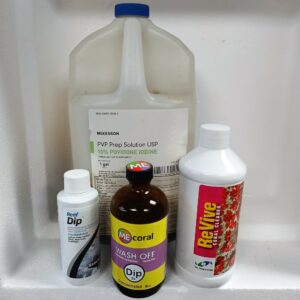
Dipping corals can help remove pests and parasites as well as treat a number of infections and conditions. Many brands of coral dip solutions are available on the market and typically use ingredients like botanical oils to kill or dislodge pests from corals. Iodine can also be used in some situations, especially when treating new frags or damaged colonies with tissue that can be vulnerable to infection. When choosing a dip, be sure to read the instructions as some dips can’t be used on some types of corals and concentrations or timing can vary from brand to brand. The instructions here are a basic guideline for most corals and dips.
1. Prepare the containers for your dips. These dips should always be done in a separate container but can usually be done with either water from the tank (if you can safely remove enough for the dip) or with freshly prepared saltwater. The container should be big enough to completely cover the corals being dipped but doesn’t need to be larger than necessary to avoid wasting your dip to reach the proper concentration.
Depending on the dip and concentration you are using or the corals you are dipping, you may want to prepare a second container to “rinse” your corals after the dip. This should be about the same size and amount of water and can also be either tank water or fresh saltwater.
2. Add your dip solution to the water before adding the coral. This makes it easier to mix the solution throughout the dip container without dumping it directly onto the coral. Most dips have recommended concentrations like 1 teaspoon per gallon of water but can usually be adjusted depending on the coral; use a weaker solution for more sensitive or stressed corals or stronger solution for resistant pests or very hardy corals.
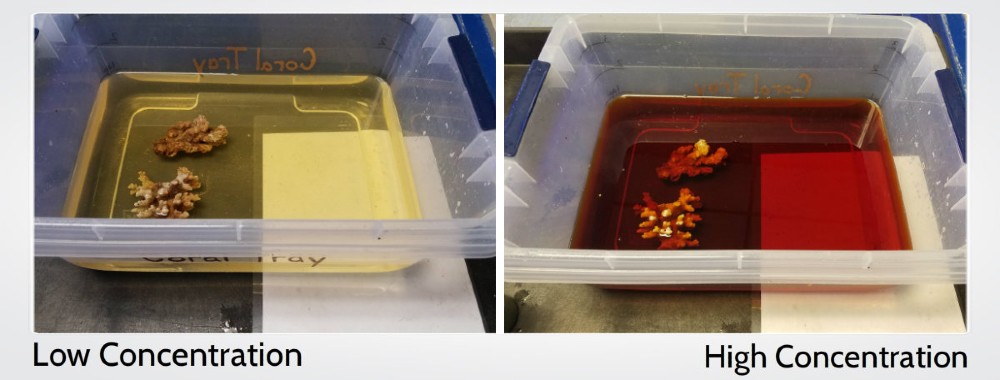
For Iodine dips, you can use the color to determine the strength. On a white background, a weak Iodine solution should be about the pale tan of a manila envelope. A strong Iodine dip would be a rusty red-brown but the corals should still be visible. Avoid a concentration so strong that you can’t see through it.
Iodine Dip Concentrations
3. Add the coral to the dip and follow the instructions on your dip. Most corals can be dipped for 5-10 minutes but if the coral appears very stressed or starts releasing a lot of slime, remove it from the dip. Hardy corals like polyps or milder solutions may be dipped for longer.
4. After the dip, rinse your coral in the dip by gently “swishing” it around underwater. If you prepared a rinse container, you can do the same in this container as well. This is especially useful after strong Iodine dips or with especially mucus-y corals.
5. Replace your corals back into the tank and dispose of your dip and rinse containers….don’t add this water back into your tank!
When done properly, these dip methods can help keep your tank parasite- and pest-free without the need to medicate the entire tank, or to supplement a medication regime. Feel free to contact us if you aren’t sure if a dip is right for you!
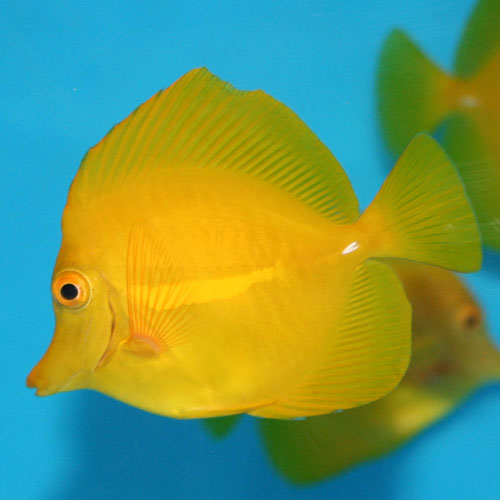
The Yellow Tang has been one of the most popular and iconic saltwater aquarium fish for decades and its popularity increased even more after Disney’s “Finding Nemo” introduced us to Bubbles, the neurotic Yellow Tang kept in Dr. Sherman’s dental office at 42 Wallaby Way. However, its days as an aquarium mainstay may be over due to new legislation from Hawaii’s Department of Land and Natural Resources (DLNR) banning Hawaiian aquarium fish collection.
Yellow Tang (Zebrasoma flavescens)
Some History
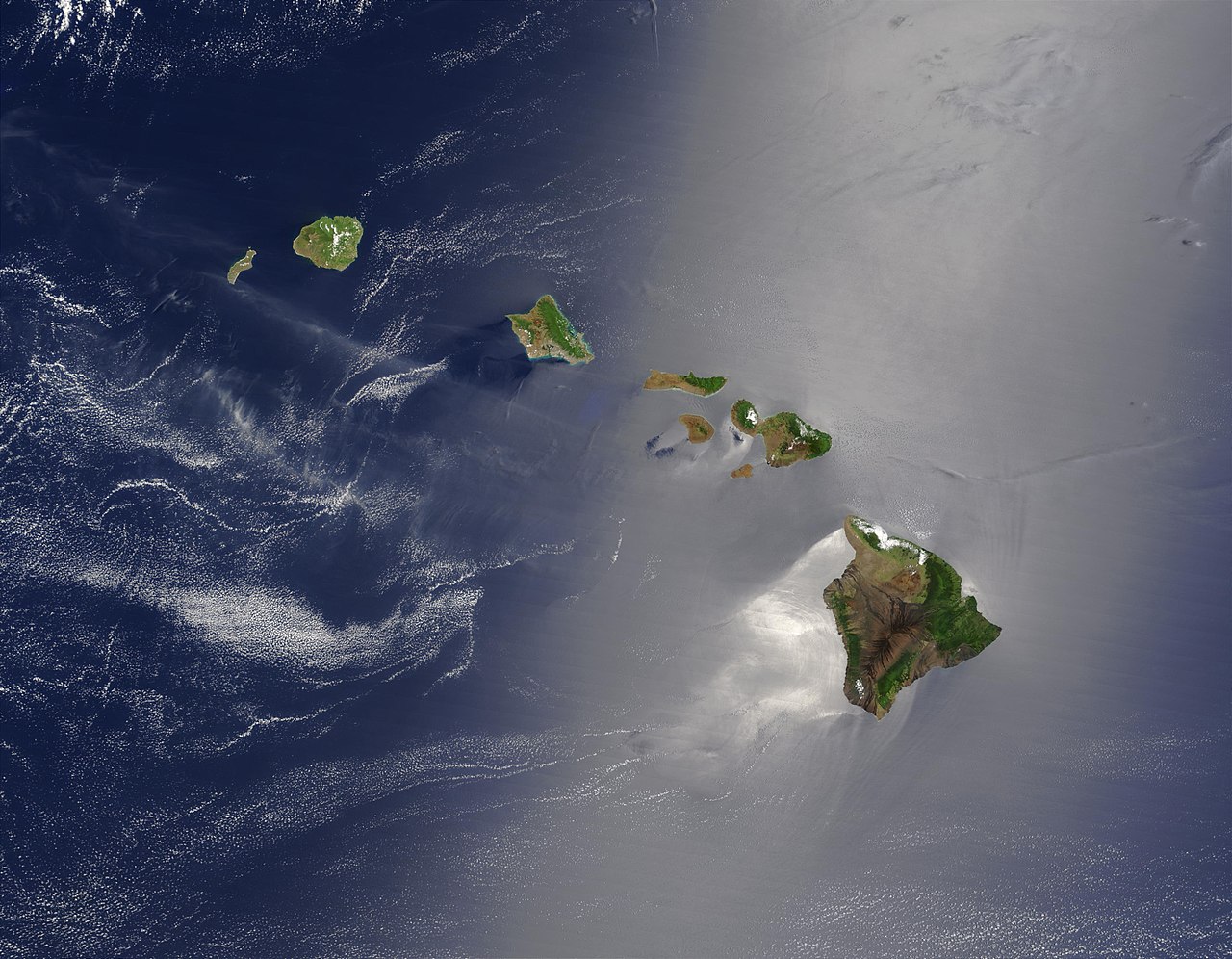
The waters around the Hawaiian islands are some of the most unique habitats on Earth. According to the National Oceanic and Atmospheric Administration (NOAA), an average of 21% of fish species above 100 feet deep and up to 50% of fish between 100-200 feet deep are endemic to Hawaii, meaning they are found nowhere else in the world[1]. Many other fish that are also found elsewhere may have different color variations around Hawaii or nearby islands. They face some unique challenges as tourism grows and habitats shrink, however. Overfishing and habitat loss threaten some populations and recreational activities like fishing, snorkeling, boating and others can damage reefs and their inhabitants. Naturally, such an important part of Hawaii’s economy and natural history needs protection.
As the aquarium industry grows, so does the concern about its impact on the environment. In recent history, this first began seriously intersecting with Hawaii’s preservation efforts in 2017. In September of 2017, the Hawaii Supreme Court halted the renewal of all aquarium collection permits pending an environmental review of the practices used and their impact on native populations. Prior to this ruling, collections were allowed by permit using fine mesh nets (HRS §188-31[2]). Over the following year, this statement was revised and expanded[3] but live collections continued in smaller capacities. Other activities like spearfishing did not appear to be impacted. In August 2020, the aquarium collection industry took another hit when an impact statement from a number of aquarium fish collectors and the National Pet Industry Joint Advisory Council was rejected by DLNR[4]. As of January 2021, the DLNR announced that not only were permits no longer being renewed but all existing permits were invalid and all collection was halted indefinitely pending environmental review[5].
The actual impact of aquarium fisheries on populations has long been debated and is extremely controversial for both sides. The Marine Aquarium Society of North America’s Hawaii Ban Fact Check page[6] argues many of the ban proponent’s claims. In one study cited on the page, the impact of aquarium fisheries compared to recreational fisheries and commercial food industries shows the high value and low impact compared to recreational and commercial food fisheries. It also cites a growth in the population of popular aquarium fish like Yellow Tangs and Kole Tangs in the most common collection areas despite the increase in fish being collected from these areas for the aquarium industry[7].
So…what now?
While this ban is in effect, don’t expect to see Hawaiian fish[8] like Yellow Tangs, Kole Tangs, Achilles Tangs, Potter’s Angels, Fisher’s Angels, Flame Angels, Blonde Naso Tangs and many more. We have seen the prices of these fish increasing in price and dropping in availability since the early 2010’s and those prices have tripled just between fall 2020 and January 2021. A Yellow Tang that we may have been sold for around $65-70 in October would have sold for $400 or more in January 2021, and we’ve seen some other online retailers advertise them for over $1000.
Due to their breeding and life cycles, many of these species are incredibly difficult to breed in captivity. While a few breeders are just starting to figure out some species like Yellow Tangs, we are a long way off from seeing them as commonly as easier fish like clownfish, and they are still very small and expensive when they are available.
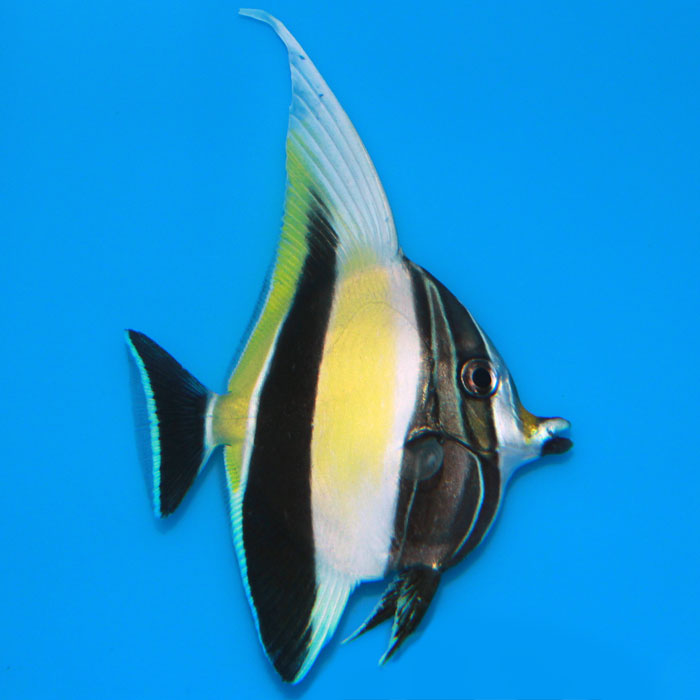
Moorish Idol (Zanclus canescens)
What are some alternatives?
While these species may not be seen in our tanks anytime in the foreseeable future, there are alternatives to give you a similar look or function. These three species in particular are just the most popular fish affected by this ban. Some of these alternatives do have different size ranges, care requirements and compatibility guidelines than their inspiration so be sure to research all choices carefully.
*This species is also found in Hawaii but is also found in other areas of the Indo-Pacific. Hawaiian fish may not be available but fish collected from other areas may be.
Many other species that are endemic to Hawaii will disappear from the aquarium industry for awhile, and others that are native to Hawaii but also found elsewhere may become scarce or increase in price. If you can no longer find your Dream Fish after this ban, feel free to let us know and we can help you find it or recommend some alternatives.
One of the most common questions we get is “How much does it cost to set up a tank?” This is also one of the most difficult questions for us to answer because there are so many options! Every piece of equipment – filters, lighting, heaters and more – has different varieties, options and price levels. Some may be more efficient than others and some may be more cost-effective. We are always happy to go over the options available to you and what we would recommend for any tank you are trying to create.
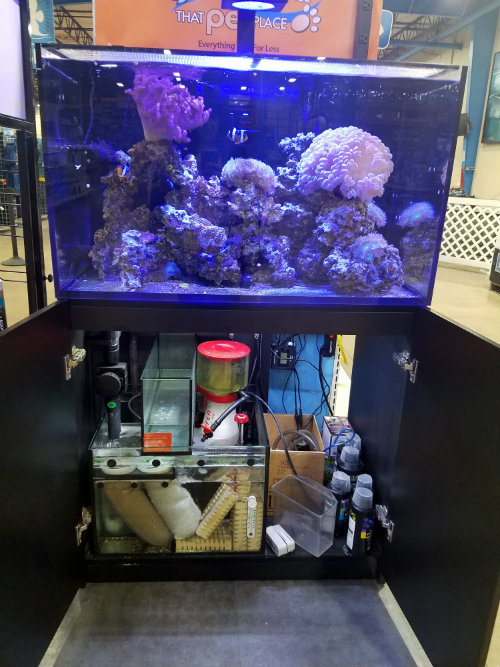
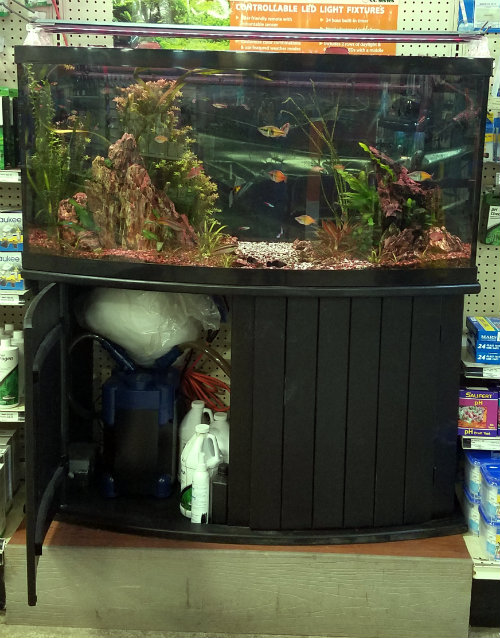
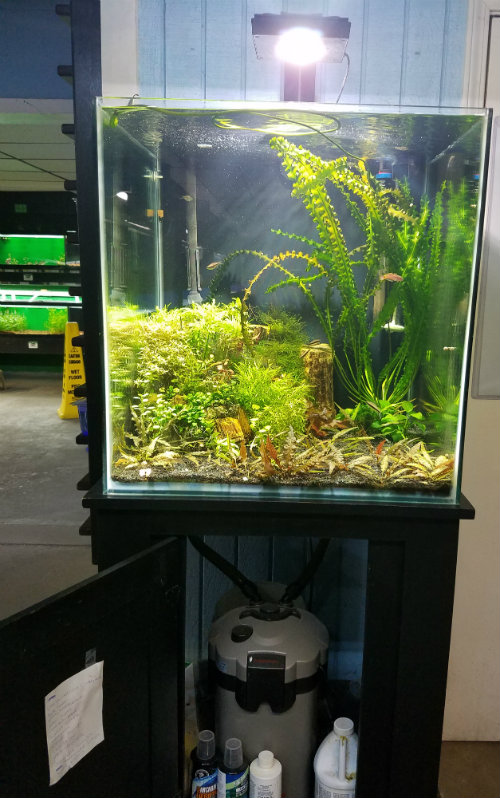
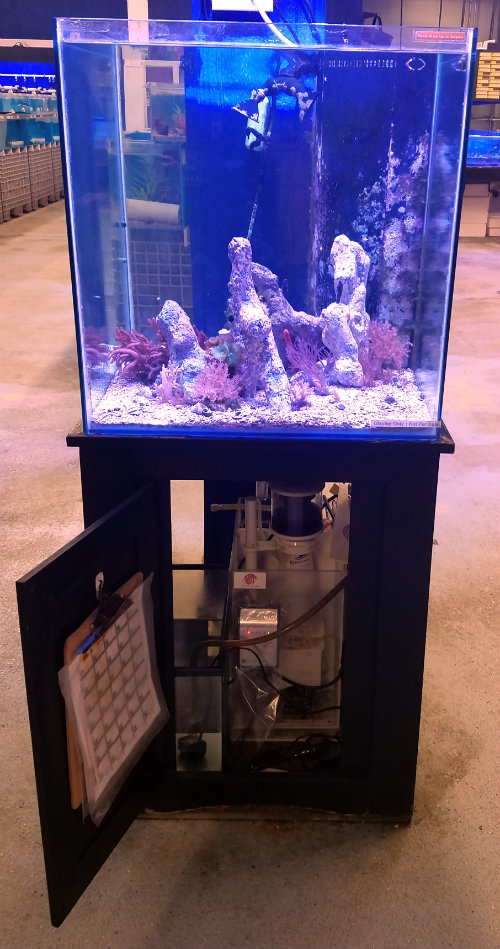
To give you a general idea of tank costs, we’ve gone through some of our store display tanks to give you an idea of how much the tanks you see would cost. This is only intended as a general example of the costs for different types of tanks. Keep in mind, these are our display tanks so most of them feature the Best Of The Best products we would recommend and some of the newest options available. These tanks are typically going to be more expensive than the average tank a hobbyist may set up. If you are on a budget, we can show you some lower cost options similar to those shown here.
These lists were created in late October 2020 and the availability and prices of these items are subject to change at any time. These lists are for equipment only for most tanks and do not include any livestock (fish, inverts, plants, or live rock) or decorations.
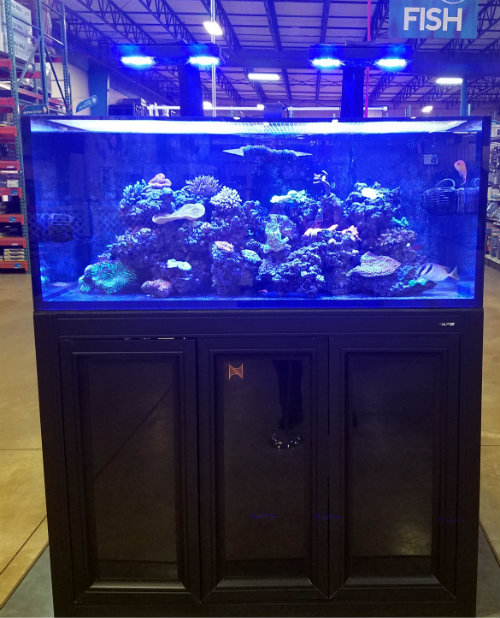
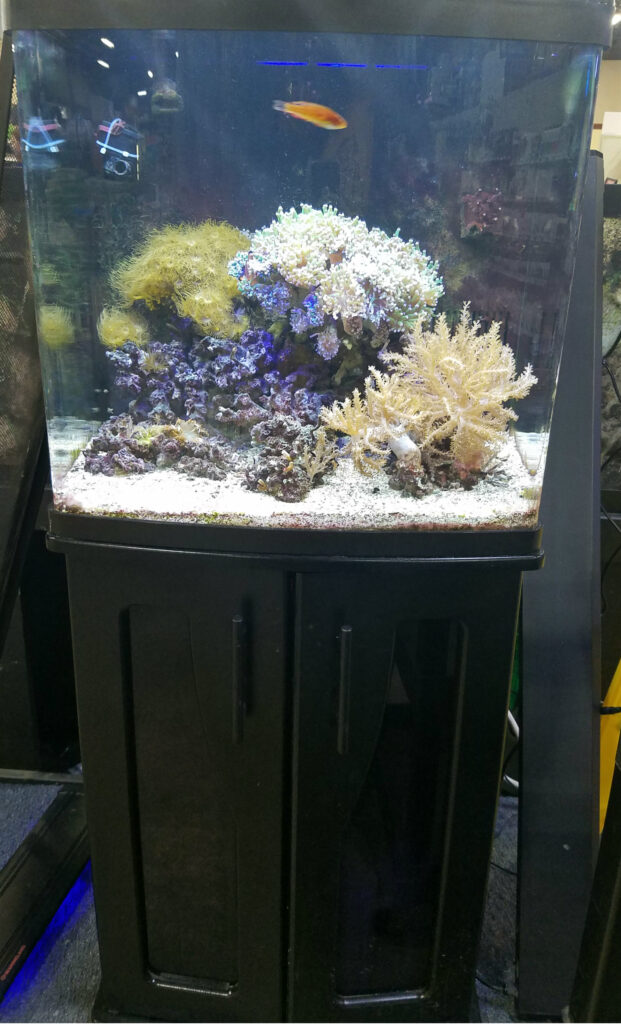
This tank is designed as a high-end reef tank for SPS and LPS corals. It features the latest in automation and filtration with WIFI controls.This setup isn’t for the budget-conscious. The equipment on this tank is The Best Of The Best and the latest, most hi-tech to hit the market to date.
TOTAL:
$8,381.70
$7,726.90
Item #
Product
Non-Loyalty Price
Loyalty Price
282686
Innovative Marine INT 100 Gallon
$1,430.00
$1,300.00
279255
Innovative Marine APS Stand for 80/100
$769.99
$699.99
278295
Innovative Marine Hydrofil Ti-Reservoir
$109.99
$99.99
278294
Innovative Marine Hydrofil Ti-Pump
$76.99
$69.99
278293
Innovative Marine Hydrofil Ti-Controller
$76.99
$69.99
281692
Innovative Marine Hydrofil Ti-Return Bracket
$25.29
$22.99
267978
Trigger Ruby 36 Sump
$384.99
$349.99
248866
Reef Octopus 200 Internal Protein Skimmer
$395.99
$359.99
275933
Ecotech Radion XR30 Pro LED
$923.99
$839.99
267881
Ecotech XR30 Tank Mount
$114.99
$103.99
268606
Ecotech MP40 Vortech
$403.99
$366.99
249321
Ecotech Battery Backup
$173.25
$173.25
280134
Neptune Apex System EB832
$839.99
$799.99
280146
Neptune Auto Feeder
$104.99
$99.99
280143
Neptune Wireless Expansion Module
$132.99
$124.99
280135
Neptune DOS/DRR Kit
$469.99
$449.99
280141
Neptune Flow Monitoring Kit
$209.99
$199.99
280136
Neptune Par Monitoring Kit
$314.99
$299.99
280139
Neptune Wave Pump
$192.99
$174.99
280142
Neptune Leak Detection Kit
$159.99
$149.99
281546
Neptune COR20 Return Pump
$359.99
$324.99
284268
Neptune Trident Water Analyzer
$659.95
$599.95
285114
Eshopps Bio-Lux Ceramic Media
$49.39
$44.89
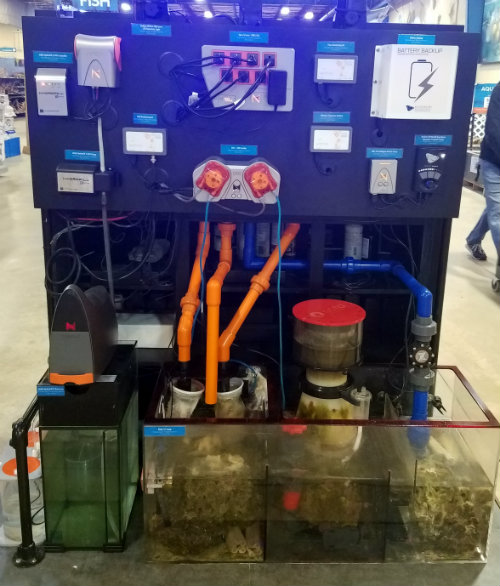
(Back view of all the high-tech equipment on this tank)
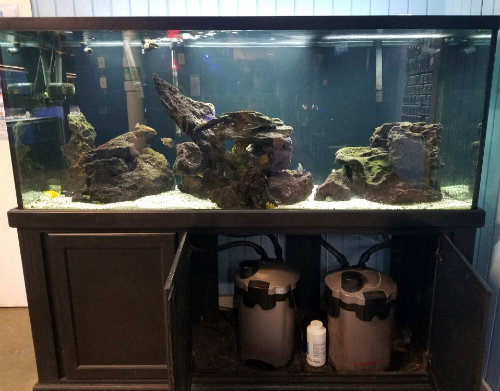
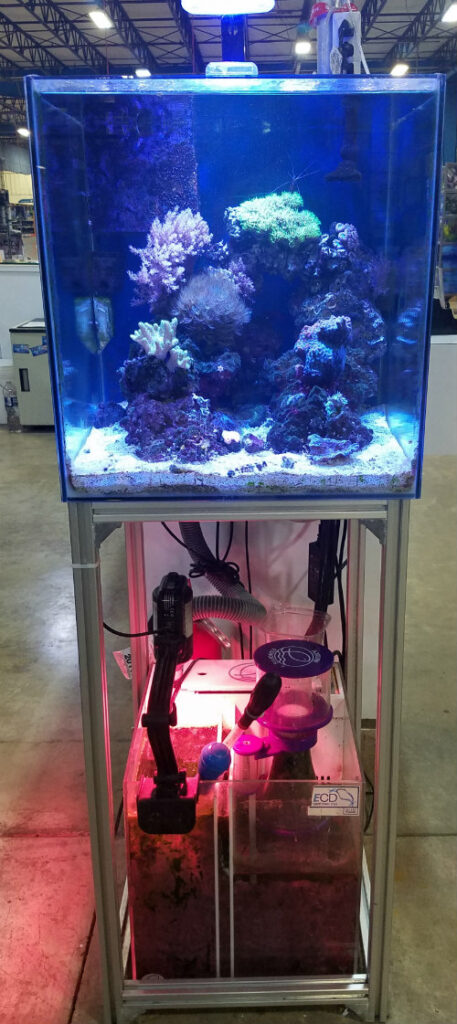
This saltwater tank is the same style as the planted tank above but with a corner overflow connected to a sump filter under the tank. It contains soft corals and a group of Lined Seahorses (Hippocampus erectus).
TOTAL:
$2,199.36
$2,000.06
Item #
Product
Non-Loyalty Price
Loyalty Price
262398
Marineland 60 Gal Cube Frameless Aquarium Corner Flo-in back
$439.99
$399.99
245164
Cube-Sized Aquarium Stand – 24 in. x 24 in. – Ventura – Black
$241.99
$219.99
281582
AqueonHeater Pro Series V2 – 200W
$41.79
$37.99
212355
Floating Thermometer – Economy
$3.69
$3.29
287695
EcoTech Marine Radion XR30 Pro G5 LED Light Fixture
$923.99
$839.99
256403
Ecotech Radion Hanging Kit
$52.79
$47.99
268975
Eshopps The Cube R-Nano Refugium
$284.99
$259.99
206397
Supreme Aqua-Mag 700 Water Pump with 10 ft. Cord
$93.49
$84.99
278293
IM AUQA – Hydrofill Ti – Controller
$76.99
$69.99
204181 x3
Flexible Tubing – Clear – 3/8 in. (Sold per foot, 3 feet used)
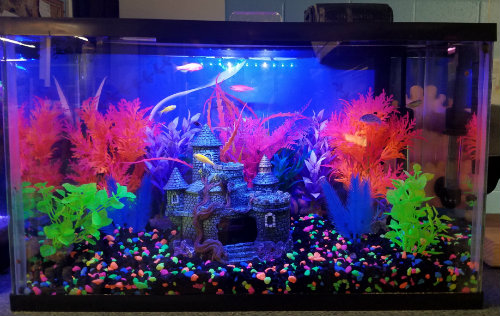
This GloFish kit contains the lighting and filtration needed for the popular GloFish that “glow” under blue actinic lighting. While on a counter in our Fish Room, stands are available for this basic 10-gallon size. This is a good beginner tank setup and similar kits are available without the GloFish options.
TOTAL:
$196.87
$178.97
Item #
Product
Non-Loyalty Price
Loyalty Price
259867*
GloFish Aquarium Kit – 10 Gallon
$81.39
$73.99
268816
Tetra HT30 Submersible Heater – 100 Watts
$16.49
$14.99
212160**
Pine Wood Majesty Stand – Black – 20 in.
$98.99
$89.99
*includes filtration, lighting, tank.
**This tank is not on a stand in our store. This is an appropriate stand for this tank size.
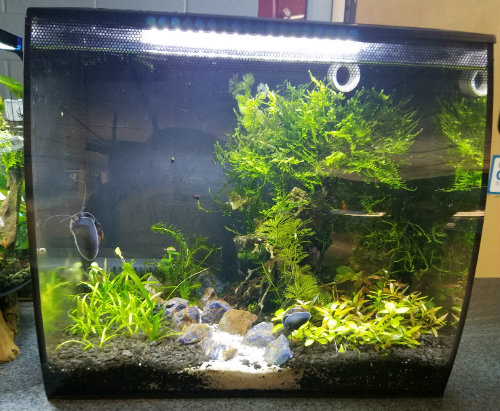
This desktop aquarium is aquascaped into a bonsai garden setting wit freshwater shrimp, snails and gobies. The filtration and lighting are integrated into the tank.
This tank from Aqueon is one of the most uniquely-shaped tanks available and has integrated filtration. While not on a stand in our store, it will fit onto a standard 20-inch-wide stand. The aquarium kit includes filtration, special shrimp substrate, and lgihting in addition to the tank itself.
TOTAL:
$233.77
$212.47
Item #
Product
Non-Loyalty Price
Loyalty Price
282534*
Aqueon – LED Shrimp Aquarium Kit – 8.75 Gal
$109.99
$99.99
279878
Aqueon Submersible Glass Heater – 50W-Up to 20 Gal
$24.79
$22.49
212160**
Pine Wood Majesty Stand – Black – 20 in.
$98.99
$89.99
*includes filtration, substrate, lighting, tank.
**This tank is not on a stand in our store. This is an appropriate stand for this tank size.
This Fluval Spec V tank is set up as a nano-reef – a challenging system for advanced reefkeepers – but the Spec V kit can be used for freshwater aquariums as well.
As we mentioned, there are a lot of options that can be customized. Kits are also often available that can help you bundle the equipment you need to make it easier to purchase, especially for smaller sizes below around 55-gallons. You can start out higher end or start basic and upgrade as your skill level and interests grow!
Hopefully, these aquarium setups will help give you an idea of the investment needed for a variety of types and sizes of aquariums. Many of the options for each tank can be swapped out depending on your needs and budget, and our associates are always available to assist you in making the best choices to make your vision a reality!
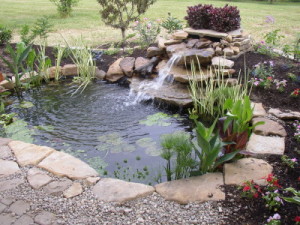
At our retail store in southcentral Pennsylvania, there are a few things we can always count on as soon as the temperatures start to rise: that particular fragrance as farmers get their fields ready for planting, new road construction projects, and our pond customers to start looking for new pond fish and plants for their outdoor ponds. However, those first warm days of the year aren’t the best time to start stocking your ponds. In our area in particular, the first warm days don’t mean it will stay warm. It is pretty common during a Pennsylvanian spring to have sunny 70 degree days followed by chilly 30 or 40 degree nights and even snow flurries. Even if it is warm during the day, that is only the air temperature…water temperatures and ground temperatures take far longer to warm up and stay a consistent temperature.
Springtime is one of the more dangerous times of the year for new and old pond fish alike. Moving fish that are kept in a climate-controlled indoor system like our retail store to an outdoor pond with cooler and inconsistent temperatures leaves them extremely vulnerable to stress and secondary infections like the dreaded Aeromonas bacteria. Fish already in a pond that are “awoken” from their winter dormancy by the warm temperatures are also vulnerable as the water temperatures affect their metabolism and immune systems.
So when should you add new pond fish and plants or “open up” an existing pond for the spring?
Keep an eye on the water temperatures and wait until the temperature is consistently above at least 50-60 degrees. Do not feed any fish already in your pond until water temperatures have stabilized above 40 degrees as your fish will have trouble digesting food in cold temperatures, and use a Spring and Fall Formula fish food that is easily digested until your ponds temperatures have stabilized above 60 degrees. For plants, wait until any danger of overnight frost has left your area. Weather websites like AccuWeather.com often have Lawn & Gardening sections that can help you determine when the best time is for your area. It may be necessary to wait even longer for more tropical, warmer-water plants like the popular Water Hyacinth.
While the weather conditions in your area may vary and the seasons are always a little different every year, we’ve found that for our area, May 1st is a good guideline for the safety and health of the fish and plants. This is also around when many hatcheries and nurseries start having the best stock available as well so we can get you the best variety and healthiest stock possible!
For more information on Spring Pond Maintenance, check out these related That Fish Blog posts:
Here at That Fish Place – That Pet Place we are doing our best to educate our customers on the dangers and risks of using goldfish as bait. In addition to offering an extreme risk to native species, anglers also face steep fines if they are caught in possession of goldfish for bait. In Lancaster County Pennsylvania, where we are located, there are several bait and tackle shops that offer better alternatives for fishing.
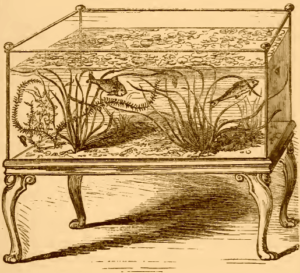
A western aquarium of the 1850s illustration from Shirley Hibber, The Book of the Aquarium and Water Cabinet
Goldfish are freshwater members of the carp and minnow family. While many of us admire them from the view of our tank, they are actually one of the first aquatic invasive species to reach North America. How did the goldfish go from being the cute googly eyed fish you would feed after school, to being such a widespread risk to native plants and species?
Goldfish began to come to the America’s in the 1600s as ornamental fish for aquariums and water gardens. If the fish became too large for their surroundings, or the owner became tired of it, they simply got rid of it in the closest freshwater source. Today, goldfish are becoming reintroduced as livebait. Pennsylvania has stepped in, as well as many other states to make it illegal to use goldfish as live bait.
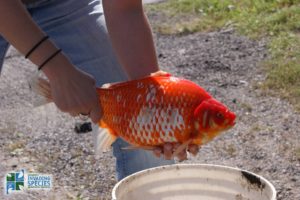
Goldfish (Carassius auratus) photo by Ontario Streams
Goldfish will typically eat their own eggs when held in captivity, so breeding is not a large issue for most hobbyists unless they are intentionally breeding their goldfish. Given the right conditions, goldfish can spawn several times a season. A lot of the eggs will get eaten by the adult goldfish once they are laid, but several hundred eggs are produced at each spawning. With only a few eggs eaten, and fry hatching within 48-72 hours, you can imagine how just a few goldfish can turn into a large problem rather quickly.
Often referred to as the “little piggies” of the aquarium, goldfish are opportunistic feeders and will not stop eating of their own accord. While goldfish typically feed off of crustaceans, insects, and various plant matter; when this food is scarce they will eat eggs from native species nests. The native egg-laying species populations have now been disrupted, and due to that, the population has declined and disrupted other wildlife food chains.
It is unlawful to use or possess goldfish, comets, koi and common carp as bait fish while fishing in the state of Pennsylvania. If you are caught fishing with feeder goldfish or any other illegal bait fish there is a minimum $120.50 fine, and you can be fined an additional $20.00 – $50.00 per illegal bait fish. Pennsylvania Fish & Boat Commission wants you to know that you aren’t off scot-free just yet. Law enforcement also has the authority to confiscate or seize, any fishing equipment as evidence of your violation of the law. The Pennsylvania Fish & Boat Commission may, upon proper notice, suspend or revoke your fishing privileges, boating privileges or other permits of any person convicted (or acknowledging guilt) of a violation of the Fish and Boat Code or Fish & Boat Commission regulations. That would also include your naive fishing buddy. Should multiple violations occur within a 12-month period you will be given a fine of $200 in addition to the previously mentioned summary offenses. That $0.10 feeder fish now cost you a fishing license, a fishing rod, fishing equipment, a whole lot of cash, a boat, and a fishing buddy. The consequences per state will vary, so check with your local Fish & Boat Commission for more information.
The employees at That Fish Place – That Pet Place are all avid hobbyists, and a lot of us live in the local river towns where fishing is just a way of life. We don’t want to ruin the sport for other enthusiasts, just as much as we don’t want others to ruin the sport for us. We will always strive to do our best when it comes to conservation efforts, and want to encourage others to do the same. Thank you for reading!
 That Fish Blog – Aquarium Advice and Information

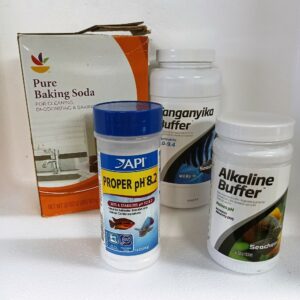 1. Prepare your dip container and water. The container should be clean and free from any detergents or waste and large enough for your fish to swim comfortably. Use clean, dechlorinated freshwater that is the same pH and temperature as your aquarium….this is key! You may need to use a buffer like baking soda or high range buffers for African cichlid tanks to raise the pH to match your aquarium, but make sure it is as close as possible. Adding your saltwater fish to freshwater with a much lower pH (for example, a neutral 7.0 when your aquarium pH is 8.4) is very stressful.