Brackish Aquariums
US Natives for the Marine Aquarium – Mummichogs, Striped Killifishes, and Sheepshead Minnows – Part 1
Jul 16th
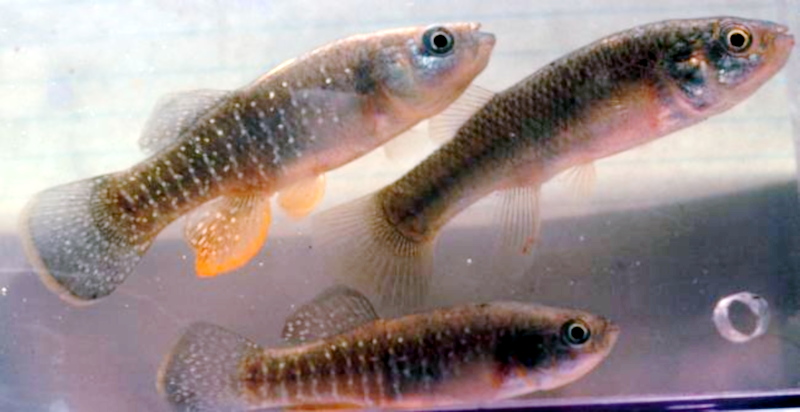
Hello, Frank Indiviglio here. In common with most aquarists, I’m enthralled by brilliantly-colored reef fishes. However, I find that little can compare to the thrill of catching, keeping and breeding native fishes. Today I’d like to look at three hardy species that are among the most beautiful and interesting I’ve yet to keep. I’ve collected all by seine net and minnow trap within NYC limits and off nearby Long Island.
Note: Please check your state’s regulations before collecting native fishes. More >
A Brackish Water Oddity – the Four-eyed Fish or Large-scale Foureye
May 17th
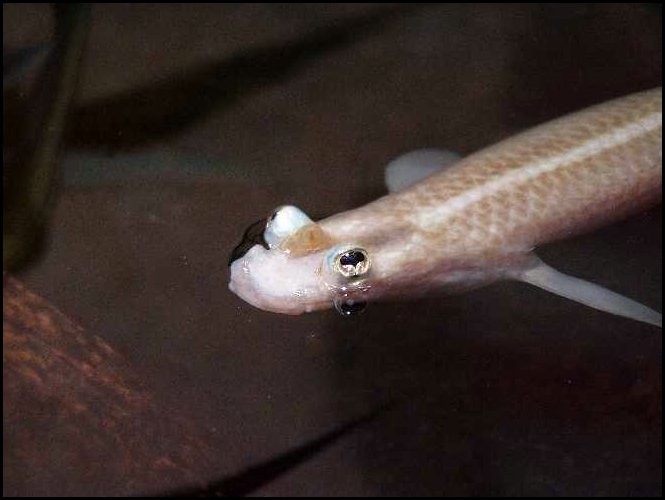
Hello, Frank Indiviglio here. It takes some doing to stand out among brackish water fishes, in whose ranks we find the tree-climbing Mudskipper and the insect-shooting Archerfish. However, in both appearance and behavior, the Four-eyed Fish (Anableps anableps) manages to so quite easily. Less often kept than other brackish water species, it is well worth considering if you favor unusual, responsive fishes.
Natural History
Four-eyed Fishes are found along coastlines and associated tidal streams and marshes from Oaxaca in southern Mexico to Brazil. Although sometimes encountered well inland and in the ocean, they spend the majority of their time in brackish water. Three species have been described, with Anableps anableps being most commonly available in the trade. More >
The Dragon Goby – Not Quite What You Would Expect
Feb 15th
Hello everyone, Craig back again with another odd and interesting fish species to highlight! In this entry, I want to talk about an old favorite among fish enthusiasts, the Dragon Fish, Gobioides broussonetti. It has a long, slender eel-like body and a huge, gaping basket-like mouth. Coloration ranges from silver to grey to purple depending on health and environment. The Dragon Fish has tiny eyes and can hang vertical on your glass with its suction cup-like ventral fins. Want to know more? Well, let’s get into some specifics! More >
The Wrestling Halfbeak – a Tiny Brackish Water Warrior
Oct 9th
Hello, Frank Indiviglio here. This Southeast Asian fish’s slender, 3-inch- long body belies its reputation as a fearsome combatant. However, in betting parlors from Thailand to the Sunda Islands, matches between male wrestling halfbeaks (Dermogenys pusilla/pusillus) rival those featuring the better-known bettas (Betta splendens) in popularity. In contrast to bettas, battling halfbeaks rarely inflict any serious damage…other than to the billfolds of losing gamblers!
Description and Habitat
Halfbeaks sport a startling adaptation to surface feeding…their immobile lower jaw is more than twice the length of the upper. This, along with their subtle beauty – a silvery body highlighted by hints of blue and green – renders them a most unique addition to one’s collection.
Halfbeaks inhabit estuaries and other areas of fluctuating salinity, and, while sometimes kept in fresh water, are at their best in brackish water aquariums.
Feeding Wrestling Halfbeaks
Halfbeaks are highly specialized surface feeders and rarely if ever swim to lower depths in the aquarium. They tend to be picky feeders and prefer tiny live invertebrates such as mosquito larva, brine shrimps, fruit flies and Daphnia. Chopped blackworms may be taken, but these sink quickly and so must usually be offered via forceps (tedious but effective!).
Halfbeaks may be habituated to flake and frozen foods, but the progeny of such fishes rarely reproduce, most likely due to a nutritional deficiency.
The Halfbeak Aquarium
While visiting pet stores and aquariums in Japan, where halfbeaks are more commonly kept than in the USA, I was surprised to find that multiple males were often housed together. I learned that males will co-exist in large, well planted aquariums if emergent and surface-dwelling plants are grown as sight barriers. Watching the threat displays and interactions in such aquariums was most interesting, and cast these little fellows in a new light for me.
A unique habitat preference and feeding style dictates that halfbeaks be kept in long, shallow aquariums and, with few exceptions, in single-species groups.
Breeding Halfbeaks
Wrestling Halfbeaks are live bearers, with healthy females giving birth every 30 days or so; males may be distinguished by a bright red blotch located in front of the dorsal fin.
Unfortunately, adults are quite cannibalistic, and the fry rarely survive. Breeding traps are not recommended, as the birthing process takes several days and females become stressed by long confinement in small areas. Thickly-planted aquariums, with much of the vegetation at the surface, offer the best chance of success.
Further Reading
Detailed information on the natural history of these and related fishes is posted at ZipCodeZoo.com.
A book I’ve written, The Everything Aquarium Book, addresses the care of brackish water fishes in detail.
Please write in with your questions and comments.
Thanks, until next time,
Frank Indiviglio
Halfbeaks image referenced from wikipedia and originally posted by Neale Monks
Archerfish – Aquatic Snipers
Jul 15th
Patty here.
Often brackish fish are a hard sell to people on the market to start an aquarium. Fish appropriate for brackish systems don’t tend to be as colorful or as easy to mix in communities as many other types of fish, or so many think. But though these fish are often banished to a remote corner of the fish shop, and often seem too complicated to keep, there is one fish in particular that may be the one to convince you to try your hand at a brackish system.
Archerfish are a common offering in the trade, but their brackish classification and simple beauty may keep them hidden from the view mainstream aquarium enthusiasts. They are native to India, Southeast Asia, Australia and other countries of the western Pacific. They prowl through estuaries and mangroves mostly, but may be found upstream in full freshwater or on reefs periodically.
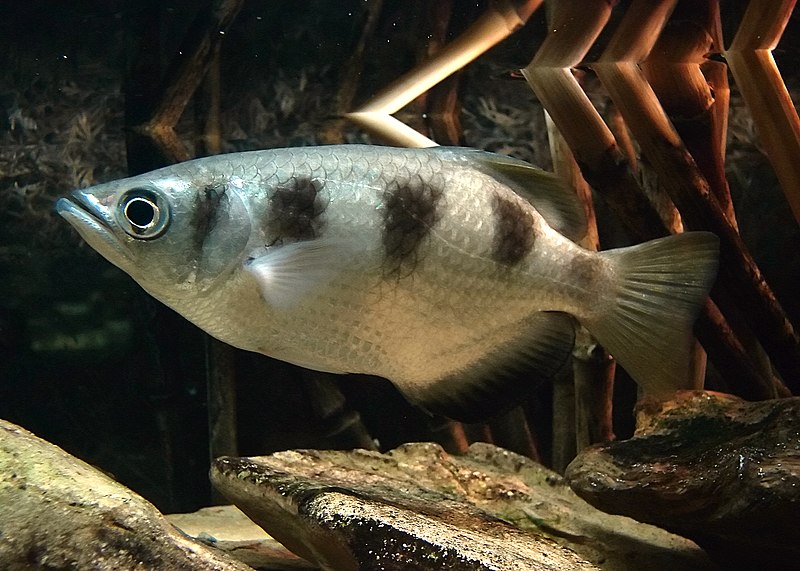
The Banded Archerfish (Toxotes joculatrix), the species commonly offered in the trade, is modestly colored with a tan-grey dorsal area and a pale silvery-white body. Bold black markings camouflage them from prey and predator above. They have a compressed body with a flat area from the dorsal fin to the mouth which allows them to move along just under the surface of the water. The mouth is angled upwards.
The most fascinating thing about Archers is their unique and famed ability to shoot their prey. These fish are skilled predators that are able to snipe insects from branches and foliage 3-5 feet above the surface. The fish shoots several droplets of water, quickly correcting any error in trajectory and aim to knock prey from the safety of the canopy to the water’s surface where the fish devours its meal. They may also leap from the water to catch prey that is within reach or dine on small shrimp and fish in the water, but in the wild they commonly swim in groups of “shooting parties”, working together to pick off unsuspecting bugs. With the right set up, you can witness this behavior in your own living room!
This species can reach a max size of up to 12 inches in the wild, so habitat size is the first thing to consider. They can be expected to reach about 8-10 inches in captivity, and the minimum size aquarium is 55 gallons. Larger, deeper tanks are better! Though juveniles may tolerate freshwater environments for some time, as the fish mature a brackish level of 1-2 percent will be necessary (roughly 8-15 teaspoons of aquarium salt per 10 gallons). The ideal set-up is one that allows for plenty of room to swim and terrestrial areas or areas of open air (like a large tank filled half or 3 quarters full/paludarium set-up) to make the fish happy and allow for a great show!
You can furnish the tank with salt tolerant vegitation both in terrestrial areas and submerged, driftwood, root wood, rock, and sand or fine gravel. Good filtration is a must! Though the fish are hardy, they like clean water like that where they are found in the wild. Once in their new home these fish will quickly resume normal hunting activities, and a batch of live crickets will make for some sport. These fish will also eat frozen and freeze-dried foods. Other fish can also be housed with archers as long as they are tolerant of brackish conditions, large enough not to be considered prey, and not overly boisterous.