 That Bird Blog – Bird Care and History for Pet Birds

Nothing is more pleasing to aviculturists than an entire room in which their birds can really stretch their wings and legs. Birds housed in such circumstances will exhibit a range of behaviors that are only hinted at in small quarters, and their chances of successfully breeding will skyrocket.
Bird Room Basics
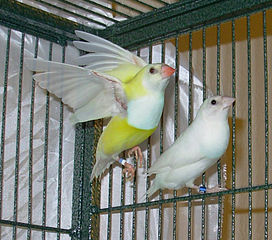
Simply put, a bird room is a room which is outfitted especially for birds – essentially a giant cage. The first I saw were re-converted attics in small private houses. One held Canaries, the other was give over to a colony of Gouldian Finches…both behaved so differently from caged individuals that they appeared to be of entirely different species. Each room was a carnival of color, song, activity and begging nestlings. The individual birds were in great condition and color, and far more vigorous and alert than those I cared for at the local pet store.
Porches, attics, sunrooms and spare bedrooms can all be easily transformed into exciting environments for birds. If devoting a full room to your collection is not feasible, many of the same benefits may be obtained by situating an Outdoor Aviary indoors, if space allows.
Groups of smaller parrots or pairs of larger species, flocks of finches, perhaps a pair of Chinese Painted Quail – all these and more can be accommodated. Specialists keeping Hummingbirds, Sunbirds, Turacos and other softbills find bird rooms indispensible. Even relatively inexperienced bird keepers may expect good breeding results, as the environment is much more favorable than a cage.
Light and Furnishings
Skylights and or large, screen-protected windows should be incorporated whenever possible. Depending upon where you live and the species you keep, natural daylight changes may be enough to stimulate breeding behavior. If additional lighting is needed, timer-controlled Full Spectrum Bird Lamps, can easily be added.
You can really go wild when furnishing your bird room – vines, natural perches and live plants can be used to create a beautiful environment that is stimulating for your pets. You may even be able to utilize Wild Bird Feeders and Baths. Just be sure to keep your species needs in mind, and don’t overcrowd the habitat – flying room is one of the most important benefits of a bird room.
The bird room’s floor should be overlain with tile, and, for most species, covered with a layer of sand. Sand allows for spot cleaning, which will greatly simplify maintenance.
Some Cautions
Be sure to observe newly introduced birds carefully. Additional space usually allows one to keep more birds, but in some cases individuals that would co-exist in small quarters fight when given enough room to establish territories (I once lost 3 Laughing Jay Thrushes that had lived together for years in this way).
New birds should always be quarantined and examined by a veterinarian before being allowed into the bird room, as lice and other parasites will be hard to eradicate once established.
Further Reading
Please see Breeding Gouldian Finches for more info on colony breeding.
A video of a very attractive bird room is posted here.



just to let you know, our parrot mchael skeans went from a 300 word vocabulary donw to 50..Not talking much anymore & he is still in the same inviroment. what to do??? mike skeans
Hello Michael, Frank Indiviglio here.
Thanks for your interest in our blog.
I can’t say that I’ve run across that much of a change, but parrots sometimes slow down in talking when they do not feel the need to attract attention – so, assuming the parrot is in good health, it may be a good sign, in a sense. You might experiment and see if it speaks more if you stay in another room, out of sight, more than usual; or set a tape recorded while you are out of the house – perhaps the bird talks more when it is alone all day.
On the other hand, hearing words it knows may stimulate the bird as well; their personalities are so unique that its hard to make any generalizations.
Good luck and please keep me posted.
Best regards, Frank Indiviglio.
a total treat for all bird owners
Hello Michael, Frank Indiviglio here.
Thanks for the feedback; I look forward to hearing from you in the future,
Good luck and please keep me posted.
Best regards, Frank Indiviglio.
hello Frank , Michael Skeans from Scottsdale Arizona wants to say thanks for the info & feedback. over a 110 degrees today ..ready to move back to Chicago..Our parrot is back to normal but getting fat … I know!!!! quite feeding her so much!!!
Hello Michael, Frank Indiviglio here.
Thanks for the feedback …great to hear that your parrot is back to speaking well again – did the weather prompt her to ask for a return to Chicago! ..or perhaps she realized you’ll feed her more and more if she talks!
Good luck, enjoy and please keep me posted.
Best regards, Frank Indiviglio.
I have a question please, is 3mx1.6m enough for a bird room shared by 2 african greys? Will they feel comfortable enough to fly in it? They’re used to a 5mx5m room but I’m moving to a very small apartment.
Hello Flora,
It’s difficult to predict their reaction, as this varies greatly from bird to bird, but it will be a significant change. Watch closely for agression and signs of stress, and do your best to provide exercise time in a larger area. Pl kep me posted, good luck, Frank